
Footballers after football – financially set for life, attractive wife, worshipped by thousands after a career living every boy’s dream. What could possibly go wrong?
Well, recent studies show that quite a lot can, and does, go very wrong indeed. The football charity XPro reports that footballers earning an average weekly wage of roughly £30,000 (that’s £1,560,000 a year) have a 60% chance of filing for bankruptcy within five years of retirement. Part of this swelling club include ex-Premier League names such as Lee Hendrie (Aston Villa), Eric Djemba-Djemba (Manchester United), Colin Hendry (Blackburn) and Keith Gillespie (Sheffield United).
Added to this, rates for divorce amongst footballers after retirement are staggeringly high. The brittleness of status-based relationships is revealed – no longer is the size 10 glamour model happily married to a successful professional footballer, instead they are unhappily lumbered with an now unemployed ex-footballer. This often compounds the financial difficulties under which ex-players are under as often when divorce is filed for the player loses half his money.
Furthermore, depression is another blot on the landscape of those that have hung up their boots. Having known nothing but football for their whole life, the transition from training every day then a match on weekends to the routine-less void that is left is a challenging one. Ex Manchester United and England forward Andy Cole says himself “I hated myself as I sat in front of a television staring at the print-out of the football results on a Saturday afternoon. For years I had played a part in those results. Now I was sitting there like a sad former professional dwelling on former glories”.
A saying goes ‘if you love football it will love you back’, however for the masses of players who don’t go on to get jobs in media or coaching, this phrase can be altered to come with the warning ‘if you love football it will love you back (until you retire)’. While every case is different, one common theme is that players are consistently poorly advised by self-interested agents who tend to be there when times are good but are nowhere to be seen when a player’s groin goes for the third time in a season, or when a player has put his foot in it on twitter, or when a player is dropped for the new Brazilian hotshot.
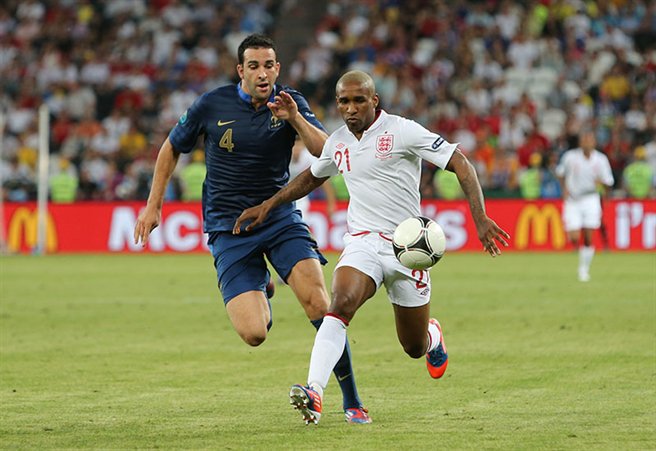
Players like Jermain Defoe have set up their own foundations aimed at giving back to the community. Image Credit: Wikimedia Commons
The role of government here is a precarious one, as already it and football have an uneasy relationship. Charities like Xpro carry the majority of the burden when it comes to things like this, as does the FA, however there could be a role for the government to play. In an unemployed high-profile ex-footballer the government have someone who wants to be occupied, and in the right circumstance has a very potent skill set. For example, players like Jermain Defoe, Rio Ferdinand, and Steven Gerrard all have their own foundations designed to give something back to the community, Gerrard saying ‘It’s important that players in my position use their status in the game’. It is of my opinion that if the government could channel such thinking from past and present footballers into a cohesive scheme then the benefit to the community would be enormous. It could potentially do the government’s popularity some much needed good too.
With public opinion currently set firmly against high earners (eg. Bankers, big companies), however, it is probable that the government spending its time and resources on helping multi-millionaires in times of austerity would be met with a little bit of opposition. Should the government: a) deem this a big enough problem or b) make it a big enough problem so they have a reason to intervene and potentially gain politically, then strategy they choose will be hugely important but could be a masterstroke.
About the Author






nice article mate. very interesting stuff.
Thanks.
Interesting one.
ESPN did a pretty good documentary recently about this topic. The title was ‘Broke’, and it was part of the ’30 for 30′ documentary series. The focus was on American football and baseball players, but of course the same applies to football players here in Europe – little financial education, enormous salaries when they play, huge investments… and then their salaries pretty much disappear.
To this you have to add the amount of people who ‘leech’ from professional sports stars. It’s hardly surprising that many of them go bankrupt, to be honest!