
The long-awaited rise of China has arrived, and with it, geopolitical concerns. Japan and the United States have been the principal victims of this rising. Both countries, allies since 1945, now face tough competition in light of three issues regarding China: its growing defense expenditure; its quest to solve, diplomatically or militarily, territorial problems with neighbours (including Japan) and the unlawful mercantilist practices of Beijing that hinder Japanese and American economies. These three factors are shaping the perception of China as a threat more than a partner. How will the relationship of this triangle evolve in the years to come? Analysts have warned about the potential security problems and instability the US-Japan alliance will bring the Communist regime. But is the presence of the United States a good safeguard against any type of military escalation in the region?
Related: The Blame Game: Political Chess in the Far East
The United States has recognised china’s growing geopolitical importance and has made decisive actions to strengthen its position, via balancing and engaging with China. In his trip to the Asia-Pacific region, Barack Obama made clear that “the United States are a Pacific nation”. This means it will do whatever it takes to deepen its weight in the area, including signing new security agreements with Australia and The Australia, New Zealand, United States Security Treaty (ANZUS), attending the East Asia Summit in 2011 for the first time and starting conversations to strengthen its alliance with Japan and South Korea bilaterally and multilaterally. This is what has been called “the pivot to Asia”, first announced by then Secretary of State Hillary Clinton, a shift in the focus of foreign policy from the Middle East to the Far East to try to balance the growing influence of China—and the threats of North Korea.
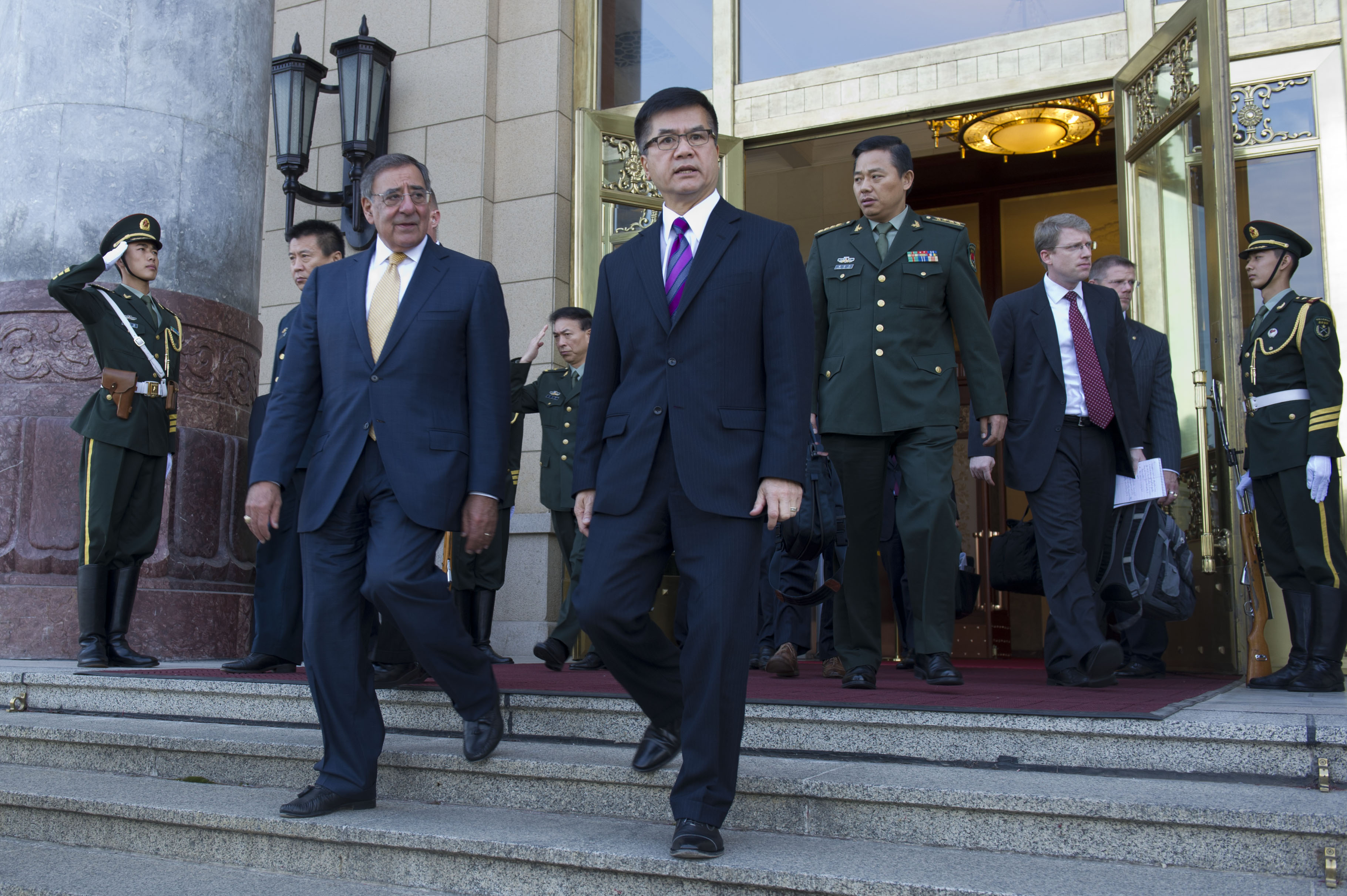
Secretary of Defense Leon E. Panetta visits defense counterparts in Beijing China, Sept. 19, 2012. Panetta visited Tokyo, Japan before continuing to Beijing and traveling to Auckland, New Zealand on a week long trip to the Pacific. DoD photo by Erin A. Kirk-Cuomo
Japan’s strategic position is more complicated, however, it must try to maintain good relations with both China and the United States. To address the issue of a rising China, Japan has focused, together with the US, on research and development of an anti-ballistic defense missile system—Aegis and Patriot More importantly, Japan has reinterpreted its Constitutional limits to become a “normal” military power. Japan’s abnormality comes from its Constitution. Article 9 of the 1947 Constitution of Japan has strictly forbidden the use of force, declaring that the “Japanese people forever renounce war as a sovereign right of the nation and the threat or use of force as means of settling international disputes”. To this end, the article provides that “land, sea, and air forces, as well as other war potential, will never be maintained”. By different methods, the Japanese government has been able to work around article 9 by adopting what is calls “self defense forces” (see, for example, Hook, G. “The Erosion of Anti-Militaristic Principles in Contemporary Japan”). The turning point for Japan’s military came when the Bush administration decided, by means of a multinational coalition, to invade Iraq. Being a close ally of the United States, Japan cooperated with the multinational efforts and sent troops to fight in the war, even though its Constitution strictly forbade it. It must have, for if not, Japan would have repeated the mistakes made in the Gulf War. After the US demand to send troops to help the coalition, Japan argued that its Constitution did not allow them, and so sent only financial aid which was received with fierce criticism in the United States’ Congress. Not sending troops this time would have proven devastating for the bilateral alliance.
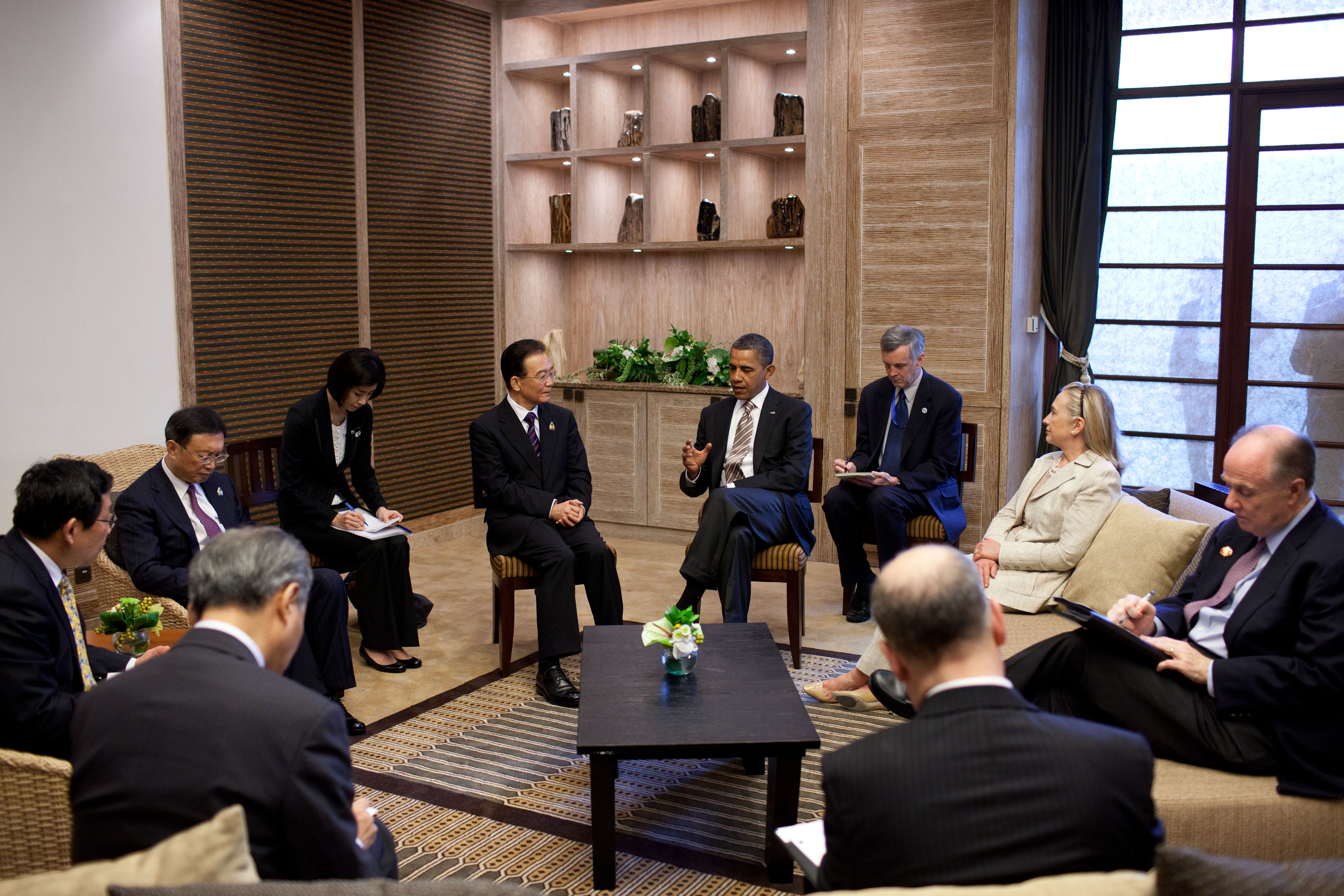
President Barack Obama meets with Premier Wen Jiabao of China at the Grand Hyatt Bali Hotel in Nusa Dua, Bali, Saturday, Nov. 19, 2011. (Official White House Photo by Pete Souza)
On the other hand, as Japan got closer with the United States and developed a strong military, criticism arose from China, Indonesia, South Korea and Singapore that an increment in Japan’s military forces would bring back the harsh imperialistic years prior to the Second World War. The suffering inflicted by the Japanese troops is still very raw in the minds of the people in those countries. Thus, any change in Japan’s military posture is seen as an immediate threat to the interests of their neighbors and was one of the main reasons why the Japanese government decided not to send troops to the Gulf in 1990. In the following decades, rhetorical conflicts have flourished between Beijing and Tokyo over sensitive historical interpretations of the Massacre of Nanking and the appraisal of war-crime guilty generals of Imperial Japan by the Prime Minister Koizumi. Simultaneously mollifying China’s worries while complying with the obligations necessitated by their US alliance leaves Japan in a difficult position, appealing to the United States is their best choice.
Strategically speaking, the region is prone to a cyclic security dilemmas that can disrupt its fragile peace. There are many factors contributing to this fragility, old rivalries between neighbors run deep, arguably influencing the limited economic interdependence and territorial disputes. Big changes in the balance of power and cultural differences are also factors that threaten the fragile peace. Possible miscommunications or miscalculations may give either China or Japan a good reason to build up their already powerful armies. One of the ways to diminish security dilemmas that may end in an armed conflict is to include a third-party referee that can play a police role and lower the incentives of a destabilizing competition. The United States, therefore, may prove a key-stabilizing actor, keeping peace and cohesion in the region.
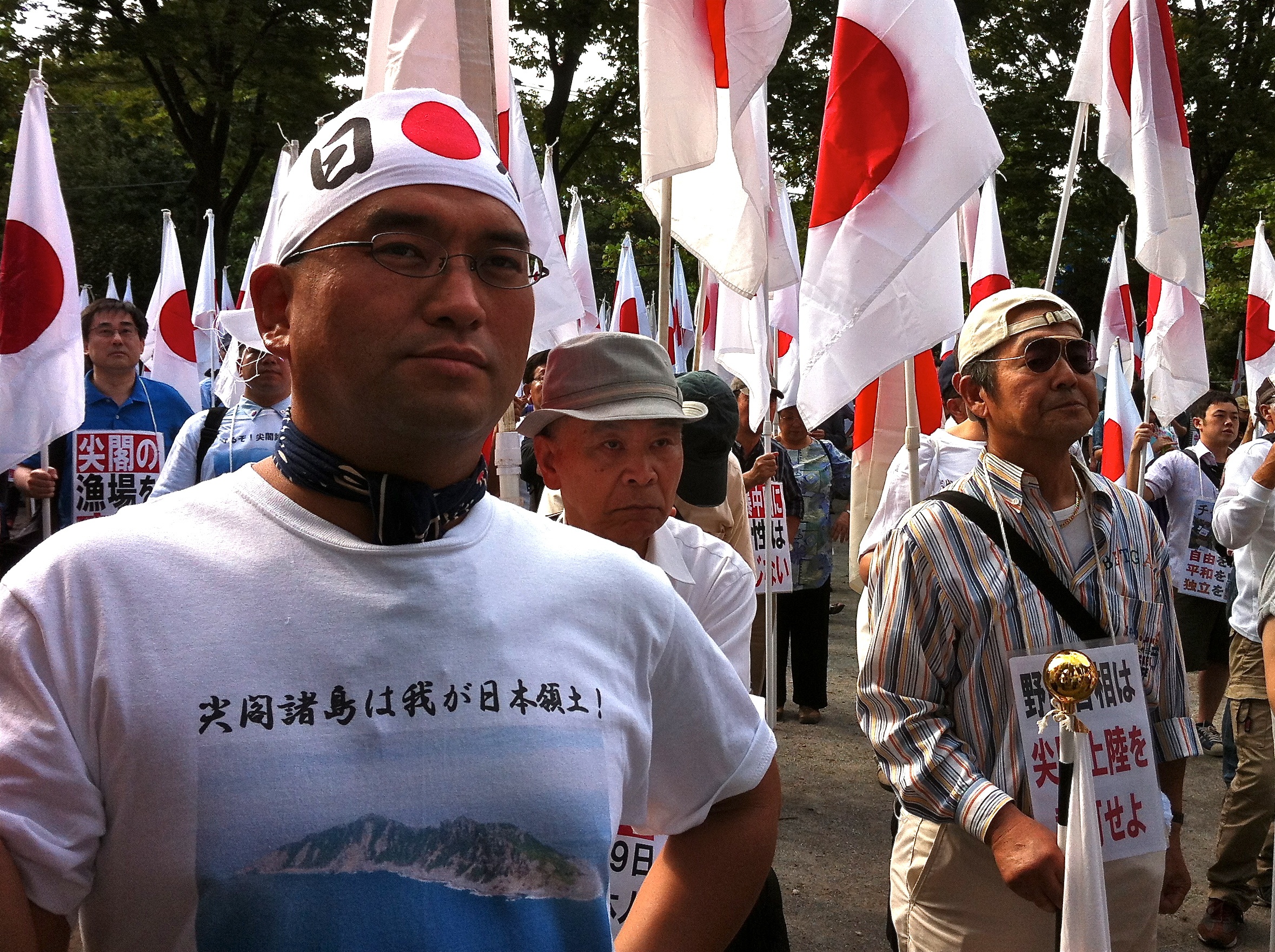
A demonstrator bares a shirt declaring the Senkaku/Diaoyu islands as Japanese territory. Nationalist group ‘Ganbare Nippon’ has seized on the issue as an example that Japan needs to enact a tougher foreign policy position towards China and its recent ‘aggression’.
But for the US, the sensitivity of China to almost all changes in the alliance between the United States and Japan presents a major challenge for Obama. The President faces a dilemma. On the one hand, it is pressing Japan to share the burden of their costly alliance but, on the other, it needs to keep American presence in Japan in order to protect its interests. Also trapped in this web, Japan’s best way to reconcile these two apparently contradicting objectives lies in its response to the Iraq War: adopt a non-offensive military role (send 600 non-combat troops) that is little threatening to its neighbors but enough to soften American critics. In the end, the US pressure exercised on Tokyo to enter both the Gulf War and the Iraq War does not find its cause in the practical necessity of Washington to get cooperation for the military operations, but to try to raise the participation of the Japanese army in order to share the burden of the alliance that, given the structural conditions of the Asia-Pacific region, will have a more important role. The demand for support—and ultimately, of the modification of Japan’s auto-imposed limits to its armed forces— has its main aim in the stability inside the region and a counterbalance to the power of China. The US knows that it cannot order Japan to take a more offensive role in its military policy, but it can do whatever it has to prevent it from looking weak.
From China’s point of view the situation is similar. China has reduced its criticism towards Japan’s military posture indicating that the regime seems to concede that Japan’s US alliance will be more beneficial for Beijing. Comforting Japan and supplying resources for its security, the United States promotes a political climate in which the Japanese public opposes a rise in military expenditure, thus leaving the hawkish elites without any other option but to comply with them. If, on the other hand, the relationship between the US and Japan weakens or transforms itself radically, Japan’s hawks would have a more prominent role, a result of its sudden lack of US provided security. This possible scenario would mean, to China, given its eternal rivalry with Japan, a fiercer threat than if the United States makes itself present in the region.
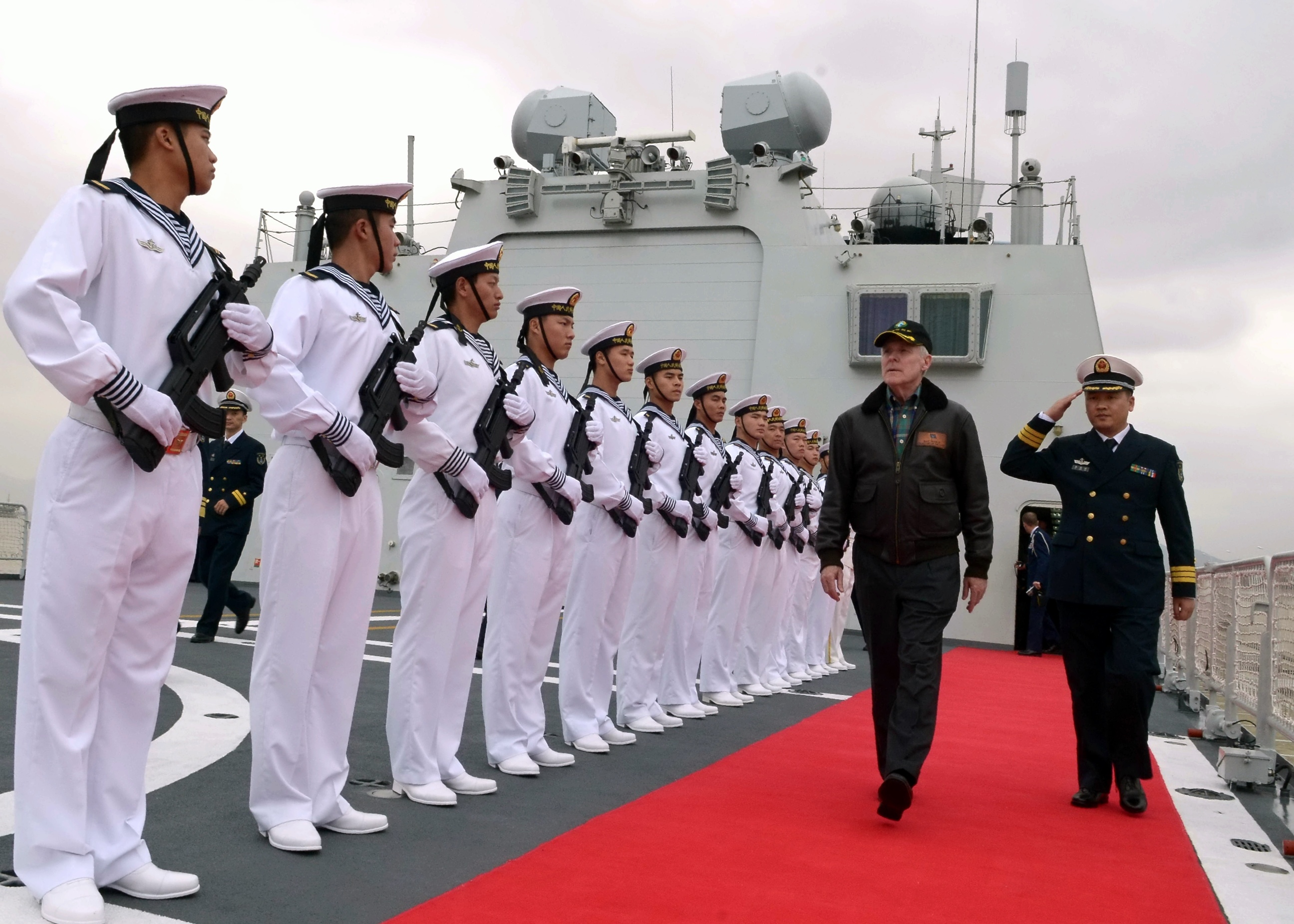
Featured image: Ningbo, CHINA (November 29, 2012) Secretary of the Navy (SECNAV) Ray Mabus is rendered honors by Chinese Sailors, during a visit to the People’s Liberation Army (Navy) Jiangkai II class ship, XU ZHOU (FFG 539) in Ningbo, China. Secretary Mabus is visiting China to discuss the United States’ new defense strategy, deepening our military-to-military engagements, rebalancing toward the Pacific and fostering a positive, cooperative and comprehensive relationship with China. (U.S. Navy photo by Chief Mass Communication Specialist Sam Shavers/Released)
In this sense, it is convenient for both the United States and China that Japan expands its military forces. The presence of the US maintains a police role that keeps Japan in check, thus, from the Chinese point of view, bringing stability. It is not surprising, then, that China opposed the development of nuclear arms by North Korea, fearing that it would make Japan develop its own nuclear arsenal to counter it.
In sum, there exists a fragile equilibrium in the Asia-Pacific that, if left unchecked, may give way to unnecessary tensions. The United States must create a long-term strategic plan that proves useful to tackle the different preferences in the region, such as the Cold War containment policy did. This includes, as Aaron Friedberg says, engaging China via soft power measures, such as commerce, diplomacy and human rights talks, but also needs balance-of-power politics by reinforcing its strategic alliances, assessing the importance of a plausible hegemonic attitude by China in the region. This, as mentioned, will be not only better for Japan, but for China too, as it keeps the region stable for further economic growth which, in the end, legitimates the communist regime.
About the Author






[…] International Political Forum (2013). Geopolitics in Asia-Pacific: China, Japan and the US. Retrieved at the 15th of January 2014 from http://archive.the-ipf.com/geopolitics-in-asia-pacific-china-japan-and-the-us/. […]