
The earthquake of 2010 devastated Haiti – since then it has perpetually struggled to re-build itself and for those that have chosen to keep an eye on this impoverished Island we have seen few success stories. Corruption, insufficient and ill organised foreign aid and news of the deadly wave of cholera that swept the Island are the only stories that leaked out onto our news pages.
Only 16% of rural Haitians and 50% of those in cities have access to sanitation facilities, since the earthquake Haiti’s human waste has been taken to the city’s dumping ground, the waste is then traveling through the ground water and into drinking water making it toxic. These poor sanitary conditions acted as a breeding ground for cholera. The disease spread quick and fast erupting into the worlds largest cholera epidemic with more than half a million people in Haiti contracting the disease in the last two years and over 7,000 people dying from the rapid dehydration and lack of medical facilities to save them. So many deaths reveal a global failure to act, the situation was made all the more alarming when it was revealed that United Nations peacekeepers were the probable cause, bringing the disease over from Nepal and contaminating the river. A responsibility the UN still fails to recognise.
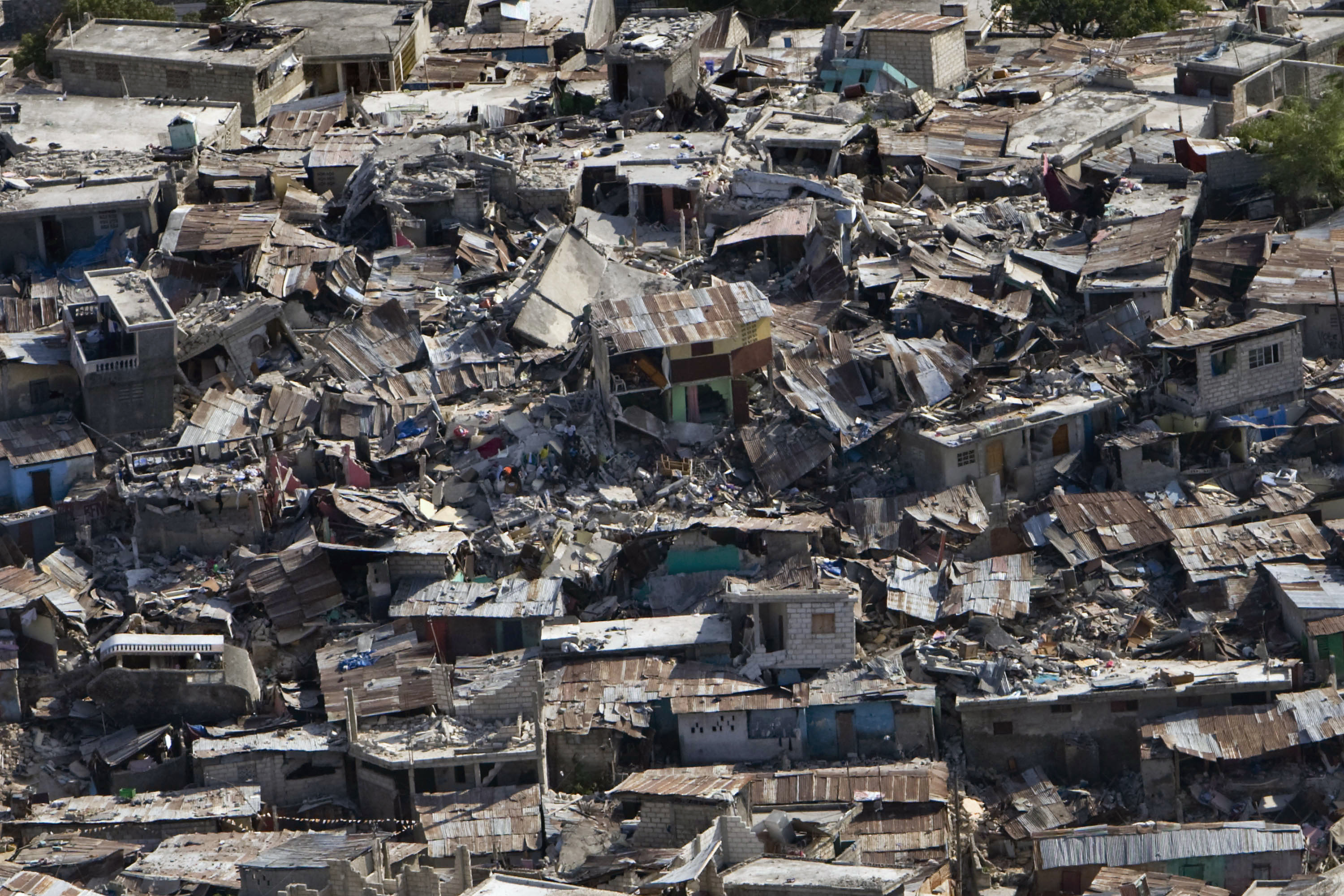
A poor neighbourhood shows the damage after an earthquake measuring 7 plus on the Richter scale rocked Port au Prince Haiti, 13 January 2010. Image credit: UN Photo/Logan Abassi United Nations Development Programme
Alas, the NGO Sustainable Organic Integrated Livelihoods (SOIL) has been working successfully in Haiti since 2006 and is one of a few success stories for the country. They have been working effectively transforming waste into resource and empowering local communities. They have successfully built 200 toilets so far where the urine is separated from the solid waste. The solid waste is then taken to a composting site where it is covered in Bagasse, a by product of sugar cane. Over the next few days the temperature of the compost rises , effectively killing any viruses contained in the human waste. It doesn’t end there – the waste is then used to fertilise the ground, creating a sustainable ecological system. Perhaps human waste, the cause of so many problems for Haiti could actually be one of its saving graces thanks to the hard work of SOIl and the locals.
About the Author






it’s a good initiative, but it’s so paltry – if 200 toilets serve 10 people each it’s still only 2000 out of 10 million (and in 3 years) – why not a public education campaign on how to build one, free “parts” (often the squat-on base) and instructions? Why not get the big NGO’s to commit to installation in a whole zone or even a whole suburb or whole slum?
Haiti is mired in random applications of miniscule technologies, without any vision to expand them…
Mandy, if you look at SOIL’s work, they have expanded immensely since they began their work and with very little financial support. They continued serving tent camps to the best of their abilities (or their bank account’s) long after the big NGO’s pulled out. Other NGO’s tried the same work as SOIL after the earthquake, but without the relationships and a commitment to education around these toilets. Those temporary housing projects failed and the toilets were not embraced.
If you have influence with the Haitian govt., you should go ahead and work with them to start the educational campaign. If you want NGO’s to do it, then who is going to pay for it?
Having lived and worked in Haiti in the 1980’s and then again after the earthquake I would say your broad stroke depiction in the first paragraph paints a very incomplete picture. The aid which has gone to Haiti has to work within the existing framework of Haitian culture. Most of the major NGOs are still there, many have 5 or ten year plans to continue their work but gradually turn most of the work over to Haitians, as is appropriate. Even in the 1980’s there was no waste management- it was non-existent and has always been a formidable problem.
I think this initiative by SOIL is terrific and hope that they work closely with other NGOs who are building in order to maximize their impact.