
Barring a miracle, the war in Syria will soon enter its fourth year. Hope among experts that the conflict may reach a prompt conclusion has waned. Every aspect of what has happened in the country – from the sheer number of casualties to the use of chemical weapons for the first time this century – deserves a place in humanity’s museum of horrors. The war has displaced considerable parts of Syria’s population, creating one of the largest cases of forced migration since the end of the 1940s. And yet the most powerful members of the international community have been unable to man a coherent response to the refugee crisis, much like they could not bring the war itself to an end. This is the story of how European countries have failed Syria’s refugees, and what this tells us about the EU.
The Refugee Crisis
Although it is hard to accurately measure the size of the Syrian refugee population, official statistics paint a bleak picture. The UNHCR has registered more than 2 million refugees to date, and it is safe to assume that the real numbers are much higher due to many people not being registered at all. These statistics can be put into perspective if we compare them to the total population of Syria, which stands close to 22 million. In other words, one-tenth of the country’s population has fled as a result of the war – just imagine 4.5 million Spaniards or 6 million Brits having to leave their homes.
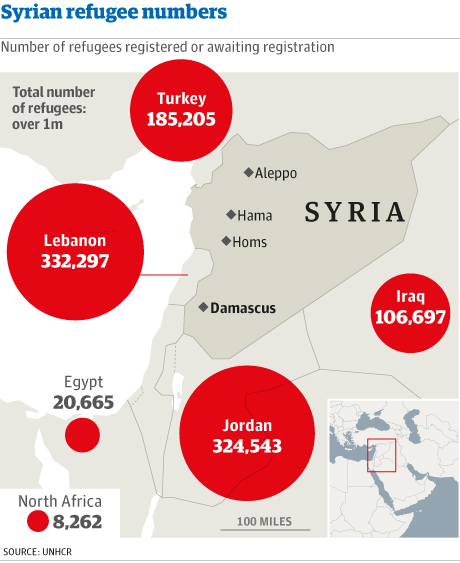
Map of Syrian refugees in March of 2013
Ad hoc refugee camps have absorbed large numbers of these persons so far. Some of them have become as large as medium-sized cities, places where children are born, educated, and brought up. But the uncertain future of the Syrian conflict leaves us with an inescapable conclusion: a long-term solution must be found.
Given the brutality of the situation, pressure on the world’s wealthiest states to help has grown. Even if the West may not find a solution to the Syrian conflict, it should at least try to alleviate its humanitarian consequences. European Union members in particular, due to their proximity to the region and general acceptance of migration, have been called upon to take in Syrian refugees. To say that the European response has been disappointing would be an understatement.
The European Response
Let’s begin by pointing at two countries which have dealt with the situation in an exemplary manner. Sweden was the first Western country to offer permanent residence rights to any Syrian refugees entering its borders, and has to date received close to 15,000 of them. This is not entirely surprising, given Sweden’s welcoming attitudes towards refugees, from the Latin American political dissidents of the 1970s, to the Iranians and Kurds of the 1980s or the more recent waves of Somalis, Iraqis and Bosnians. Germany, meanwhile, has adopted a similar policy, vowing to admit 10,000 Syrian refugees.
That is as far as European solidarity has gone. Some other states have offered to take in asylum seekers – 500 by France, a mere 30 by Spain – but the small numbers are almost insulting given the gravity of the situation. What is worse, 18 EU member-states, including Britain and Italy, have refused to accept a single refugee from Syria. The British and Italian governments may well have appeased the anti-immigration voices within their borders, but they have also tainted the European Union’s reputation as a beacon of human rights and protection from violence.

A Syrian refugee girl (Getty Images)
Speaking with one voice?
But this is not just about reputations and national politics. The Syrian refugee fiasco, much like many of the events that have taken place since the beginning of the crisis, highlights the structural weaknesses of the European Union. If the lack of a common financial policy deepened the effects of the economic recession, so has the lack of a solid common migration and asylum policy diminished the chances of making a contribution. As long as national politicians close their countries’ borders in order to win elections in London, Rome or Paris, Syrian refugees will have no hope of finding safety in Europe.
And while the Swedish and German reactions to the crisis have been commendable, one must wonder how long these countries will manage to pursue such exceptional policies when their neighbours are not willing to help out. Just a few months ago the Swedish migration minister Tobias Billström called on other European states to agree upon a coherent, generous response to the crisis, but this has not happened. The consequences of such inefficacy will increase the burden on countries like Sweden and Germany, and thus encourage them to close their borders just like everyone else is doing.
The Syrian refugee crisis has been yet another failure in the arena of European integration. The selfishness of the member states has further damaged the reputation of the continent, and essentially punished the only two countries that are making a positive contribution. As innocent civilians continue to die in Syria; or struggle to survive just outside its borders, European policy-makers have responded by covering their eyes – and closing their borders. History will not be kind to our elected officials, for this time their failure to co-operate has come at a price that Europeans should be ashamed of.
About the Author






[…] one of the side effects of wars is that they force populations to move. This is happening in Syria, in Nigeria, in Sudan, and will happen wherever there is a violent […]