Amazingly, it was US Secretary of State John Kerry’s ‘gaffe’ that offered a temporary respite from the chemical weapons situation in Syria. However, it can be argued that warmongering across the pond was exactly why Assad agreed to hand over his stocks. Nobody wants to be at the mercy of the only remaining superpower. While Assad has allies in Russia and Iran, it is incredibly difficult to project the extent that they would have stood up for the Assad regime in the face of US attacks. If the Obama administration had not made its intentions with regard to military intervention quite clear, Assad may not have had the same incentive to co-operate with weapons inspectors. Obama could have deployed the US army without the approval of Congress, and as a second term President with a Republican House of Representatives holding him hostage at any opportunity, it could be convincingly argued that he had little to lose and saving the day in Syria would have given him a humanitarian legacy in the history books.
The point is that peaceful settlement is all very well but to what extent is the use or threat of force necessary. This is a highly interesting argument and Northern Ireland can be used as an example here. It is not quite a comparison because the two situations are vastly different in too many ways to go into here. However, Northern Ireland can be seen as exhibiting a successful start to a peace process that will no doubt be long and hard, indeed Northern Ireland is by no means a stable, united, cohesive region, but it is an instance of diametrically irreconcilable parties governing together, an example of a previously thought intractable conflict becoming largely non-violent.
The Northern Irish peace process, be it starting with, ending with or being defined by the Good Friday Agreement, came about as a result of subtle shifts in the perception of political conflict and political actors within the Anglo-Irish political framework. There is much debate over what motivated such shifts, about why Provisional Sinn Fein participated in a peace process led by Westminster and the Dail, institutions they initially deemed illegitimate, and why David Trimble accepted a power sharing agreement that put him in government with the people he deemed terrorists. There is not the time nor the space to even attempt to outline the debate here but there is one point that can be considered highly relevant to Syria; the role of the threat or perceived threat of violence.
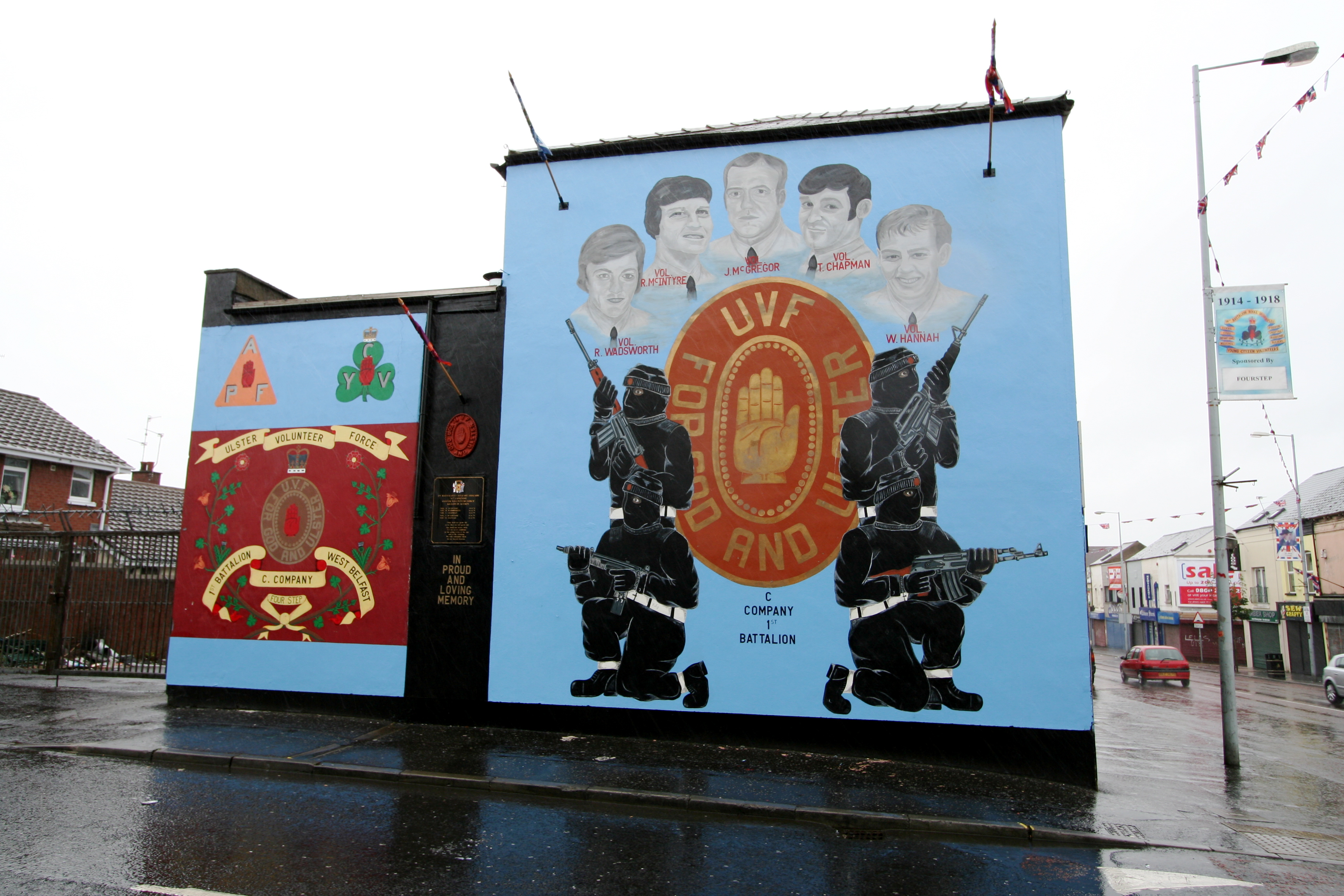
A UVF mural in Belfast. Image credit: Sitomon
Provisional Sinn Fein underwent substantial shifts within, and arguably beyond, the bounds of Irish republicanism that brought them to a transformed position. Their perception of the British and political conflict in the territory had shifted such that dealings within the frameworks outlined by these entities was no longer considered abject treason. Within these shifts a new realisation emerged; the PIRA were unable to force the British to withdraw and even if they could, British withdrawal would not solve the conflic. British force and military presence in Northern Ireland is crucial here as it is here the utility of violence within the Provisional movement can be seen to diminish as a result of violence or militarism from other sources. Increasingly, PIRA attacks were scuppered due to the extensive infiltration of the British army, and while there were still significant high profile attacks, the volume and frequency were falling. Similarly, increasing loyalist attacks on nationalist communities prevented the PIRA meeting their raison d’etre of protecting nationalist communities in Northern Ireland. Loyalist attacks were reducing the popularity of republicanism and subsequently damaging the republican cause. These factors make a case for the role of violence in bringing Sinn Fein to the negotiating table.
Violence or the threat of violence can also be seen to have been a driving force behind Tony Blair’s personal involvement in Northern Ireland. The Manchester bombing in 1996 caused £700m of damage and the Docklands bomb somewhere in the region of £85m. There was also an indirect economic backlash in which companies began to consider moving out of the UK because of the enormous damage done in these two incidents. Shifts in provisionalism were hugely significant in the development of the Northern Irish peace process but so were the shifts undertaken by the British government under New Labour. Inclusion of Sinn Fein was one of the significant differences between the Good Friday Agreement and previous attempts at a settlement, none of which had stuck in the same way as the Good Friday Agreement. And, again, it can be argued that the threat of violence from the PIRA played a significant role in British government policy shifts.
http://www.youtube.com/watch?v=GFpvfz8Ls4Y
Going back to Syria, it is easy to speculate but hard to determine the extent that fear of a US military intervention influenced Assad’s thinking regarding giving up Syria’s chemical weapons. Similarly, it could be argued that Russia was particularly persuasive because they did not want another proxy war in Syria. There could, therefore, be an argument for the utility of a threat of violence in negotiations. However, it is surely too great a risk; if the bluff of the perceived aggressor is called, the bloodshed could be an incalculable cost to human life.
About the Author