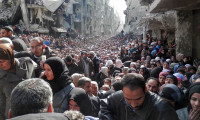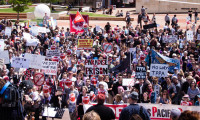
“A picture is worth a thousand words“, as we have often heard, was clearly presented by ‘Human Rights Human Wrongs‘, the current exhibition at The Photographers’ Gallery in London. This excerpt from the history of photojournalism, organised by curator Mark Sealy, is a reflection on the events surrounding the collapse of colonialism and the steps taken towards establishing a universal standard of human rights.
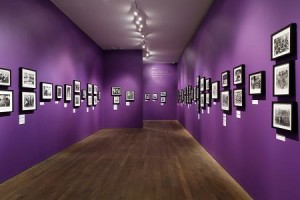
Image Source: http://bit.ly/1OuSdn9
Sealy’s exhibition maps various social and political conflicts that took place worldwide following on from the end of the Second World War, in the wake of one of the biggest atrocities in history. Choosing a selection of photographs shot between 1945 and the early 1990s (taken from the Black Star archives, an agency that supplied publications such as Life magazine with some of the iconic photo-reportage images of the 20th Century), Sealy takes inspiration from the 1948 Universal Declaration of Human Rights, specifically Article Six: “Everyone has the right to recognition everywhere, as a person before the law”.
Among the collection are images of some of the most famous international figures; revolutionaries and Nobel Peace Prize winners, along with some of the least known, and next to pictures of Ché Guevara and Martin Luther King are photos of the unnamed in concentration camps, the faceless crowds of a protest.
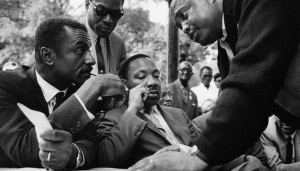
An image of Martin Luther King Jr. from the ‘Human Rights Human Wrongs’ exhibition. Image Source: http://bit.ly/1OuT2wg
Something that struck me while visiting the gallery was the lack of information about the subjects. A large group of photographs in the gallery depicts one of the biggest prison breaks in history, on Anchieta Island off the northern coast of Brazil, which shows the violent deaths of several prison guards. But as it is displayed, hung alongside images of persecution and inequality, it’s difficult for someone without prior knowledge of the context to understand what they are seeing. Are these brutal images showing men killed by murderers and criminals, or are we looking at the desperate escape of political prisoners and innocent men?
The same can be said of other images, and while the exhibition is eye opening and often shocking, it didn’t always seem very informative. This could be explained by Sealy’s statement that our perspective affects how we view and take photographs, so perhaps removing any context pushes us to think differently; “Clearly the right to recognition should indeed be the basic entitlement of everyone, but I hope this exhibition shows how complex it is to gain rightful and effective recognition.”
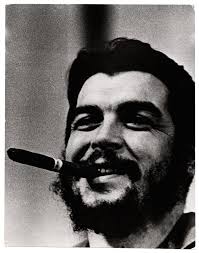
Che Guevara from the ‘Human Rights Human Wrongs’ exhibition. Image Source: http://bit.ly/1CLC6Nd
As an aside, a little research about Anchieta Prison after leaving the exhibition revealed that while it was set up as an institute for your typical convict, by the 1920s it had indeed been used to accommodate more and more political prisoners, with its construction preceded by the removal of the island’s native inhabitants.
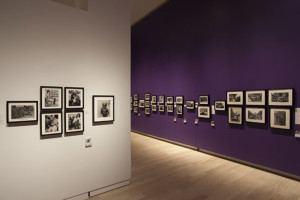
Image Source: http://bit.ly/1EMmN6g
The exhibition encapsulates many of the volatile changes during the end of the 20th Century, but not all of the images are violent. As well as an innocent looking series showing a village photographer at work developing his photos, there are, as pointed out by my friend who visited the gallery with me, a lot of images of people standing by, watching and waiting.
Human Rights Human Wrongs is a timely project that comes at a point where many people across the globe are waiting for change. From the approach of the general elections in the UK (and talk of wanting to withdraw from the European Convention on Human Rights), to the continued protests in Ferguson and the many, many other ongoing issues to be addressed, these images seem as relevant as ever.
NB: Press release with photos here.
About the Author