
The overwhelming victory of the previously governing Fidesz-KDNP in Hungary`s latest elections last week brought no major surprises. However, how this result is possible in Hungary’s current political and social climate is an important question, both within the country, and the wider European political sphere.
Fidesz’s ways of governing received relentless international attention since they won the elections in 2010. Winning two-thirds of the parliamentary seats, the party embarked on a radical, four year long campaign of reforming Hungary’s economic, social and legal landscape.
Radical and unexpected changes seemed to appear in virtually every aspects of life from pensions and education, to people`s personal habits and family lives, and these changes were often unwelcome.
The most criticised new legislations are forced retirements, limited freedom of press, changes in the private pension scheme and in higher education. For example, in a much criticised regulation, university graduates are now forced to spend time working in Hungary or else pay their tuition fees back in full. The law prompted nationwide protests and critical attention from the European Union and beyond.
https://www.youtube.com/watch?v=1NNMz3eXSJM
New legislations went well beyond reason with the introduction of the ‘National Tobacco Shops‘ -the government’s attempt to apparently control tobacco consumption and gain more control over prices, prompting accusations of license distribution to companies with connections to political leaders. Sounds oddly familiar? It may be so, it strongly resembles the past era of Socialism – a concept criticised by Fidesz itself.
Constitution
Fidesz’s only obstacle in executing these often extreme changes, was The Fundamental Law of Hungary, thus it also became altered. Five times to date. The new constitution hardly reminds us of the old one with its amendments affecting laws on higher education, the election system (which now strongly favours the Fidesz party), homelessness and family rights, all in light of Fidesz’s conservative Christian worldview. The document now includes new terms such as the Holy Crown, and God and Christianity, despite Hungary’s position as a not a particularly devout country. Entirely new laws were introduced too, including the rights of the foetus from the moment of conception. With its strong emphasis on traditional, conservative Christian values, the new document appears as only an introduction to more extreme changes yet to be announced. These changes to the constitution were widely accused as undemocratic, an allegation the party denied, claiming that the alterations are based on ‘popular will’.
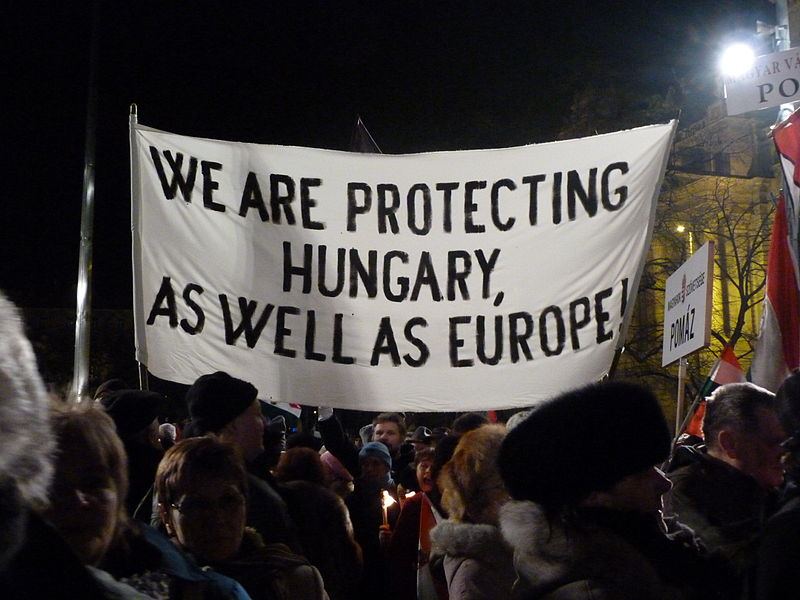
2012 Protest Against Fidesz’s Policies. Image credit: Derzsi Elekes Andor
Were the people of Hungary satisfied with these changes?
Many, especially those newly awarded the right to vote such as Transylvanian Hungarians are most happy. Nonetheless, nationwide protests and large scale emigration are hardly good signs of a happy society.
Yet, Fidesz won another election, and there must be good reasons for that.
The apathy triggered by decades of ineffective politics –as it seems- took its toll on decision making. Last week’s elections saw the indifference of a large number of people with many deciding not to vote at all. Some people say, they stayed away to protest against the available choices, yet many simply felt uninterested. People and especially those, who live in poverty, think their vote makes no difference to their lives. And they may just be right. Politicians on both sides repeatedly proposed to lift up those in deep poverty, yet people who were poor 25 years ago are still deprived, along with many more who joined them since.
Some people however voted, and they had good reasons to do so.
Fidesz’s populist political campaign appeared to be an effective tool – reflecting on the nation’s desperation for change – may have evoked hope in some, thus Fidesz`s extremist acts appeared as a way forward.
This, in itself, of course wouldn’t be enough for such an overwhelming electoral victory. The Fidesz party prepared for the elections way in advance.
In a much criticised act, they awarded voting rights to Transylvanian Hungarians, thus Fidesz could count on further numbers of loyal voters, especially since the previous government turned down their appeal in the past. Distracting propaganda scattered across all media, also bypassed the information threshold of many, causing further indifference.
If these didn’t secure Fidesz yet another 4 years of governing, then political scapegoat making did. Drawing attention on mistakes made by the previously governing MSZP party, Fidesz’s political campaign appeared to engage itself in political badmouthing more enthusiastically then proposing the party’s own political aims. These, together with the new electoral system introduced in the constitution – undeniably in favour of Fidesz – led to the party’s eventual overwhelming victory.
The rise of the far right
Fidesz’s ways of governing are arguably far from democratic, but the party’s triumph draws attention on an even more worrying trend: right wing extremism, that is apparent both in the victory of the more and more right-wing Fidesz, and the rise of the extreme far right Jobbik party. As far as historical examples go, economic and social desperation are hotbeds for dangerous ideologies, and realizing this potential is essential in prevention. If the Fidesz party has the slightest sense of responsibility, it will act against this rather than fuel it any further, in order to distract attention from its much criticised actions.
Hungary’s political scene, and its relations to international politics will be worth keeping an eye on, in the years to come, whether the upcoming 4 years bring further extremities or much needed peace to the country.
About the Author





