
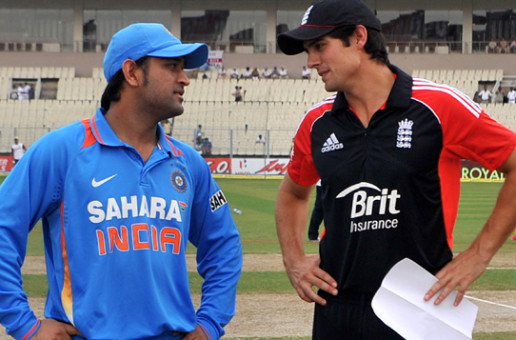
As England and India clash this summer it is worth considering whether the loyalties of British-born Asians tell us something about the deeper issues of identity and integration in modern, multicultural Britain.
Alongside Enoch Powell’s “Rivers Of Blood”, Norman Tebbit’s infamous “cricket test” is perhaps the most memorable political utterance about race relations in Britain.
Controversially proposed by the former Conservative cabinet minister nearly 25 years ago as a measure for levels of immigrant assimilation, it was seen by its creator to uncover the true identity of migrant populations through the medium of cricket.Targeting the large South Asian and West Indian population who had settled in Britain during the 50s and 60s, whilst emphasising the conduct of the former, Tebbit remarked:
“Which side do they cheer for? It’s an interesting test. Are you still harking back to where you came from or where you are?”

Norman Tebbit, Chairman of the Conservative Party 1985 – 1987
The manner of his comments, which taken in context seemed to hit out at a perceived disloyalty common among the British Asian community, was widely criticised by his opponents, some of whom went so far as to claim he ought to be prosecuted for inciting religious hatred.
Despite this, the founder of what became known as “The Tebbit Test” stood by his comments, reigniting the controversy in the aftermath of the 7/7 bombings in London by claiming a starker appraisal of assimilation in Britain based on his method could have prevented the terrorist attack on the capital.
Such expansive claims aside, the debate around the test remains salient particularly in the contexts of the fiery test series recently concluded between England and India. That India receive significant and vocal backing when playing in England is undeniable. And it is clear having been to games that the swathes of Indian fans are not exhausted by devoted fans from India, or even just first generation migrants, but instead individuals who have been born and raised here in Britain.
To the bemusement of those who sympathise with Tebbit, the recent fracas between Jimmy Anderson and Ravi Jadeja saw the counterattacking batting of Jadeja (who was admittedly boo-ed by the crowd on the way to the wicket) at Lords be greeted with raucous chants in his favour.
This was not the first time that a Lords crowd lived up to Tebbit’s prescriptions by any means. England’s hosting of the ICC T20 World Cup in 2009 saw their side boo-ed heavily by Indian fans before their team were eliminated by the hosts. Such a reaction at their traditional home (and indeed the home of cricket in general) caused a stir in the England ranks, with captain at the time Paul Collingwood claiming the hostile reaction was “strange” and “hurt a few people” but ultimately acted as a motivational boost for his side.
And as a young, 2nd generation British Indian, who was once a keen cricketer and remains a massive fan of the sport, it is this second case that I feel hits upon a more bizarre and concerning trend, that Tebbit’s test in fact misses. There seem to be a portion of the British Asian population that not only do not cheer for the English team, but rejoice in abusing and ridiculing them. This trend becomes all the more alarming when you consider some of the players in the firing line.
Nasser Hussain, a Chennai born former England captain was commonly a pantomime villain for supporters of India, and has come out in the past to express his confusion as to why 2nd and 3rd generation fans don’t get behind his team. Hussain’s confusion is perhaps easier to understand when you consider some other prominent names to represent the England team in my time: Mark Ramprakash, Vikram Solanki, Owais Shah, Monty Panesar, Sajid Mahmood, Samit Patel, Ravi Bopara, Moeen Ali.
Plenty of young British Asians have taken the chance to represent England, and have done so with distinction.
However consider the penultimate name on that list. Bopara, whose family originates from the Sikh province of Punjab in India, comes across as the most quintessential of young Asian Brits. A London boy, whose cricket developed in line with the twin inspirations of the Indian legend Sachin Tendulkar and the aforementioned Hussein, Bopara away from the pitch owns two popular chicken shops in the capital. Yet, though he is so similar to many of the young British Asians who love cricket, Bopara has come in line for protracted abuse from some Indian fans. Branded a “gaddar” or traitor (which then is sometimes chanted at him by partisan crowds), howled at when batting, and consistently criticised and mocked by a portion of the Indian support. Why? Simply as he plays for England.
![Ravi Bopara for England cricket team [Source: BBC]](http://archive.the-ipf.com/wp-content/uploads/2014/08/59238134_59238130.jpg)
Ravi Bopara for England cricket team [Source: BBC]
It is this aspect of local support for India which seems most paradoxical in nature. Rather than celebrating the achievements of a talent from their own community making it big on the international stage, a portion of fans choose instead to denigrate him, though they in fact have much more in common with him than their Indian heroes. Could it be that such fans are suffering from a form of identity crisis?
Drawing generalisations is of course always a dangerous game. The continued support of the Indian team from embedded migrant populations needn’t entail a rejection of their identifying strongly as British for example. In fact, recent statistics seem to suggest that the Asian community in Britain do identify as such. Support of the Indian cricket team might then simply be a way of connecting with one’s culture, sharing something with parents and grandparents, or celebrating one’s roots in a positive and joyous manner.
Tebbit’s test makes the mistake of construing identity in too rigid and simplistic a way. Each of us has numerous identities, drawn up on differing lines. To claim that the support of a team in one sporting arena gives us a definitive insight into the psyche of those descending from migrants in Britain seems rather hasty. However, there remains a salience to his warning. Whilst the continued support of some British Asians for the Indian team is perfectly capable of being a positive thing, the continuing sense of hostility towards the English team and, most worryingly some of the British Asians who represent them is harder to explain away.
The issue at hand is no longer “which side do they cheer for?”, but sadly, instead “who do they abuse?”, and when it is seen by some to be the action of a “gaddar” to represent England it would seem that cricket might still have something interesting and ultimately concerning to tell us about identity in modern Britain.
If those supporting India do genuinely feel hostility towards England, and to British Asians representing their country of birth then it does not seem sensationalist to claim this points towards a crisis of identity, and a trend that is damaging to the project of meaningful multiculturalism. We need to understand why it is these individuals feel this way, debate it and then seek a remedy. However whether this is genuinely felt, or a case of football hooliganism invading cricket and manifesting in an unrepresentative minority is hard to tell.
But don’t write off the power of cricket to instigate an important and meaningful debate about immigration and identity. Even if Norman Tebbit’s cricket test has not been remembered favourably throughout history, we’re still talking about it. Most crucially we are still feeling the need to reflect on the issues it sought to address. Issues which regardless of our view on the matter, should not be deemed too controversial to think about in modern, multicultural Britain, for it is in understanding them in their fullest that we can preserve that Britain most effectively.
About the Author





