
There is something startling in how little the British seem to know about their history. The same holds true for the majority of Europeans. I arrived in the UK aged 13 from Portugal in 2004. My father had been in England for 12 months prior to my arrival. He was first stationed in Hull for a period of 6 months and then moved to Scunthorpe for the following 6.
I watched my father leave his homeland without knowing why he felt obliged to. Surely he was not doing it for fun, he must have had a reason I thought. I knew he did not want to leave, after all what father enjoys leaving his wife and kids behind?
My Story
My mother and brother were both working at the time, contributing to the household income as necessary with their meagre 485 euros monthly salary, barely enough to cover all the bills and my high school education. My brother could not attend University because the Government did not assist toward it and because the family circumstances did not allow him the privilege. Portugal’s economic condition was already dire then, with rising unemployment and increasingly under-employment. My family’s situation was becoming the prototypical scenario that an increasing number of families were experiencing.
Why did he, like many others, leave his country? Certainly he had no intention to stay long-term nor did he wish to impose his culture over British culture. He came over to the UK but could have easily gone over to France. The agency gave him an option and his answer was ‘wherever there is work’. He was 49, considered too old in Portugal by most employers. An international jobs agency was his only chance to provide for his family. He did not follow my grandfather’s footsteps to France, choosing instead Britain for its colder climate. He was never a big fan of the heat. My father, who had migrated in the late 1980’s to Israel to work in textiles, is someone who gained first-hand experience in the treatment of Palestinian Arabs in Jerusalem. Not only did this experience influence his anti-discrimination stance, he also began to see how people were arguing against the wrong subject. Instead of politicising their struggle, both sides were depoliticising it. It became a struggle between individuals.
After my father had managed to save some money, my mother and I came along too. I was excited, it was a new opportunity. I had been told what England was like by my high school English teacher (she was Portuguese) and was keen to visit the famous British pubs. Not that I drank at the time. I was far too Mediterranean to start binging so early, certainly something that I adapted to at University later on. I arrived in October 2004. My father had heard of a small town in Norfolk with a Portuguese community called Thetford. We had a distant family member there so it made sense to familiarise ourselves with our new home whilst maintaining a close proximity to people from back home. And so our adventure began.
Grievances must be addressed
There is a large Portuguese population in Norfolk/Suffolk. A Portuguese newspaper is distributed throughout; to cafés, restaurants etc. It’s called ‘As Noticias’ or ‘The News’. Last week I noticed my parents had picked one up. The front page read ‘David Cameron wants factory jobs for British workers’ and underneath a bigger heading ‘Return the Work’. Thetford is exemplary in one sense. It is a small town in Norfolk with a great variety of people from different nations. There is no segregation and everyone seems to get along. It is common to see British couples and families dining in Portuguese restaurants. Equally common is the sight of Portuguese and British individuals purchasing products from Polish shops. There are small pockets of reactionary resistance though this is limited to small groups of young people who feel their government has failed them, educationally and economically.
Their grievances should not be ignored. I experienced this in school. Now, those same people that held reservations about me, appreciate that I managed to go beyond it and finish University. Their problems were not caused by immigration but by Governmental economic policy that has done little to breach the gap between the rich and the poor and by a degrading education that does little to reach the inner capacity of children to seek knowledge. The greatest crime is allowing the political classes to take advantage of demographic imbalances to further their own agenda.
In the ensuing days, some Portuguese colleagues asked me, ‘why should we be ostracised for accepting factory work when our British compatriots do not’. These immigrants effectively accept that type of work precisely because wages and work conditions are less appealing back at home. Or non-existent (as in the case of my Father who worked 6 months without pay prior to entering into a 6 month ‘slave’ contract in Hull). It is an economic issue. The present Southern European crisis is causing mass migration from South to North. These are people looking for better opportunities, sometimes simply seeking survival; a way to feed their children. People like me, young graduates, have a greater privilege than most.
Underlying causes
Quite often we have a clear choice. People like my parents and others are not in the same position, they have no bargaining power. They have to go wherever work is and are treated with contempt if they do not accept it. Governments want internal devaluation, the fight to the bottom. Namely who can work for the least amount of money and equal the same output. The political classes in the UK say ‘look at those Ukrainians, they work for so little and seem happy about it! Why don’t you!?’ This causes friction with minorities because reactionary pockets within them then say to themselves ‘these British are so lazy, they don’t want to work’.
It is easy to see how a systemic problem of economic equity translates into xenophobia and the problem of ‘mass migration’. Binaries like the one described above are created, shifting our attention from the real causes of societal discrepancies. It is not a cultural problem, it is the system itself. So long as we continue to blame the next door neighbour for receiving benefits without ‘deserving’ them, or look to the migrant as the sole cause of British rupture, the happiest the government will be. Polarisation serves them well. This does nothing to address the issues at hand, it merely addresses the symptom.
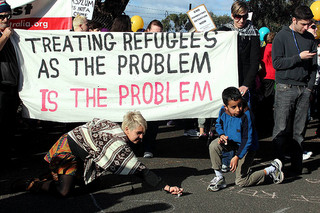
Refugee Rights Protest at Broadmeadows, Melbourne
We should look at the reasons for mass migration, dealing with the root cause. Regulating migration per se is not a solution. The political classes will say whatever they have to say to gain a political advantage even when doing so poses the problem of new forms of apartheid, segregation and rise of nationalisms. The world is transforming. We widely accept the globalisation of finance, technology and communications without reticence yet are unable to accept the globalisation of human movement.
Let us not forget that immigrants are people. They are not lesser people or greater people. By deciding what ‘type’ of immigrants should or should not enter into the UK or any other country for that matter, we are essentially in favour of immigration if, and only if, there are obvious economic benefits. This is akin to treating someone as an economic agent, ignoring their moral agency. When an individual moves through choice, such individual is likely to have an interest in the targeted country. On the other hand, when an individual moves for survival, one cannot expect that person to have considered the culture and rules of the country sought a priori. Either way, there is always an appreciation.
A Government and the constituents of a State cannot expect immigrants to adopt an entirely new identity upon arrival. Integration is a process and can often take many years. When immigrants are mistreated and labelled ‘scroungers’ there is little they can do to overcome the anti-immigration sentiments they are subject to. Quite the contrary, it may only give rise to anti-British feelings amongst the immigrant populations.
Nothing should ever be about tolerance. Did women turn around to men and ask them to ‘please tolerate’ them when they sought the right to vote? Did Martin Luther King and the movement for racial equality ask white Americans to tolerate their skin colour? It is never about tolerance. As soon as that word is uttered, my ears hurt. Even today, does the LGBT community want straight people to ‘tolerate’ their sexual preference? I mean, it’s absurd to even consider it. Equally we should not be talking about ‘tolerating’ immigration. We either accept the fact that Europe is failing politically (not providing adequate opportunities for its workers) or we are nationalists who care little about other cultures. Here I agree with Zizek when he says, “The liberal idea of tolerance is more and more a kind of intolerance. What it means is ‘Leave me alone; don’t harass me; I’m intolerant towards your over-proximity.”
This article was originally published on Urban Times.
About the Author





