
With news reports flooding in highlighting the ever deepening involvement of Hezbollah in Bashar al-Assad’s struggle for Syria, the scenario which so many Lebanese feared appears to be on the brink of being realized. Conflict is spilling over, further destabilizing a country where peace always hangs in a precarious balance, and I believe that civil war cannot be prevented for long.
From 1991 to 2005, Syria had a political and military stranglehold on Lebanon. Following the assassination of Rafic Hariri it withdrew, on the surface at least. Since the start of the revolution in Syria, the hand which has been secretly, (and sometimes not so secretly,) feeding Hezbollah, has developed gangrene. Eventually, one way or another, it will have to be amputated. The inevitable loss of its key ally – the Assad regime – will be a huge blow to Hezbollah and, to make matters worse, it realizes that a conclusion of the Syrian conflict could mean a Muslim Brotherhood led regime arriving in power. Thus, Hezbollah will go from having a friend and benefactor as a neighbour to having what will be an openly hostile and opposing foreign enemy that is an extension of the larger collective Arab/Sunni hand.
Hezbollah is not an inexperienced, rag-tag group of Islamic fighters. It is a smart, synchronized, well-oiled organization that understands the game extremely well. It understands that the fall of the Assad regime is inevitable. I also believe that it is keenly aware that there is a very good possibility that, in the coming years, it may lose its only remaining benefactors – the Islamic Republic of Iran. The revolutionary fire is burning under the surface of the rule of the Ayatollahs, and their iron fist alone will soon be insufficient to crush the boiling frustration of a young population. Without a vent, this angst and anger will be internally channelled into revolution. What can Iran do to stop it? I think that the only play the Ayatollahs have is to provoke a war; an attack from an enemy which will unite the country and provide a vent for the anguish of youth.
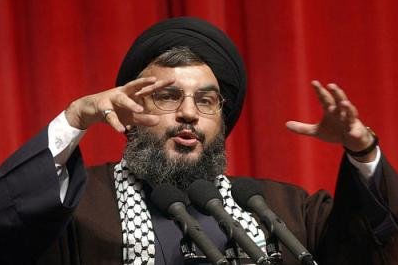
Hassan Nasrallah. The Hezbollah leader last week declared that Hezbollah would deepen it’s involvement in Syria. Image credit: Anton Nossik/Flickr
The situation in the region is a powerful and dangerous chess match in which groups must try to speculate on the moves that opponents could possibly make, and then plan their own strategy accordingly. Here’s one way I think it could play out. Hezbollah, upon Iran’s request, (or under its own volition,) fires its Katyusha rockets into northern Israel either as a pre-cursor to or response to Israeli air strikes against Iranian infrastructure. These Israeli airstrikes are arguably imminent – Israel has recently conducted strikes in Syria against weapons convoys that they claimed were destined for Hezbollah. Hezbollah will oblige Iran in either provoking or jumping into a conflict with Israel, not necessarily for the sake of its benefactor, but for its own sake. Hezbollah was born as a result of Israeli occupation of southern Lebanon and since its inception has defined itself on a core level with resistance to that presence.
The trouble seems to be that, for perhaps the first time in its existence, Hezbollah seems to be concerned for its survival. It sees the imminent death of one benefactor and the very possible death of the second. It also sees its legitimacy being publicly questioned – in many quarters where it previously enjoyed support it has come to be seen as a bigger liability in itself than the threat, (Israeli aggression) that it is purportedly there to protect against. Hezbollah has, at this point, only has one card up its sleeve; its military apparatus, which is unmatched internally in Lebanon even by the Lebanese Army. If Hezbollah feels its power to be ebbing further, as I believe it inevitably will, then its probable move would be to take the internal Lebanese battle to an environment that favors its strength – military might – as opposed to relying on its ever weakening political power. It will take the battle from the halls of government to the streets, from using rhetoric and diplomacy to bullets and grenades, just as it did in 2008 and again in 2010 when it felt its ambitions outstripped its political clout.
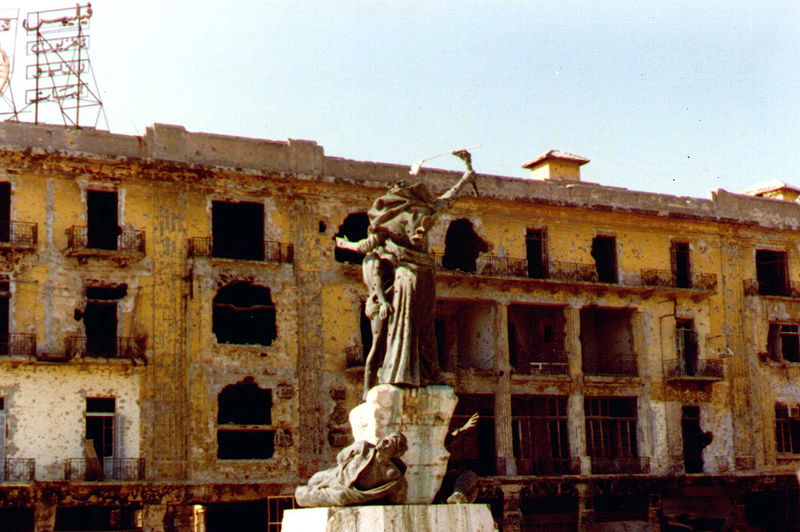
A return to civil war? Beirut’s Martyrs’ square in 1982. Image Credit: James Case/Wikimedia Commons
I believe Hezbollah is pushing towards war in Lebanon and it is, of course, not the only factor in play. There are also the radical Sunni clerics who have a much larger and stronger political base of support than Hezbollah. It makes sense for them to flex their political will while their enemy is weak and getting weaker. Of course they know that they are no match militarily for Hezbollah, but military assistance from Saudi Arabia or even the USA could be reasonably expected in the case of conflict. On top of this, there is the problem of Syrian refugees in Lebanon, which the UN has estimated number over 400,000. The camps are a breeding ground for all sides to covertly plan and try and destabilize each other, as well as allowing the Free Syrian Army to operate from inside the country. Let us remember one of the destabilizing factors leading to the civil war in 1975 was PLO attacks on Israel being planned and executed from inside Lebanon.
The point is that there are a number of factors that point to a very possible, nay, probable outbreak of civil war again in Lebanon. I call it a civil war, but the reality is it will be just one part of larger regional conflict that may very well change the borders of the region as we know it. I pray that a repeat of the 16 year war that ravaged the country from 1975-1989 can be avoided, but I am skeptical. At this moment in time, too many actors (a right-wing government in Israel, Hezbollah and the Ayatollahs in Iran) need some sort of a war or conflict to justify their existence.
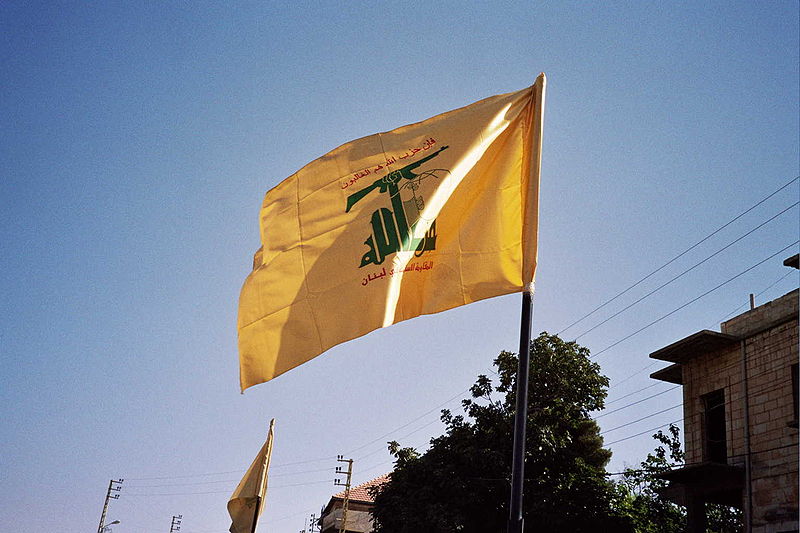
Flying the flag: Hezbollah’s yellow and green emblem is emblazoned on the Syrian skyline. Image Credit: upyernoz/Wikimedia Commons
About the Author






[…] article was originally published on InternationalPoliticalForum.com by Michael […]
Hizbollah interference in Syria is going to destroy Lebanon sooner or later, they are working on Ayatullah’s agenda, they don’t believe in Lebanon as a state or as a country.
In regards to their loss in Syria, Hizbollah now pushing the young Shia’a to join their forces.