
What made the MaD conference 2014 so special? For me, it was because it was an Asian conference.
As a youth who was born in Australia, grew up in Hong Kong, but studied in an international school for seven years in Beijing before returning to Hong Kong for university – I have gone through my fair share of an identity crisis. With a certain degree of Western influence, I have also questioned what it means to be “Chinese”, or “Asian”.
With the modern development of China, and as other countries in Asia emerge to play a greater role in the global platform, like a person, perhaps one can suggest that China is undergoing its own set of identity crisis as well.
In MaD 2014, I was most touched by Dr. Hseih Ying-chun’s presentation on “Building for the People”.
As a humble observer, I witnessed Beijing’s skyline of construction sites and new skyscrapers while growing up. Yet behind these glossy modern buildings (while admitting that I lived in one of these apartments myself), was the hard work of China’s generation of 262 million rural migrant workers, forming the largest flow of migration in human history. Yet, they are also the ones that have arguably faded into the city’s backdrop as second-class citizens.
Home to almost 1.4 billion people, China’s large scale development projects have always been known for their ambition, size, and scale. The society has come to modernize at one of the most rapid rates in the world. However, the country still struggles to detach itself from labels such as being known for its counterfeit goods, or even Tianducheng in Hangzhou, a luxury real estate development, otherwise known as a “Paris look-alike” with the replica of an Eifel Tower. Though there are numerous things to be proud of, some have also argued that China’s development is blinded by a seduction of Western cosmopolitanism, losing an appreciation for its own traditional culture.
This is where MaD comes in.
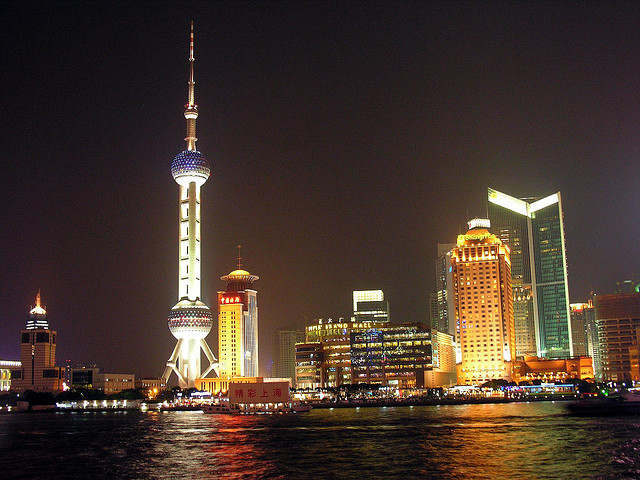
Image courtesy of Dennis Jarvis © 2006, some rights reserved.
In Dr. Hsieh Ying-chun’s presentation on his “Building for its People” project, he stresses on the incorporating indigenous culture and local participation. After the Sichuan earthquake, a lot of young people that were working in the large cities like Beijing and Shanghai returned to Sichuan to their village to participate in reconstruction. Respecting sustainability and diversity, the entire reconstruction process was voluntarily conducted by the local people. The power of the community was fuelled with willpower and determination, while the people sang their traditional village songs as they erected homes that they could truly take ownership of.
Another speaker, Dr. Diane Geng, the co-founder of Rural China Education Foundation, sets to promote education that prepares students to improve their own lives and their communities. She argues that the current national curriculum is geared towards an urban lifestyle that is often irrelevant and unfamiliar to the rural students. Furthermore, it strongly reinforces a popular culture that rural lifestyles are inferior and backwards, instilling an “urban dream” that are at times an illusion. Rather than just helping students improve test scores, the organization hence develops teaching methods and curriculums that are more relevant to their own communities.
We need to think beyond the black and white. The dilemma between the eradication of the past for the sake of modernization, versus a preservation of traditional culture, is not an “either/or” option. Rather, “traditional” and “modernity” are relative concepts that can only exist in relation to one another. Hence, perhaps it is about selectively taking the wisdom rooted within China’s ancient civilization – and utilizing it in an innovative manner to move society forward.
In the end, regardless of whether you see yourself as a MaDee, a Hong Konger, a Chinese, an Asian, or a global citizen, it is crucial that we reflect upon what it means to carry these identities. Perhaps the time has come for us to begin yet another creative experiment in search for our new identities.
About the Author





