
After years of military rule, Nigeria clawed her way to democratic governance in 1999 and today, for the first time in her history, the country has witnessed three successive democratic transitions without the military’s intervention. Though marred by electoral irregularities, political assassination and post-election violence, the Nigerian democratic model is seen as that which is growing from the nascent stage of teething pains to the part of maturity.
Based on the American Presidential system of government, the Nigerian government is tailored to the federal System of government with a two term limit of four years each for the executive arm, and an unlimited four year term for the legislative arm. With a skewed federal system concentrating central power on the executive, the elections for executive posts (Presidential and gubernatorial) are seen as a ‘do or die’ affair. The matter is not helped with the juicy pecuniary emolument attached to political posts coupled with the power to issue contracts which is usually a drain pipe to loot public funds; politics is seen as a worthy full time career/business venture.
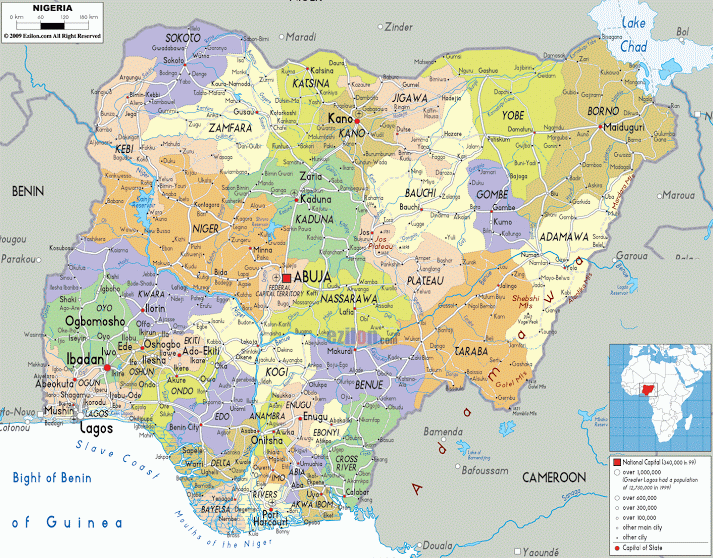
Nigeria’s political map [Image Source: The Eagle Online]
Religion and ethnicity are other divisive factors used as political tools in the country. The population to the north of the Niger/Benue rivers is predominantly Muslim and unified by the Hausa language; though still ethnically diverse, the influence of the defunct Sokoto Caliphate which ruled the area in pre-colonial times continues to be felt which accounts for the unity in language and religion. Nevertheless, there are pockets of highland areas untouched by the jihadi movements thereby resulting in different ethno-religious groups. Areas like Jos, Southern Kaduna differ from their predominantly Muslim Hausa/Fulani neighbours by their religion/culture (mostly Christianity).
The population is predominantly Yoruba to the south of the Niger-Benue trough to the West, and their religious leaning is a near equal balance of Christianity and Islam albeit mixed with a deep affinity for cultural and indigenous belief/bonds. To the East of the Niger River, the population is predominantly of the Igbo ethnic stock and the Niger Delta is awash with an agglomeration of several ethnic leanings, though the Ijaw ethnic group is dominant. Christianity is the dominant religion in this part of the country.
Such is the diverse polarity of Nigeria’s ethno-religious mix, making the ethnic/religious leaning of any political aspirant a first point of question. As such, major political parties in Nigeria are cognizant of the country’s diverse ethno-religious mixture. It is customary for political aspirants of one religion/region to field candidates belonging to another. This principle is referred to as zoning and is widely accepted in the national political consciousness.
This however, has enhanced the fault-lines and deep mistrust among tribal groups. The North is seen to be politically dominant having produced 8 of Nigeria’s 12 rulers since independence who have spent a combined 30 yrs of 54 yrs of independence in power.
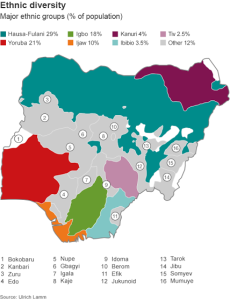
Nigeria’s ethnic diversity [Image Source: BBC]
Agglomerated by British colonial rule, the fault lines in Nigeria’s political make up was evident during the pogrom of the Igbo’s in the North after the first coup d’etat in 1966 which led to a 30 month civil war. Ever since, there has been no stop to bloodletting in pockets of sporadic ethnoreligious violence in Northern cities of Kano, Kaduna, Bauchi etc each time targeting Christians and Southerners (either Christian or Muslim). It is however sad to note that after such riots, no master minder/perpetrator is brought to book. This lack of apprehending allegedly guilty insinuators has fuelled suspicion and mistrust conjuring rumours that the government (at those times controlled by Northerners) where behind the violence.
With the advent of democratic rule in 1999, power shifted to the south as Ex-Military ruler, Gen. Obasanjo won the presidential elections. His advent to power was seen as power balance after 20 contiguous years of military rule. Gen. Obsanjo went on to rule for two terms. His attempts at pushing for a third term were thwarted. The North/South ethno-religious mistrust continued to fester during his rule as some governors of Northern states sued for sharia law in their domain. With the Presidency powerless to stop the trend, the entrenched mistrust cascaded into riots in Northern Christian enclaves of Jos and its environs.
Aside from cases of ethno-religious violence, Nigeria’s peace has been taunted by the rise of militancy. These actions fuelled the ferocity and menace of the Niger Delta militants in the Niger Delta and Boko Haram in the North East.
The Niger Delta after a long agitation for resource control managed to produce the country’s current president – Dr. Goodluck Jonathan which in turn helped quell militant activity. However, with elections around the corner and the president intending to run for a second term, there have been associated fears in the national polity given the following:
- The Niger Delta Militants’s threat of war if the President doesn’t win or refuses to seek reelection.
- Fears of elections being withheld in some parts of the North East where Boko Haram’s activities are ferocious.
- Concern towards the army’s capacity { to effectively} contain the Boko Haram insurgency within the six week deadline of election postponement and the threat of a formation of a parallel government by the opposition APC (All Progressives Congress) party if not declared winner of the forth coming Presidential polls.
Ultimately, the consequences of President Jonathan contesting the elections are dire. Should he lose, the Niger Delta militants would then commit acts of violence such as bursting oil pipelines and kidnapping oil workers all of which could well shut down oil production in the country and severely damage the economy. A win for President Jonathan however, might trigger post-election violence in the north which might be difficult to quell.
In conclusion, the writing on the wall is clear for every Nigerian. The resilient spirit shall carry on, but at the cost of innocent lives.
About the Author




