
Sexuality has occasionally been employed by women as a campaigning tool for gender equality. This has been manifested numerous times in campaigns such as SlutWalk, which aims to fight against the notion that women ought to be stigmatised for being sexual, or that victims are in any way to blame for sexual harassment or assault. Campaigners have sought to demonstrate this by publicly dressing in a way that may be construed as ‘slutty’, and emphasising the distinction between willingness to have sex and indiscriminate sexual invitation. The argument that sexuality is ‘empowering’ has come up with regard to women appearing in sexualised media, such as lads’ mags.
Sexual stigma remains a problem in our society, particularly towards women. The Daily Mail recently hit a new low by criticising M&S’s choice of female models with judgements passed on their personal lives and number of sexual partners. The majority of sexual slurs and language suggesting that enjoying sex makes a person lesser are still directed towards women. Too much focus is still placed on the conduct of female victims of sexual harassment or assault; how they dressed, what they looked like, their sexual behaviour, whether or not their actions could be viewed as ‘provocative’, and so on.
Related: Do Western Feminists Have Any Right to Speak out for the Female Muslim Community?
Sexuality can be an effective tool for bringing these issues to light; for making a statement that women’s sexuality and autonomy matters and they have a right to exercise it on their terms. It can help to broadcast the message that ethics, safety and consent should be the main issues with regard to sex, not how much of it you have and who with. It reinforces the idea that sexual assault is entirely the fault of the perpetrator, regardless of circumstances. Using sexuality as an activism tool can be an opportunity for women to take back control and exercise sexuality on their own terms.
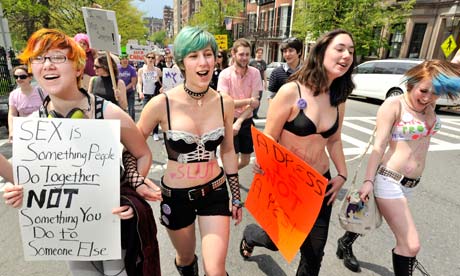
Protestors at a ‘Slut Walk’. Image Credit: The Guardian
However, the movement has its disadvantages and has met with criticism, including the recent backlash after Lady Gaga’s song “Burqa” which has been interpreted as inappropriately sexualising Muslim women. The use of sexuality in activism has been accused of pandering to male desire and attempting to destigmatise feminism by making it ‘sexy’. It can also imply that sexuality is the only issue that feminists need to tackle.
Sexual imagery that supposedly ‘empowers’ women still places unrealistic standards of appearance on them and can therefore contribute to the marginalisation of people who are not conventionally attractive, or buy into the notion that women are for sex. Conversely it can imply that women who don’t want sex or have conservative attitudes to their own sexuality are ‘oppressed’. Whilst sex is an important part of life for the majority of people, it should also be acknowledged that (among other things) some people are asexual, or just indifferent or put off by the idea of sex. Some people also have attitudes towards sex that may be viewed as prudish and conservative simply due to personal preference. It becomes necessary, therefore, to establish a divide between sexuality and compulsory sexuality; to emphasise that sexual autonomy includes the right not to have sex without facing judgement. Otherwise there’s a risk of going too far in the other direction; to ignore or condescend to anyone who chooses not to have sex. We need a clear divide between ‘sex is natural and nothing to be ashamed of, if ethically pursued’ and ‘sex is for everyone’. The latter mentality leaves little option for people (particularly women) who are disinterested or actively put off by the idea of sex when seeking empowerment.
Sex-positive attitudes should come with a willingness to discuss sexual politics and dynamics, to acknowledge that some areas of sex are problematic and that sex is not empowering by default. If sex is to be used as an activism tool, it should be clarified, to put across the message that sex is not inherently negative and people’s sexual behaviour (assuming it falls within ethical boundaries) should not be policed, including the decision not to have sex. It is necessary to question the notion that sex is empowering for women, and attempt to avoid sexual objectification.
This article originally appeared on the Urban Times.






I agree with what is being said here. I have partially modest views of sex and don’t like watching shows/films with over-sexual concepts: It makes me uncomfortable, that’s just my preference. And the same goes for using sex as a tool for gender equality campaigns- in my opinion, I think it’s ethically wrong and can portray one extreme, which can be irresponsible and damaging, as it can hyper-sexualise women, turning them to just an object of sex.
What fervently annoys me are the double standards that exist between the genders when it comes to sex. It annoys me that if a man was to sleep around he increases in the eyes of his peers, but when he chooses to not have sex until marriage or just waits for a special person he is less of a man, and in vice versa when it comes to women. I think there are better ways of correcting these double standards, and believe the use of sex as a tool for this would just exacerbate things.
I supplement that people should not be pressured into being sexual if it does not interest them at all, and I think there is a gap in the rights of these people and that they should be included more in LBGT campaigns. I don’t agree with any kind of pressure when it comes to sexuality or sex, and think, especially in the adolescence stage, when hormones and sexual thoughts are the most volatile, they should be left alone. Above all, anything they do choose, they should be given the right guidance and be taught how to be safe.
I’ve never understood how hopping from genitalia to genitalia is considered “empowering”.