
Dhaka: Bangladesh prison authorities executed a top Islamist leader on Saturday night for committing crimes against humanity during the country’s 1971 liberation war, after he refused to seek presidential clemency.
The 62-year old Jamaat-e-Islami leader was hung at Dhaka Central Jail four days after the Supreme Court scrapped his plea to reconsider the death penalty sentencing.
Mohammad Kamaruzzaman, the third-most senior leader of the right wing political party Bangladesh Jamaat-e-Islami, was sentenced in 2013 by a special tribunal set up in 2010.The aim of the tribunal was to prosecute the local agents of the Pakistani military that were responsible for atrocities on unarmed civilians during the nine-month bloodshed war.
Bangladesh central jail official said the war criminal Kamaruzzaman was hanged at 10.01PM, five hours after a 24-member delegation of his family members and relatives met him for the last time.
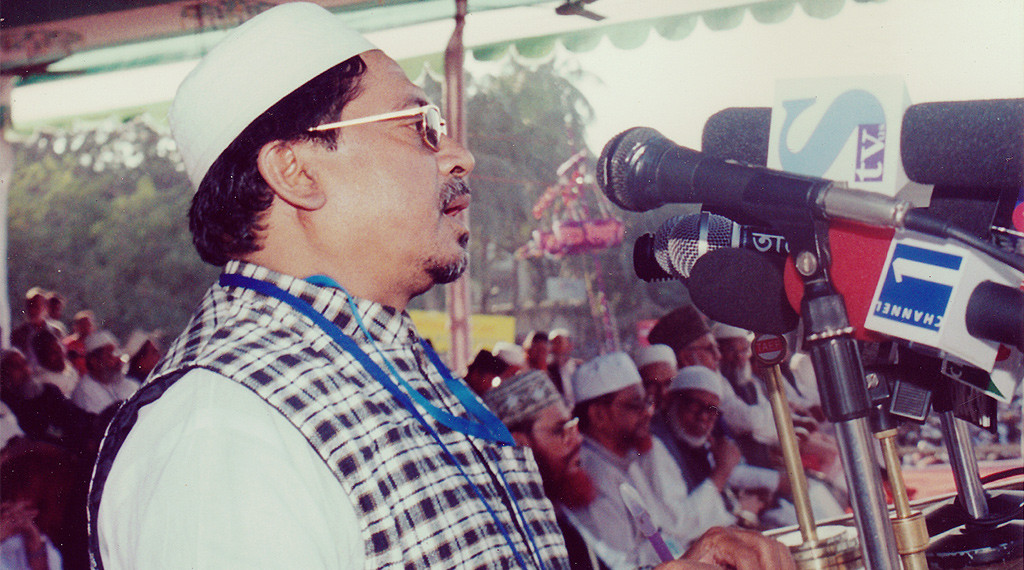
Mohammad Kamaruzzaman. Image Source: http://bit.ly/1JThpQC
Soon after the execution, Kamaruzzaman’s body was taken to his home town in the northern district Sherpur for burial. A heavily-guarded ambulance is said to have carried his body. Due to the execution, security was tightened in and around the central jail and movement of both vehicles and people were restricted on the adjacent roads of the central jail.
A member of the crime-busting elite force, Rapid Action Battalion, and local police and paramilitary troopers from Border Guard Bangladesh were deployed around the prison. Shops and other business establishments were shut soon before the execution took place.
Second leader to face execution
Kamaruzzaman was the second Jamaat-e-Islami leader to be executed over charges of war crime after Abdul Kader Mullah, who was hung on December 12, 2013. The execution comes 44 years after the fight for Bangladeshi independence, which left three million people dead and more than 200,000 women raped.
Ambulances, physicians, senior jail officials and some high law enforcing officials entered the jail just a few minutes after Kamaruzzaman’s relatives left. At 9:55PM, all the lights inside the jail were switched off. Welcoming the execution, people from different socio and cultural organisations brought out procession.
Hasan Iqbal, son of Kamaruzzaman, said his father did not seek presidential clemency over the death sentence.
“He (Kamaruzzaman) is in good health.”
Kamaruzzaman was one of the key organizers of the wartime vigilante al-Badr force. He was convicted of abduction, torture and mass murder in a remote northern district town that is popularly known as the “Village of Widows”.
Prosecutors said Kamaruzzaman presided over the massacre of at least 120 unarmed farmers who were lined up and gunned down in the remote northern village of Sohagpur in the 1971 independence struggle against Pakistan.
Jamaati-e-Islami, the nation’s largest Islamist party, is a key ally of the main political opposition Bangladesh Nationalist Party (BNP). BNP repeatedly demanded an international standard trial on crimes against humanity while Jamaat claimed the trial to be farcical and politically motivated.
Most of the top leaders of the Jamaat are behind bars on charges of crimes against humanity during the liberation war. The International Crimes Tribunal has already pronounced 18 verdicts —most of them are Jamaat leaders. Of the 18 verdicts, 14 were sentenced to death, three to life in prison and another to 90 years in jail.
On Wednesday, the United Nations urged Bangladesh not to carry out the death sentence, saying his trial did not meet “fair international” standards.
About the Author





