
These risks will transform to opportunities for Israel to take over more Arab lands under the pretext of the Jihadist threats and weak governments that cannot provide security and peace. In the very least, Israel will create buffer zones around its borders and surrounding potential threats leaving Arabs more weak and fragile.
It is inevitable that the social unrest that followed the Arab revolutions has caused Israel more security concerns. With the rise of many Jihadist groups in Sinai and Syria as well as the existing threat posed by Hezbollah and Hamas in Gaza and Lebanon, Israel is left with high levels of security risks.
The statements made by many Israeli officials recently might confuse the audience as they present Israel as weak, fragile, and ill prepared. The Israeli Prime Minister, in many occasions, has highlighted the security risks that have emerged from the Arab Revolutions and assured Israel’s right to take necessary actions to prevent these threats. In February 2013, IDF chief of General Staff Lt.-Gen. Benny Gantz began a five-day visit in the United States as the guest of the chairman of the Joint Chiefs of Staff, Gen. Martin E. Dempsey. The announced goal of the visit is to discuss the newly emerging risks in Syria.
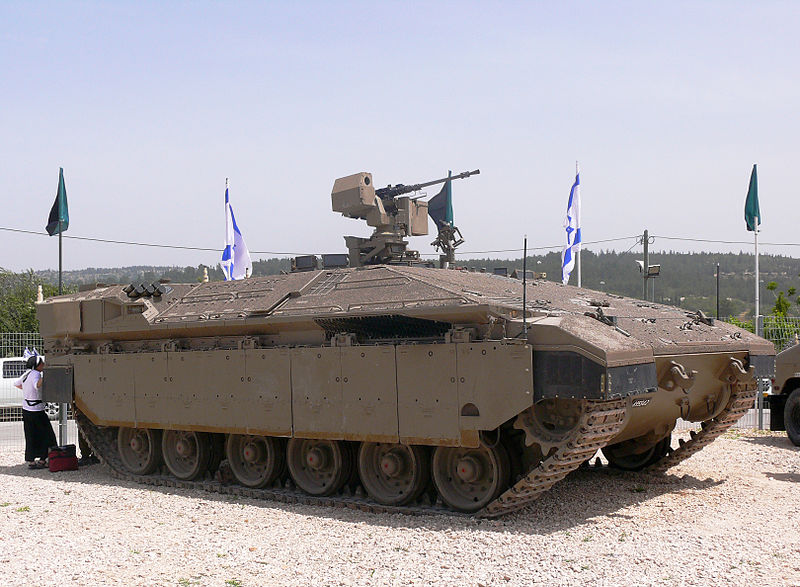
However, in reality, Israel is neither weak nor ill prepared. In term of total military budget, in 2012, Israel spent $15.2 billion on its armed forces, placing it in the top five states with for percentage of GDP spent on defense. While Egyptian military expenditure was just $5.85 billion in 2009, including $1.3 billion of U.S military aid annually. The Syrian army too, has lower military expenditures comparing to Israel whereas their military budget in 2011 was only $1.8 million (about 3.5% of GDP). Jordan does not represent any real risks for Israel as they are both committed to the peace treaty signed in 1994.
Source: Wikimedia Commons
Technologically, Israel military capabilities are more advanced than any other country in the region and of course, the nuclear military capability gives Israel preference and leverage over all the Middle Eastern countries including Egypt and Syria.
Regarding Armed non-state actors such as Al Nussra Front Jihadist group in Syria, Hezbollah in Lebanon, and Hamas in Gaza, their armed capabilities are far from causing critical threats to Israel existence and they have serious problems with funds, organization, and logistical support.
In 2012 and 2013, Israel committed many preemptive strikes against Gaza, Syria, and Lebanon attacking military targets and facilities that might create “security risks”, as well as signing a ceasefire agreement with Hamas in late 2012. These preemptive strikes and actions illustrate the effectiveness of Israel’s intelligence and preparations for the newly emerging risks, but also show how weak Arab countries are becoming and that only Armed non-state Actors are seriously engaged in threatening Israel.
The Israeli position is stronger than ever. Yes, it is! I am not being Pro-Israel or Anti-Arab I am being realistic.
Jihadists are not organized. There is no structure or organization that connects these groups to the different levels of society and government. They are all non-state actors that have obtained weaponry capabilities that come nowhere near to being serious security risks that would jeopardize a conventional and technologically advanced army like the IDF.
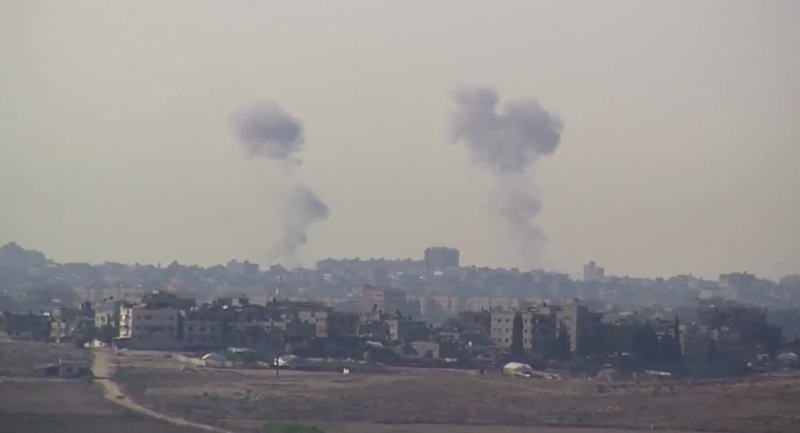
Rising smoke in Gaza after it was hit by Israeli airstrikes. Image Source: Scott Bobb/Wikimedia Commons
They also lack resources needed to wage attacks. In the case of Hamas, it receives its support from Iran, Syria, Turkey, Saudi Arabia, Qatar, Malaysia and other Islamic oriented groups and countries. This support comes as weapons, financial aid, or training. Hezbollah and other Jihadist groups receive most of their support from Iran or Saudi Arabia and partially from Turkey. Lacking independent financial capabilities and access to armed equipment make these groups weak and disorganized.
This weakness is reflected by the absence of a clear strategy; these groups lack tactical or strategic objectives towards a political settlement of the conflict with Israel. It is observed that these groups do not share the same agenda; some of them have a hidden agenda like Hezbollah and the Sinai Jihadists, whilst others are not realistic about their aims like Hamas and newly emerging Jihadists in Syria. The aggressive statement of the full destruction of Israel seems irrational and dispositional as it suggests that the only problem facing Arabs is Israel and not the internal division and the different agendas of social groups within Arab countries.
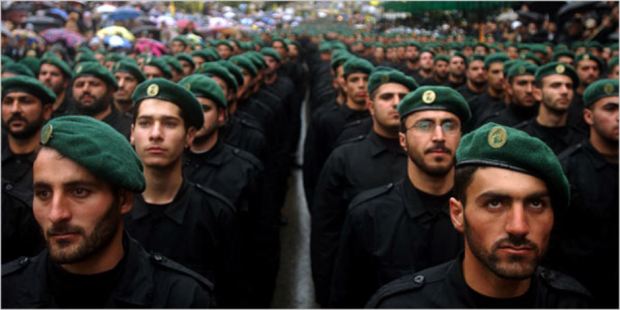
Hezbollah Army
These risks may transform into opportunities for Israel to take over more Arab lands in the pretext of the Jihadist threats and weak governments that cannot provide security and peace. Israel will create buffer zones around its borders and surrounding potential threats leaving the Arab states weaker and more fragile.
However, Israel is facer something greater than the security risk. Israel’s actual problem is the internal social unrest and the ongoing restructuring of the social groups, as demonstrated in the recent elections.
The social demands have mainly shaped the programs previous victories in the Israeli government. In the recent election, all the major parties shared an almost identical agenda regarding security issues. The winning of 19 seats in the 120-seat Knesset by the new, centrist party Yesh Atid (usually translated, as ‘There is a Future’ or ‘Future Party’) founded by former journalist Yair Lapid in 2012 expresses the social restructuring that Israelis desire.
Yesh Atid was recently created by Lapid who has almost no prior political experience and yet succeeded in creating a major change in the political structure of the Israeli government. The main reason for this success is that the party focuses on social and economic issues, which attracted the middle classes in Israel, many of who are suffering from the economic crisis. The party set a number of goals, such as reducing housing prices and taxes and restructuring of the education and health services.
The rise of centrist politics shows that Israel is entering a period of social change that might well lead to a change in the security agenda of the Israeli government. If Israel continues its security agenda, it might fail to achieve the social demands that will eventually lead to deeper restructuring and change in the Israeli society pushing Israel towards more social and security challenges.
About the Author





Both.
Arab revolutions give Israel risks and opportunities as you stated. However, armed non-state actors DO cause critical threats to Israel existence, as Israel now focuses all its efforts to maintain security against those groups and this regularly reduce Israel’s attention to other crucial issues in the Israeli society. The idea of keeping Israel in a constant state of military mobilization will lead to a depression state among the Israelis. Any people can’t live such state for long time. Else, they will search for better options such as leaving Israel and immigrating to other secure country. I do believe that resistance or armed grouped are severely affecting Israel security which is the main actor for its existence.
” The Israeli position is stronger than ever”, yes , in military power only. However, Israel can do nothing of this military power for long time unless it make its own people highly believe in the purpose for possessing such power. Despite this power, Israel failed to win military operations against groups who have non-proportionate power. Time will approve that it is not power that will save Israel’s security as the Israeli aggressions increase the popular Arab hatred and rejection for it. Israel knows that very well. However, as reconciliation with Arabs has never been one of its aims, Israel will continue facing the challenges against its existence.
“Jihadists are not organized.” and they will never be .. they’re not an organization material in the first place ! and if they become an organization, they don’t have the fundamentals of dealing with a huge power such Israel!
bottom line, Israel is way ahead of us, and it will keep taking our things piece by piece.. Unless we start analyzing what we are and what is happening around us !
Israel is a stable democracy in the Middle East at a time when dictatorships are falling all around for their internal reasons unrelated to Israel. Look at what the protesters are saying in their slogans. Without freedom there can be no real unity, or growth, or stability. If the desire is to destroy Israel, then Arab societies will first need to establish themselves from the bottom up. Start building internal solidarity and stability. Find higher ideals to unite over. The desire to destroy Israel is not a good enough glue to keep people working together and making sacrifices. they will rebel when they see they were lied to. Build your society around positive foundations, not negative foundations. That will increase your chances in the next round of violence against Israel.
Threats to Israeli security
1) Chemical and non-conventional weapons in Syria. If these end up in the hands of Hezbollah, a war will become almost inevitable. This seems a real possibility due to the Syrian civil war.
2) Nuclear Iran. Even if Iran does not intend to use the bomb on Israel, it will strengthen its influence, as well as that of Hezbollah and Hamas. Not to mention the possible nuclear arms race which may ensue.
3) Israel’s continued international isolation due to settlement buildings is weakening its standing with its traditional allies, though if it needs to operate alone, Israel will do so (think of Osirak and Syrian nuclear reactors).
4) Hamas, Islamic Jihad etc, may not have the firepower of Israel, but that doesn’t ease the anxieties of Southern Israelis. In fact, in the recent Gaza war, rockets almost hit Tel Aviv and Jerusalem for the first time in about 20 years.
5) If you could pick one thing that unites the Arab and Muslim world and can bring Shiites and Sunnis together, it is their hatred of Israel (of course, that is a generalisation, but I still think it’s fairly accurate). Pretty worrying if you’re Israeli.
The atmosphere y in Israel is certainly different than that of invincibility after the 1967 war. Undoubtedly, Israel is the strongest military power in the region, but that doesn’t mean its security risks are illegitimate.
Correct me if I’m wrong, but this article implies that Israel are the strongest in the region, and therefore not just the Palestinians but the Syrians and other Middle Eastern countries are the victims? That just puts the responsibility entirely on one country, a tiny fraction of the region, a little unfair.
Now, I’m not some radical pro-settler Zionist. But I also recognise that Israel does have security concerns which we cannot ignore.
The key to Arab failure has largely been down to tribal codes that essentially form the basis on which loyalty overrides citizenship. What we are witnessing in the Arab world today is nothing more than what has already repeatedly happened for hundreds of years and will continue to happen: a power-challenge dialectic in which challenge leads to power and power invites challenge. In practise the stronger challenger ruthlessly moves to the top and while suppressing others to go higher, learns the cost of failure in achieving his goal – his own life.
These dynamics and other ancient traditions hold back advancement and result in engagement in creatively achieving new levels of destructive force. Arab society has no precedent for any democratically run system. It pays lip service by using terms like democratic change to appeal to western sensibilities and equally adapts reverse terminology using words like socialism to appeal the Eastern powers, without making any material changes. It is totally misunderstood.
Tribal systems demand loyalty, not free impulses.The practise of Islam has not moved this dynamic creatively forward. Essentially Arab society is run by despots.It has deprived its peoples a basic education. It makes few advances in technology or in agriculture that largely depends on importing nearly all its household products.
And then there is Israel. On the whole a chaotic but largely successful polity that has managed to survive the turmoil in the region until now. Its not just security issues that keeps israel on its toes, but the use of brainpower that is so under-utilised by its neighbours. Energies are focused on destroying the one country that leads by example and should be befriended and not scorned. Prince Faisal, the son of Hussein Ibn Ali, the Sharif of Mecca held a vision in which he saw settlements of Jews as being a power for good in the region. Sadly his position could not be sustained by others and conflicts erupted and ended up in full scale war to annihilate Jews. Arabs have lost these wars and fall into the other dialectic vortex of shame and honour in which honour must be restored at whatever the cost. Palestinian nationalism has in today’s vernacular become the new”just cause” but it’s fundamental objective is not so much the creation of an Arab Palestinian state but the “liberation” from the “Jewish State”
Israel’s responses to Arab aggression has been very tempered overall. Pre-emptive defensive measures to prevent military threats from Iran and North Korea (who peddle with nuclear fissile materials) are major concerns. Israel seeks to protect ALL its citizens and the code under which it operates is essentially more advanced compared to its neighbours. The numbers deaths in all of Israel’s wars combined pale into insignificance when contrasted with Darfur, Algeria, Libya, Iraq/Iran war and Syria with much less “sophisticated” armoury being used.
Ahmed, your article is very interesting, I think it is a very good analysis, and you portray very well the israeli decision makers’ mentality towards these instabilities (revolutions) in the region. I very much agree that these groups across the region need a strategy towards political settlement of the conflict, because otherwise it will remain an ideological battle which does not lead to the improvement of the lives of people de-facto.
I also very much agree with your emphasis on the internal social problems, in the Arab world and in Israel. In Israel the elections have definitely shown that people voted based on their socio-economic internal interests and not on the Israeli-Palestinian issue. I don’t think Lapid’s party will be able to really address the economic and social distresses of the people – they touch upon subjects with mass appeal like “equal share of the burden” – they want to get the religious groups in Israel to enlist in military service, and the arab minority to do civil service instead – but a lot of these problems in my view arise from the ultra-capitalist agenda Bibi and his bunch have been pushing, strong connections between capital and government and corruption, and the deterioration of the welfare state – and i don’t think Lapid is radical enough to address these issues from the core – he might assist the higher-middle-class, but the lower and poor continue to have their safety nets being swept under their feet, and i think the social unrest will rise again.
I really like your sentence that “If Israel continues its security agenda, it might fail to achieve the social demands, that will eventually lead to deeper restructuring and change in the Israeli society” – I think this is the million dollar question for me, how the hell we get Israeli people to understand that the social and political situation are tightly intertwined – that the way to addressing social security and stability goes through striving for political stability and peace – Israeli politics too very much needs a strategy towards political settlement of the conflict, which sadly it lacks at the moment.
I hope that the new generation of young people who are much more socially involved than ever in Israel, and really this is the case, will lead to addressing the conflict as part of wanting to better people’s lives, and that the young and involved Israelis and Palestinians, find a way to stand for social change, each for their own people, but create an opportunity for political dialogue which can lead to some kind of political agreement. I really don’t know how to do this, with anything ‘left wing’ being so delegitimised in Israel, and with anti-normalization in the Arab world. But walla i think we must hope for it and think how can it be done, I have hope only in the young people to have a different mentality towards the region, less suspicion and more respect.
Keep up the important work. Tom, YaLa-Young Leaders.