
The natural course of any language shows that some words, more than others, are likely to disappear. An advance in technology or a gradual cultural evolution can trigger the phenomenon. For instance, words such as mongolism or retarded are no longer able to describe individuals born with an extra chromosome and different facial features characteristic of Down syndrome. These offensive and outdated expressions have slowly been replaced by others which can better designate the condition today. More than a cultural evolution, this change can be attributed to a behaviour revolution.
Integration, capability, and achievements are just a few words that Down syndrome carriers have shown to the world that they are very much able to master. Many of them opened the invisible curtain that held them back from the outside world for generations and showed they can achieve whatever they want. Then, they became actors, writers, painters, sport personalities, husbands and wives.
More than raising awareness about the condition, today the International Down syndrome Day celebrates many milestones. One of them is the considerable increase in their life expectance. Carriers have learned how to get on with their lives and overcome the condition. Many societies around the world haven’t kept up with the same pace and are yet to recover from the most daunting disease related to Down syndrome: prejudice.
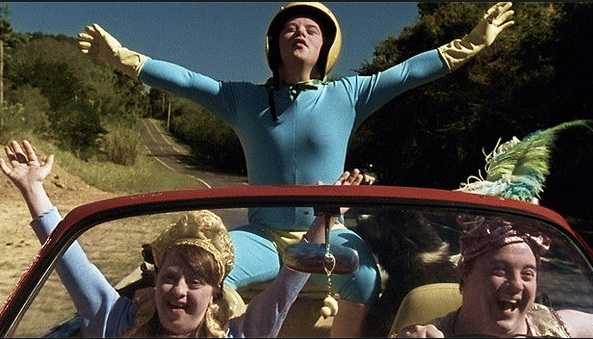
Image from the film. Image courtesy of Alek
Flávio, a nine-year-old boy with Down syndrome from Sao Paulo (Brazil) was just another victim of this terrible disease. After spending his day with his parents and cousins in an amusement park back in November 2013, the family headed to a fast food restaurant which is one of the biggest chains in the country.
Full of energy as any boy of his age, he went straight to the restaurant playground so he could get into the ball pool. Before he could dive into fun, two of the restaurant’s employees put themselves between him and the pool. He couldn’t get in because of his “problem”. Questioned by Flávio’s parents, neither of them would dare to say the forbidden word. “What problem do I have, mum? I don’t understand.”, the boy, puzzled, asked.
As the manager approached, the only answer the parents received was that it was the rules they had to follow. Only when Marilia Cabral (Flávio’s mother) asked if he was being prevented from playing because of his Down syndrome, she heard a definite statement: he cannot play because he is a Down Syndrome carrier.
Humiliated and offended, Marilia started crying and saying Flávio was like any other child, just his face was different. His life so far had never been different from any other child. Unable to call the police, the family went home.
A few days later, they could report the case to the police and search for legal help. Flávio himself told the police chief what had happened to him and his family. The solicitor then sent a letter to the restaurant’s administrators. The reply came just on the 19th of February, more than two months after the incident.
The family was offered five free meal vouchers in any of the restaurant chains as a gesture of good will. The offer wouldn’t be able to make up for the damage already caused and was rejected by the family. Since the incident, Flávio bites his nails anxiously, gets scared with any noise and still needs psychological assistance to overcome the trauma. “Mom, those are the rides I am not allowed to go, right?”- Flávio asked Maliria another day when he saw a similar playground. The family is still looking for a fair compensation and justice for the boy.
Surely Flávio will recover from the incident and as any Down syndrome carrier, he will probably be able to achieve his full potential and live the life he and his family desires him to have. As many like him, he will also be able to heal the open wounds caused by society’s prejudice.
Initiatives such as the film “Colegas” (Buddies) are very effective medicines. The film tells the story of three young people with Down syndrome working in the video library of the institute where they live. One day, inspired by the movie “Thelma & Louise”, they decide to flee in search of new adventures. Resealed in 2012, “Colegas” has been awarded at the São Paulo International Film Festival and the Gramado Film Festival.
As pointed out by Aleksandra Zakartchouk, the Communication manager of Colegas, the film’s legacy goes beyond the cinema screen:
About the Author