
Kibera, is possibly the largest and most renowned slum in Africa; home to approximately a million people, a site for hundreds of charities and a place considered the typical slum situation. Although, what can be considered typical in slum life is beyond me and most descriptions I have ever read. As visitors to Kenya are increasingly opting to extend their tours beyond the savannah into the urban slum situation, I wish to discuss the extent to which these can be considered beneficial to slum residents themselves.
I was initially told about the slum tours a few weeks before I arrived in Nairobi and was quite apprehensive. Nairobi as a tourist destination, historically has not offered substantial amounts apart from things such as giraffe hotels, visits to the Karen Blixen museum, or acting as a springboard to hundreds of animal safaris. But with the realisation of the popularity of slum tours, Nairobi has gained a new appeal for many. The idea of dipping my toe into Kibera for a controlled and organised 2 hour tour, its sewage, litter and chaos, under the watchful eye of local guides and inevitably standing beside an obnoxious tourist experiencing the entire tour through the screen of his camera, put me off. My reluctance was amplified by the naff tag lines used by many companies such as ‘Kibera, the friendliest slum in the world and a city of hope’ and ‘Despite its problems, Kibera has a unique charm…‘.In academic discourse, slum tourism is considered a form of Pro Poor Tourism, which aims to unlock new opportunities for the economically marginalised. But for me, I couldn’t think of anything worse.
My friend in Nairobi knew a slum tour guide and was keen for me to meet him. She insisted his tours were enormously beneficial to Kibera since they involved visiting charities, who then received a proportion of the tour’s earnings. When I asked whether the guide still lived in Kibera, she sheepishly said that she believed he did since the tour involved a visit to a house which he claimed to live in. Nevertheless, the cynic in me conceded that he probably didn’t live there any more, especially since each tour cost around $30 per person.
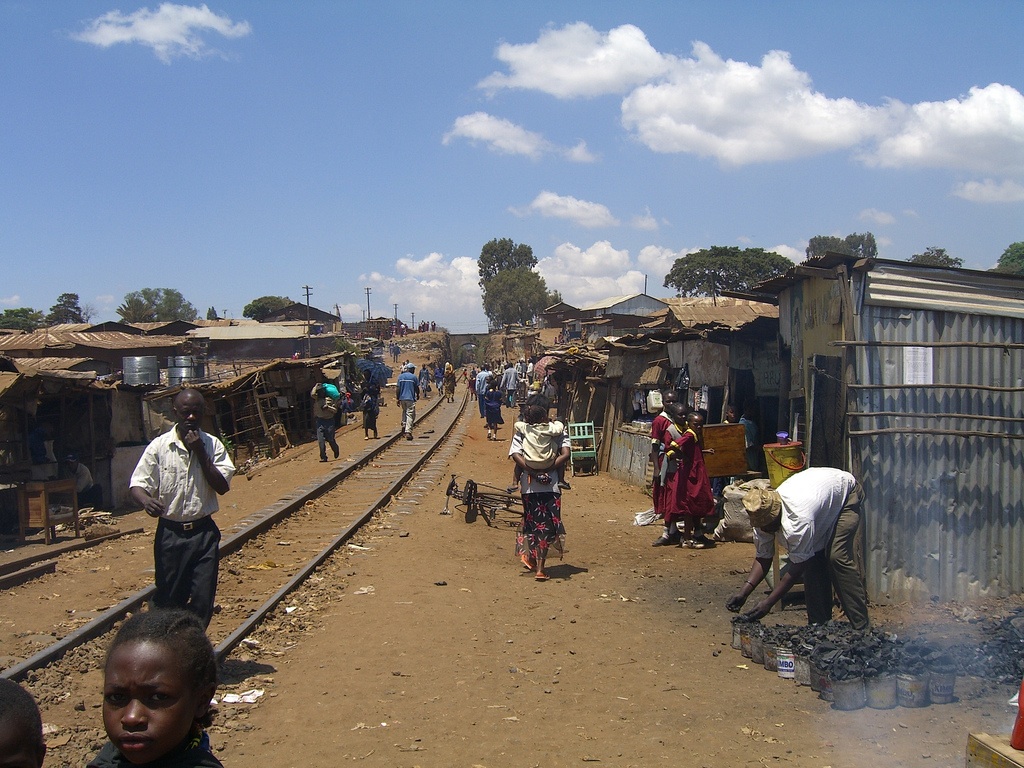
Scenes from the Kibera Slum in Nairobi. Image credit: khym54
We arranged to meet the guide on his break in Kibera, he took us into a butchers. As we walked through the outskirts of the slum we passed a couple of tourists, laden with enormous DSLR cameras and money belts around their waist. Walking past the butchers window, he knocked on a hidden door. We waited a minute and a small woman opened the door, looked us up and down and finally revealed an unexpected sight of an American style bar, with red velvet seats and a tiny wooden counter stocked with beer. A couple of men sat on stools, acknowledging our entry with a casual nod. The guide told us all about the people who came on his tours and its increasing popularity, he seemed to know every charitable organisation and every local person of interest. However, it was clear he no longer lived in the slum, but was reluctant to admit it, perhaps in an attempt to remain ‘authentic’. Of course individuals will aspire to move away from their homes, especially when they are sites of such abject poverty. But the fact that he felt obliged to falsify his residency was interesting; it revealed the extent to which Kibera has a hold over people, one that can only be felt as a resident.
It is important to consider how those who live in Kibera feel about the tours; those people who see the tourists slowly observing their lives in this somewhat voyeuristic manner. A study carried out in April 2013 found that the majority of Kibera respondents (88%) were in favour of tourism in the slum. Nevertheless, when asked whether they felt they benefited from it, 53.6% of residents responded in the affirmative, while 46.4% indicated that they had not benefited. Accordingly, it is difficult to ascertain why residents view the tours in such a positive light, when they do not wholly or directly benefit from them. Indeed, only certain individuals directly benefit since tour companies are often managed by non residents.
Is it fair to denounce the business ingenuity of those who established the slum tours from the inside? Slum tours have allowed certain individuals to escape the difficulties of slum life. They have injected a degree of agency and new kind of entrepreneurship into the area. Surely they should be praised for expanding their horizons and admitting the realities of poverty in developing countries such as Kenya. Shouldn’t any economic gain, however small, as a result of these tours be celebrated?
Ultimately, I remain confused. Obviously, tours only show a small, self consciously created part of the slum, but a part of the slum nonetheless. Something which Westerners are unaccustomed to seeing. It forces these visitors to pay attention (and money) to critical social issues such as disability, HIV and urban poverty. But, is it just a day trip, a way to fill up their itinerary or will it have a lasting impact on their attitude to the developing world and lead them to donate their time and money? Whilst I am happy to realise that tourists are increasingly interested in the darker realities of the countries they visit, I am not sure how revelatory or useful these performances of slum life are for anyone.
About the Author





