
Over the past two years 47 Cameroonians have gone to Sweden to work with tree plantation in the northern forests. They were all expecting to return to their families with enough money to pay off debts, invest and start a better life. Instead, most of them are stranded in Sweden, homeless, helpless and heartbroken. This is slavery in the 21st century: legal job trafficking.
The responsible Swedish company, Skogsnicke AB, sent a formal offer of employment to the Swedish Migration Board, which then granted the workers permission to enter the country. The same document, promising a monthly salary of 18 500 Swedish crowns, and another 6000 per month for expenses, was then sent to the Cameroonians. With this salary, the workers were going to earn enough money to cover all costs and still return with the equivalent of three years’ wages in Cameroon. But this document was not legally binding, and the employer was free to change the conditions. So when they arrived in Sweden they were given a new document: the real contract, with a much lower commission salary. At that point, when they were all in debt over flights and visas, they had no choice but to sign it.
“It is disgraceful that we have laws in Sweden that enable businesses to deceive their workers in this way, without risking anything. And this type of legislation exists in many other countries within the European Union. It allows employers to take advantage of people,” said Swedish journalist Ali Fegan who, along with Lars-Göran Svensson, brought this case national attention through an investigative programme on Swedish Television.
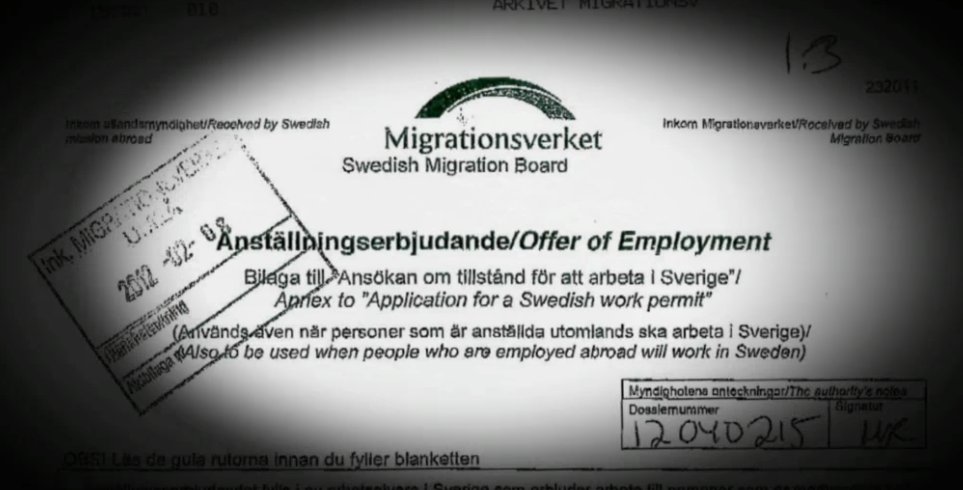
The formal letter of employment. Image: Screen shot from SVTplay.
The Cameroonians had to work 10-12 hours per day, six days a week. But with the new commission salary of 0.2288 Swedish crowns per planted tree sapling, it still did not make them enough money. Their hard work did not amount to more than 6000 Swedish crowns (around $900 USD) per month under the new contract. To make matters worse, they were only given three months of work instead of the promised six months, had no expenses paid, were overcharged for accommodation and charged for a union membership that did not exist. The full salary for the summer would not even get them back to Cameroon.
With no knowledge of the country they were in, the workers were at the mercy of their employer. They had no way to voice their complaints, and so they kept working. It was by chance that one of the 2012 workers, Ndjomo Denis, made friends with the retired teacher Erik on the bus from Stockholm to Umeå. They kept in touch during the summer, and so Erik was the first to find out about the deteriorating working conditions. Apart from the changed salary, the workers were also ill treated. They were not given enough food for the hard physical work in the forest, and were forced to sleep on the floor with up to fifteen people in one room.

Erik contacted the local union who opened an investigation. They found the commission contract completely unacceptable, and started negotiating with the company about a new deal for the Cameroonians. But the negotiations continued for many months after they had stopped working, leaving the workers stranded in Sweden, waiting for their money. In March 2013, when the parties finally reached an agreement, it did not get the workers much. The compensation of 10 000 Swedish crowns per person will not pay for their flights or cover the debts for them and their families. But there is nothing more the union can do for them. The figures in the employment offer had no legal bearing, leaving the union unable to demand the salary the workers were expecting. The money they did receive in the end was just the difference between the commission salary and minimum wage.
Since the case emerged into public attention, there has been talk from politicians about changing the laws that caused this situation. But there is little to be done for the people who are suffering from it today. They are still in Sweden, they are still in debt, they are still homeless.
“Their future is not looking bright. The legal and bureaucratic means to rectify this have been exhausted. The only way out of this situation is if another Swedish company hires them for next season to let them work and earn the money they once came for, or if the fundraising efforts that are starting now can eventually help them,” said Ali Fegan.
About the Author





