
In November 2013, following another year of widespread political disillusionment, one man stood out in the international political arena, attracting increasing interest from the people across the world. His name is Jose “Pepe” Mujica, President of Uruguay.
Probably better known for his commitment to legalising marijuana in Uruguay and his past as a guerrilla fighter, President Mujica has in the past five years gained popularity for his critical views on modern capitalism and his reformist zeal. In his remarkable address to the United Nations General Assembly on September 24th, he warned the international community about the risks of unsustainable forms of economic growth. The idea of achieving economic development through greater consumption, he stated, has already led men to generate more than they can afford and is rapidly leading to environmental and social disruption. In order to preserve the future of our next generations, he urged to shift the focus on principles such as love and solidarity, as opposed to individualism and consumerism. Only by restoring humanity among the people, he claimed, we can start conceiving a better world.
Mujica’s speech was widely praised and, although his words may sound overused and shallow, a closer look at his background confirmed his honest intentions. A year prior to his address to the UN, the often quiet and humble President of Uruguay drew the attention of international media, which documented his rather frugal lifestyle. As the BBC reported from his tiny farmhouse outside Montevideo, where he chose to reside after declining a move to a luxurious presidential palace, Mujica is no ordinary politician. He proudly drives an old 1987 Volkswagen Beetle, flies economy class and has barely two security guards defending his house, where he enjoys spending his spare time working the land. More importantly, as it emerged from the article, he donates about 90% of his monthly salary—equivalent to $12000—to local NGOs, largely contributing to the development of social projects.
His charitable character and austere lifestyle have earned him the label of “world’s poorest president”, which he has firmly denied in a recent interview with Al-Jazeera. “Poor” —he argued—“are those who need too much, because those who need too much are never satisfied. I am frugal, not poor. I live with little, just what is necessary”.
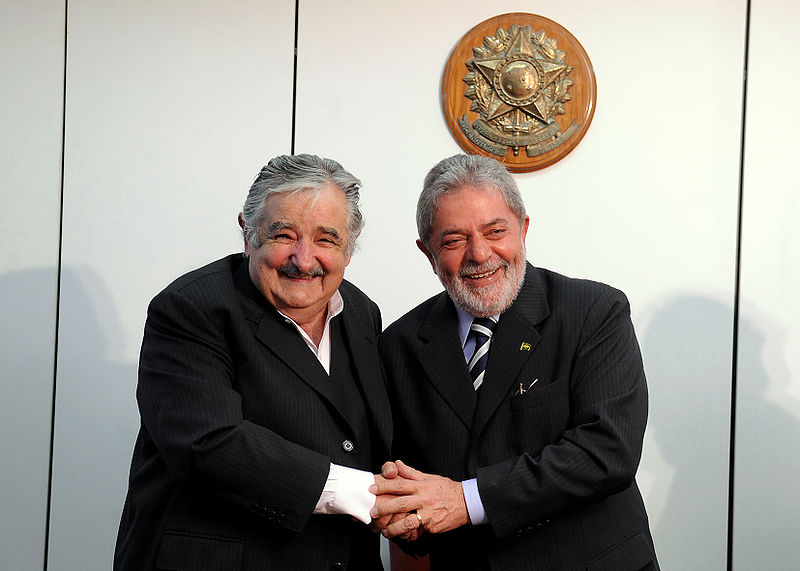
José Mujica with the previous President of Brazil, Luiz Inacio Lula da Silva. Image credit: Roosewelt Pinheiro/ABr
While controversially putting him at odds with the ostentatious conduct of the vast majority of world leaders, and for that matter, with that of most people in the developed world, his personal style has greatly reinforced his integrity and credibility, turning the president of a small nation into a global model. Since 2009, when he won the presidential elections in Uruguay, he has combined his positive inspirational attitude with a solid pragmatism. On the international stage, Mujica has offered mediation in the peace process between the Colombian Government and the Revolutionary Armed Forces, diplomatically promising not to intervene unless he is asked to. At home, in less than five years, he has gathered consensus on issues such as the legalisation of gay marriage and abortion, which, along with that of marijuana, still divide most nations in the world. Moreover, by reducing the level of corruption within the government, holding on to its strong middle class and setting ambitious renewable energy goals, Uruguay has become in recent times one of the leading nations in Latin America in terms of innovative policy-making and quality of life.
Although his administration did face criticism from more conservative and religious factions, especially with regards to his radical approach to abortion, Mujica has never really compromised his reputation on the international stage. In June 2013, following a cordial meeting between Mujica, who is an atheist, and Pope Francis, Montevideo Archbishop Nicolas Cotugno stated that “it was evident the existence of a clear tuning, a certain common denominator regarding care and love for the poor which is present in the Pope and in Mujica: From different paths, but it’s there”.
However, despite being widely acclaimed, “the world’s poorest president” he has rejected the media suggestion of being a symbol of reformation in the world. As he has recently admitted, Uruguay’s options to improve society are limited by the power of global capital, according to which we can’t realistically live without accepting the logic of the market. In fact, the global economy thrives on material expansion, and the duty of any world leader is to favour this process.
If, on the one hand, Mujica is admittedly not the subversive and Che Guevara-esque hero that radicals were waiting for, on the other hand, by setting a positive example, he might have inspired a revolution already. This might not overturn the current capital system, but it does reestablish a sense of solidarity and responsibility in the world. After all, as he put it,
“ […] a revolution is when you change your thinking”.
About the Author





