
Nigel Farage and his party UKIP (UK Independence Party) have a point about the EU (European Union) being a flawed institution. It is definitely undemocratic. The influential technocrats in the EU’s executive branch, the European Commision, are not directly elected by citizens. The Eurozone relies on the decision-making of unaccountable European Central Bank. Furthermore the EU’s proposed Trans-atlantic Trade and Investment Partnership (TTIP) has dangerous implications for citizens.
Let’s put aside UKIP’s headline-grabbing racism, sexism or homophobia. This is disproportionately covered over more destructive institutional and historical forms of discrimination. Disguised injustices embedded within society should take priority over the foolish ignoramuses outing themselves in public forums. Exposing this is healthy but only as useful as footballers eating bananas and declaring themselves monkeys will deal with racism in the sport. The behaviour of the nation’s police force rife with often racially-motivated systemic corruption deserves greater scrutiny than the usual suspects mouthing off in their little England lairs.
Privately-educated-former-investment-banker-turned-politicians don’t tend to queue in supermarkets, unless there’s a camera around. As the European election looms his views against the EU project have afforded him even more media coverage, much of this seems suspicious considering the relatively marginalised representation that the Greens actually have in parliament. UKIP might well have their day come the European elections but trading as a single-issue party is a short-term strategy. Further along, the socially liberal public and media could show this is their peak as a protest vote – especially if Europe starts to heal.
And so the EU economic war on the vulnerable of whatever race, or sexuality, continues as the gap widens between rich and poor. UKIP believes in similar neoliberal economic principles of the EU. And yet Farage has convinced many to support him posing as an outsider to the system. On the edges of the UKIP phenomena there are some revealing hypocrisies into global democracy.
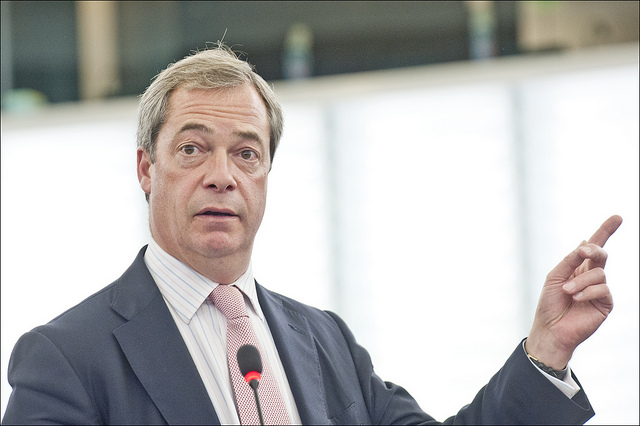
Nigel Farage, leader of UKIP. Image courtesy of European Parliament/Flickr © 2013, some rights reserved.
Neoliberalism
Neoliberalism is based on Friedrich Hayek’s free market, a trickle-down utopia of competitive capitalism detailed in The Road to Serfdom. Also it embraces Ayn Rand’s Objectivism, a philosophy of personal values that compliments Hayek with freedom of expression with individual responsibility. These are both well documented ideals and championed by the Anglo-American leaders of the eighties giving rise to the sub-genres of Thatcherism and Reganomics. It is a consensus of ideas promoting small government, low taxes, privatisation, deregulation and trade liberalisation. From multinational brands to banking and civil liberties neoliberalism is intertwined with our lives. The UKIP business suits are evangelical neoliberals. Farage, the former financier, proclaims the Iron Lady as his heroine. This makes UKIP’s accusations, that the EU threatens sovereignty, seem strange when neoliberalism has been undermining nations’ autonomy for decades through globalisation. Open borders have domestic benefits but a transient minority with resources can easily exploit this system.
It is simply not an equal playing field when local small businesses have to compete with tax evading multinationals. The illusion of meritocracy is revealed as inequality rises and social mobility falls. UKIP’s anti-EU argument would at least be consistent if it was carried over to the other neoliberal global institutions which wield more combined power than Farage’s continental nemesis. The undemocratic governance of the EU is replicated internationally. Can anyone remember having a say in the G20? the G7? Or seeing the International Monetary Fund (IMF) choose its board? Meanwhile the World Trade Organisation (WTO) oversees secretive trade talks of the Trans-Pacific Partnership (TPP) deal involving, among others, the collective economic might of East Asia, Australia and the US. This pact is very similar to TTIP in that it favours big business over citizens. UKIP appear to want Commonwealth trade to replace EU trade and the TPP and TTIP terms which the party haven’t criticised could mean the public lose out.
The talks aim is the harmonisation of rules and regulations governing trade between regions to reduce tariffs and streamline transactions. This could create more jobs but there are caveats – namely that corporations would be able to sue governments if they impede their entreprise. It is a clause formulated by the European Commission bureaucrats, yet UKIP haven’t even mentioned it. The roster of beneficiaries lobbying for TTIP includes multinationals Monsanto, American Tobacco, IBM, BP, Deutsche Bank and Nasdaq. So UKIP attack European bureaucrats when they undermine Britons but are not as concerned about non-domiciled predatory big business. This does not appear to fit the bullish British under-dog image Farage keeps pedalling.
Media
Concurrently, the globalised mainstream media, with close relationships to neoliberal elites, fail to challenge UKIP’s free market economics because they subscribe to it. Instead they focus on UKIP’s gaffes and their visceral anti-immigration argument. An informed debate should include the undemocratic ‘soft’ market power of the EU and beyond. The media as usual plays its neoliberal game. There’s barely any discussion of TTIP or the EU’s privatising agenda. The latter is something UKIP voters don’t always support, putting them in agreement with the EU-sceptic left.
If the media were doing their job correctly, a credible attack on UKIP’s economics would allow us to have a debate on the neoliberal orthodoxy of the major parties. However, as it stands, UKIP and the mainstream media perpetuate similar versions of the status quo that gave us the Great Recession by picking and choosing their micro-arguments.
Ultimately we have the choice between the socially-liberal-austerity-imposing-European-juggernaut that override any chance of a challenge to boom and bust capitalism, or those who actually mock-threaten this broken system with more of the same, adding a sinister social conservativism. A third way of a democratic EU promoting bottom-up sustainable economics with a fairer competition goes begging. These European elections are a complicated mix of national, regional and global debates but we can’t study the neoliberal orthodoxy on any national curriculum or understand it by watching the news. That is perhaps the greatest democratic threat of all.





