
“Anybody with real combat experience understands that torture is counterproductive.”
– F. Andy Messing, retired major U.S. Special Forces and director of the National Defence Council
———————-
Since the prison opened on January 11, 2002, 779 prisoners have been held at Guantanamo. In total 8 detainees have died, 6 have committed suicide and 2 have reportedly died due to natural causes.At least 12 children under the age of 18 are being held at Guantanamo, of the 779 detainees, and roughly 600 innocent detainees have been released without charge after having spent years undergoing traumatic mental abuse.
Officially, a total of 84 detainees are currently on Hunger Strike, while according to some Detainee Lawyers, all 166 inmates are refusing food. In 2005 Amnesty International compared Guantanamo to Soviet forced labour camp systems during the Stalin era, calling it ‘ The Gulag of our times’. 110 of these prisoners have been released under President Obama’s administration.
In August 2013, following a promise to resume releasing prisoners that President Obama made in May and after the majority of the remaining prisoners had embarked on a hunger strike to remind the world of their plight, two Algerians were cleared for release in January 2010 by the inter-agency Guantánamo Review Task Force that President Obama established when he took office in January 2009. In December 2013 two more Algerians were repatriated – although these two men didn’t want to go home – and two Saudis were released.
The Defence department announced 31 December 2014 that five more prisoners will also be transferred out of Guantanamo Bay to another nation, in the latest step by the Obama administration to whittle down the prisoner population in the pursuit of ultimately closing down the camp. After four Yemenis and a Tunisian were given new homes in Georgia and Slovakia, and a Saudi was repatriated, defence officials “said there would be more transfers in December, but declined to detail their numbers or nationalities.” Nearly 30 prisoners have been resettled in third countries this year as part of Obama’s renewed push to close the detention centre over opposition from Congress. The Journal cited an unnamed senior administration official who said Obama is ‘unwavering in his commitment’ to closing the prison, and wants options for a coming day when he lays out his presidential legacy.
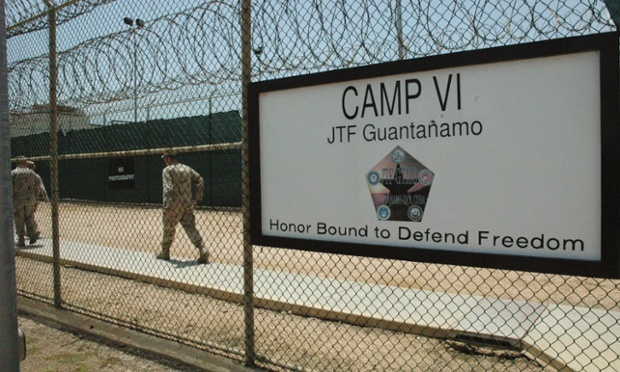
Image Source: http://www.theguardian.com/us-news/guantanamo-bay
Yet Obama would face a fire-storm of angry lawmakers if he were to hamstring the Pentagon by vetoing the entire bill over that provision. He would also risk disapproval from the Supreme Court, and a relentless public backlash – especially from Americans in states with prisons that could house transferred detainees – if he chose to ignore Congress’ restraints and do it anyway. Congress bans the transfer of Guantanamo detainees to the U.S. each year when it sends the National Defence Authorization Act to the president for his signature. It costs the Pentagon $2.7 million per year to keep each inmate at Guantanamo. The comparable annual cost for housing a prisoner at a Supermax prison in the U.S. is just $78,000.
The Wall Street Journal noted that officials told them that senior White House officials “are growing impatient as the clock ticks down on the Obama administration and the president’s promise of closing Guantanamo remains unfulfilled.” This is despite an increase in the release of prisoners since a major speech on national security issues last May, and a promise to resume releasing prisoners that we are monitoring here, at the Guantanamo Clock website.
Even in the face of a Republican Congress, there are some points of leverage for the Obama administration.The pursuit of closing down the camp may be due to the exceptionally high cost of running a prison. The number crunching statistics provided by Laura Pitter of Human Rights Watch explained, it currently costs around $3 million a year per prisoner to hold the 142 men still held, compared to a fraction of that cost on the U.S. mainland – plus, of course, 73 of these men have been approved for transfer, and yet are still being held, at a cost of nearly $220 million a year.
There are now 74 prisoners at Guantanamo cleared and awaiting resettlement. 36 have been designated for detention without charge. There are also 23 slated for prosecution and ten either facing trial by military commission or have been convicted or sentenced.The administration plans to “significantly reduce” the camp’s population over the next six months by transferring prisoners out. Officials reportedly are hoping other nations will accept the roughly 60 prisoners approved for transfer.
About the Author





