
A few weeks ago, reports emerged that North Korea had publicly executed around 80 people. Their crime; watching South Korean film and television shows. In a nation where public executions are not unknown, and punishments for minor infractions are severe, this appears at first glance to come as little surprise. However, the ferocity of the punishment for what the vast majority of us would not even deem a crime is particularly indicative of the mentality of the North Korean regime. It evidently is terrified of what the consequences are if its populace is exposed to external influence.
To put this into context, it must be stated what it is like to be born and live in North Korea. From the moment a person arrives into the world, they are insidiously indoctrinated into believing in the immutable supremacy of the state, that the ‘dear leader’ is a godlike figure, where countries on the outside are a negative force, and that an unswerving allegiance is required. Up until recently, finding out what was going on in the outside world was next to impossible, and the people readily accepted what the government propaganda spewed out, unaware of the what was going on beyond their borders. It is a situation that the late Christopher Hitchens, amongst others, compared to Orwell’s 1984. Coupled with this, those that did and do raise a dissenting voice are punished, along with their families who are often completely innocent, in a most severe manner. Often this will mean being sent to a concentration, labour, or re-education camp. It is a system that is at its very heart, one of oppression and absolute control.
These bits of information that are slowly finding their way into the country, undermine the stranglehold on the populace. As the report just linked indicates, the distribution of South Korean television programs sparks a change in the minds of the North Korean citizens, who have since birth, been subjected to brainwashing endeavours of the Kim family’s regime. It is therefore understandable why the government has cracked down, and will likely continue to do so in this way. Having built up this system of control for decades where the population is extremely docile and conforms to the party line. The influx of information that does not fit into their strictly determined ideology will be of deep concern to the regime.
Indeed, this precise fear was explicitly discussed in a recent broadcast of Dispatches; moreover, the fact that around 1 in 2 people in North Korea have seen a foreign film or television show (if this statement is to be believed) will not make it any easier for the regime to tighten or continue to hold its iron clad grip on its denizens. Again, as the programme notes, this appears to be happening, people are beginning to defy or confront the authorities. Whilst these are just a few instances that have been recorded, it nonetheless illustrates that there is a very tangible spark of resistance emerging in the population. Couple this with the ever increasing number of people gaining access to foreign media, it is not a stretch of the imagination to state that many peoples’ minds are slowly being opened, and that their feelings toward the North Korean government will be less than favourable. In fact, a Rand Corporation study, published in early September of this year, confirms much of this, expressing that
Now, it must be noted that Kim Jong-Il is of course not the current leader, his son took the reins of power two years ago. But it clearly shows that dissatisfaction has been brewing for quite a number of years. Moreover, a survey published in the aforementioned Rand study showed an increasing disillusionment with the regime, and that the government propaganda was being undermined.
It does therefore appear that the North Korea regime is perhaps a slowly sinking ship. With the population becoming aware of the outside world, antagonism mounting, and questioning the ideology of the government, there appears little that the regime can actually do. As so many of its people have heard information contrary to what they have been served for decades, and the supply of foreign media being constant, it is almost as if an incurable pandemic has swept the population. But can the state weather this? One of the central thesis of the Rand study that I have referred to was that the collapse was possible within the near future, with the influx of external influence being one factor amongst others in this possible eventuality.
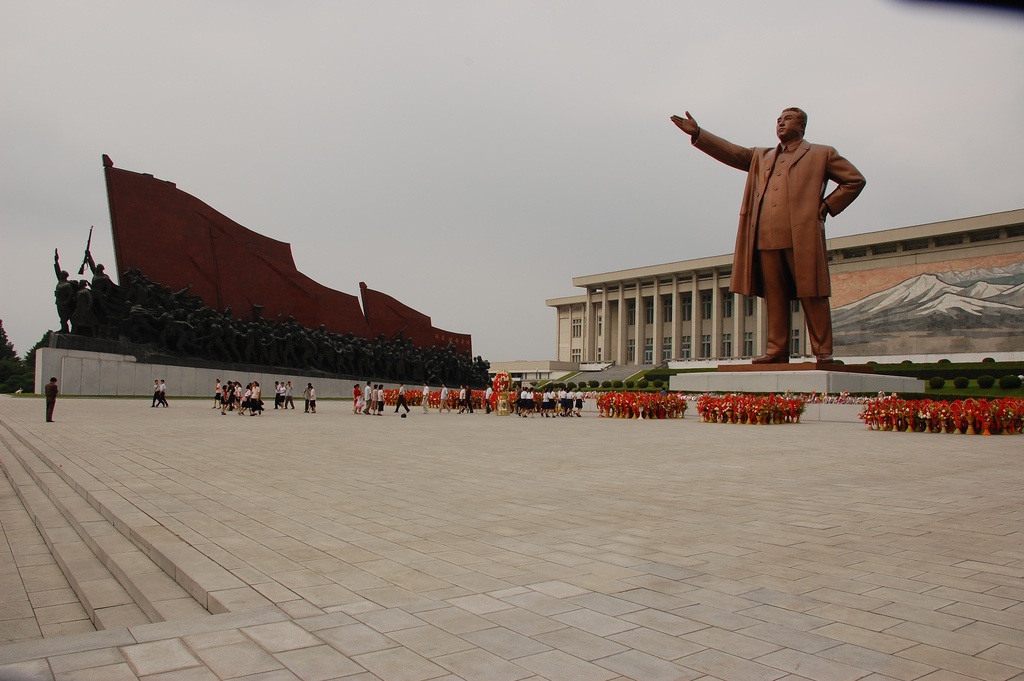
North Korea, Pyongyang. Image credit: (stephan)
Conversely, it has been argued that the regime is not on the verge of ceasing to exist; an article for the UCLA International Institute, postulated that it could in fact endure for a while longer, having survived the collapse of the Soviet Empire and its Warsaw Pact allies, it continues to exist as a political entity on the contemporary world. The reason for this being was said to be down to the North Korean ideology that was and is different from the other communist states. In similar fashion, The Atlantic, is also skeptical of the proposed near future collapse, recalling that the same sentiments were espoused throughout the 1990s in the wake of famine and the previously discussed collapse of communism. So in spite of the current situation, history shows that there is a distinct possibility that the regime may well maintain its domination of the people.
However, this is arguably not entirely convincing. The situation, I believe, is different. Firstly, the access to cheap technology was not feasible in the early 1990s. The laptops, USB flash drives, and DVD players were in their infancy, often being bulky, heavy and designed for office work. Now with this technology being incredibly cheap, distribution is arguably of considerable ease in relation to that of almost two decades ago as is sharing it. Secondly, a huge portion of the population has seen this information, it is highly unlikely that the populace had discovered this much about the outside world when the same predictions were made back then. And finally, the spread of dissent towards the government is perhaps another indicator that the situation is markedly different this time. Nonetheless, the extinction of the regime is not something that I would see happening instantly. It will take a bit of time for information to disseminate around the populace. But that the regime will last for another 20 years is hard to believe, the current state of affairs appear to be much different from that of previous decades. But of course, anything is possible
About the Author





