
What do miniskirts, booty shorts and low rise jeans have in common with rape? With the uproar that arose in India and the region, following the Delhi Gang Rape, which drew the kind of attention that issues of rape and sexual violence do not generally receive in this part of the world; also gave rise to a classic victim-blaming style counter-movement that propounded that women, by way of dressing in a certain way, or staying out past a certain time at night etc.. incite the sexual violence brought upon them. I took to the streets in Colombo, Sri Lanka, on a sunny Friday afternoon to ask the passers by what they felt.
Thennakoon (39) is a security guard at a state-run corporation adjacent to the Independence Square in Colombo. He agrees that it’s easier being a man in this society than otherwise, but doesn’t understand why women choose to wear revealing and ‘provoking’ dresses.
“I would understand if there was a shortage of fabric. But there is no such shortage. A woman should know how to dress in a decent manner. Yesterday there was an event at this office and some women were wearing disgusting clothes. Men have feelings too. So, women need to take necessary precautions.”
We thanked Thennakoon and walked along the path leading to Independence Square when we met Soorya (short for Sooryalakshmi). She was 47 but the wrinkles on her face made her seem at least 60. She worked for the Colombo Municipal Council cleaning staff. Soorya thinks it’s much difficult being a woman in today’s world. “We have to work in the kitchen, do the washing and cleaning and also find money for the family”. But she added that women should ensure their own security, to this end, she said, women should not dress in a way that might provoke a man.
Walking along the lawn at Independence Square we met Dharshana, Pradeep and Ranjan. They were seated on the grass in a circle and were going through some notes. The trio were 3rd year students of the Faculty of Science at the University of Colombo. Ranjan explained that they were preparing for a presentation scheduled for later that afternoon. Apologizing for intruding, we posed our question to them. They all felt that even though certain instances of abuse exist, the situation of women in general has vastly improved. ‘Today in a lot of fields women are competing with men in an equal footing” said Pradeep. Dharshana felt that wearing short dresses has made some men feel “those women are like prostitutes”. He added that Sri Lanka is a country with a proud history and culture and our women should dress accordingly. Pradeep nodded in approval. Ranjan, however, seemed to differ, he said “fashion evolves with time and women should be given the same freedoms as men. Whatever the way women choose to dress maybe, men should control their emotions.” Dharshana, Pradeep and Ranjan stay in the same hostel and take the same classes in university, but the way Ranjan looked at the issue was different to his friends’ views.
Walking along Independence Avenue, we met Mr. Priyantha, hurriedly walking from one office building to another with a large stack of files with the state emblem. He worked at a government department located along the road. He felt that women today have a much better place in society than men. “Even in our department, women have a much better place than men. Sometimes women get jobs simply because they are women.” When we questioned him as to why then issues such as sexual harassment of women still exist in our society he said “it’s all the woman’s fault. They wear short dresses and arouse men’s feelings. Be honest, son, when a good looking girl is wearing short stuff like that wouldn’t you will feel like turning to take a second look?” We told him, that doesn’t mean we can rape someone. But he went on “my mother didn’t even put her washed clothes out in the garden to dry up. That’s how women those days were”. There was a slight sense of condescension in his voice as he concluding by saying “but women these days are too much”.
Sujith (43) is a trishaw driver. You’d see his red and brown Bajaj parked adjacent to a popular night club in Colombo city. Sujith finds it appalling that sexual abuse still takes place in our society. He thinks that rape is unacceptable and that skirts are not the problem. He believes that “as times are changing new fashions come up and kids like to keep up with these trends”. He sees nothing wrong with this. In fact he believes that is short skirts are banned, rape ‘cases’ may even increase as men who get some kind of pleasure by seeing women in these dresses may get even more deprived and frustrated! Impressed by the ‘tuk tuk wisdom’ Sujith enlightened us with; we thanked him and walked towards the University of Colombo.
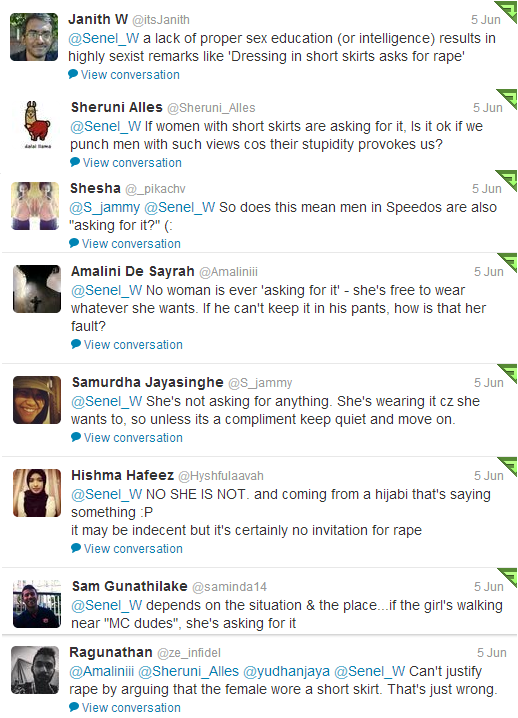
Answers to Senel’s question on Twitter on rape and short skirts.
Chathuni, an undergraduate following double degrees in Economics and Law thinks “that short or otherwise, revealing clothes invite rape is neither fair by men nor women. It makes men appear incapable or controlling themselves and recognizing that there is more to a woman than appearance. And upon women it places both the burden of guarding against harassment and that failing, of being society’s derision.” She ended with this question “if rape is wrong, why is the rape of a woman in a short skirt less tragic than one in saree”. With that, my friend Kumudithe and I ended our interviews for the day with the scorching Colombo sun right above our heads.
That evening, at a Youth Parliament meeting, I met Stephanie Siriwardena who won the Miss Sri Lanka contest in 2011. Stephanie, who is also quite an activist, thinks “we are asking the wrong question. We tend to focus on the shortness of the dress rather than focus on the shallowness of intention in men perpetrating these crimes.” I also spoke to Shahidar (23). Shahidaar who is also a very passionate activist, has been a hijabi most of her life. She said “each man is responsible for his or her own behaviour. Although I think a short skirt will desensitise a man’s reaction towards a woman, her rights cannot be violated. A short skirt is not an excuse to satisfy carnal desires. In Islam, a man’s hijab is to lower his glance and to avoid looking at the opposite sex deliberately.”
The stereotypical sequences of events that lead to rape are often the same. A woman is walking down a dark alley, by herself, in a short dress. But facts show, that often the situation is much more complex: more often than not, perpetrators are not strangers but people very close to the victim. Rape sometimes occurs in broad daylight and often victims are not supposedly ‘attractive’ women clad in ‘provoking’ clothes. We’ve seen and heard of instances when the victims were older women: sometimes grandmothers in their late 70s and 80s, and sometimes pre-puberty children as young as five or six. These old women and kids have clearly not worn ‘provoking’ dresses.
But that is all beside the point, drunk, alone at night or wearing a short skirt: rape is never the victim’s fault. City planning is not only about fancy jogging tracks and upmarket restaurants; it’s also about making our cities safer for our women and girls. Perhaps the greatest need of the day is a change of attitudes about how we look at these issues. The condescension in Priyantha’s voice when he said ‘women these days are too much’, how Darshana feels like men view women is short dresses as ‘prostitutes’; these people have been socialized into holding these opinions. It is the responsibility of the state and civil society to catalyse a change of mind-sets so as to look at the real issues without blaming innocents.
Some names have been changed.
About the Author






the world is full of contrasts…the people who consider that women dressing in a certain presumably provocative way are “asking for it”, do they realize that in this same world nude beaches exist and if we were to follow this myopic view then all nude beaches should be a rape-all zone…yet they are not.
Its not about what women wear or don’t wear…rape is reflection onto the barbaric violence loving screwed up mentality of the rapist…look at Arab countries in comparison…they cover their women from head to toe and forbid them to go out un-chaperoned yet still violent cases of raping happen…even there!
It is certainly men’s fault who rape. But think you are carrying a transparent bag full of dollars. The miscreants must take a chance to grab it. It is not the fault of the owner of the dollars. It is all miscreant’s fault. So should we all carry money in transparent bags to prove ourselves rich? Anyway snatching always happen without bringing money in transparent bags. Can we say that? Why does America does not let Iran a nuclear weapon? Is it not their right? Should we carry valuable things secretly or with guard? Why? Because not all people are good. If all people are good, we do not need guards, do not need police, do not need judges. Now come to the point. We give example of see beaches. If we have easy access to opposite sex it is fine. Then what happens if there is no easy access. For Arabs who are sex violent, must be criminals. They should be punished. But there is more sex across the non Muslim countries. See the statistics in Wikipedia. Sex is available in the USA. But they have the highest rape rate. Now consider two women. We are not talking about good men. Those good men must not look to a girl who wears or not a short or full dress. But what about bad men? let think of two girls walking one after another. One wearing short dress and one wearing hi jab. Who will attract a miscreant? It is the very truth that you cannot make every men good. but it is our duty or it all we want that we get protected. So decent dress gives girls a protection more or less.
Sexual abuse, harassment and rape happen everywhere, regardless of culture, regardless of faith, and certainly regardless of whether a woman is wearing a short skirt or covered from head to foot. It’s no longer a question of whether a woman is asking for it if she is attacked when wearing a short skirt, the questions need to be directed at the men who do such things, not the victim involved. It’s no longer an issue of should women dress appropriately but looking at why are men committing such acts. Lets not ourselves be setting questions which immediately lay blame on the victim.
I don’t think whoever says that “revealing clothing leads to rape” realises the psychological process of rapists. They’re interested in the body underneath, not the clothes the girl/woman is wearing. Women get raped in burqas, overcoats, jeans, skirts, hotpants, suits and everything else. Men are not going to decide to spontaneously rape a woman based on what she’s wearing, and it’s ignorant to suggest totherwise! Good article
[…] Related: On Rape, Short Skirts & Patriarchy: Are Women Wearing Short Skirts ‘Asking For It’? […]