
The Royal Thai Army has imposed martial law in Thailand in a bid to end violence and the political conflict which has gripped the nation since last year. But army officials are insisting that their intervention is not a coup. Further, they are inviting leaders of warring political forces to talk and resolve the political crisis.
Martial law was declared a few weeks after Thaksin’s younger sister, Prime Minister Yingluck Shinawatra, was removed from office by the Constitutional Court.
The opposition, which has been organizing provocative street protests since November, has accused Thaksin’s family of being guilty of corruption and abuse of power. Believing that the electoral process is tainted by Thaksin’s influence, the opposition is demanding the appointment of an unelected People’s Council to implement political reforms. On the other hand, Thaksin’s party supports the holding of a new election either in July or August to end the political impasse.
Invoking threats to national security, and to prevent more bloodshed, the military decided to intervene by declaring martial law.
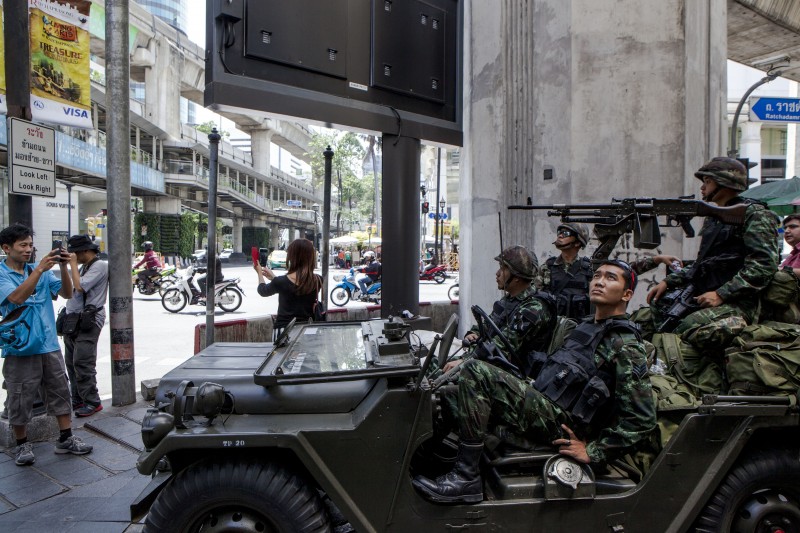
The Royal Thai Army declares martial law across the crisis-gripped kingdom and tells the nation not to panic as the announcement is meant to restore order. Photo by Vinai Dithajohn, Copyright @Demotix (5/20/2014)
Keep Calm. This is not a coup.
The army assured the public that government operations will remain normal. It asserted that the Constitution and the civilian government are still functioning. What it installed is the Peace and Order Maintaining Command whose primary task is to ensure the security of Thai citizens and the state.
Foreign analysts have described the military action as a half-coup and a soft-coup. But is it really not a coup? Isriya Paireepairit is certain that it is military intervention:
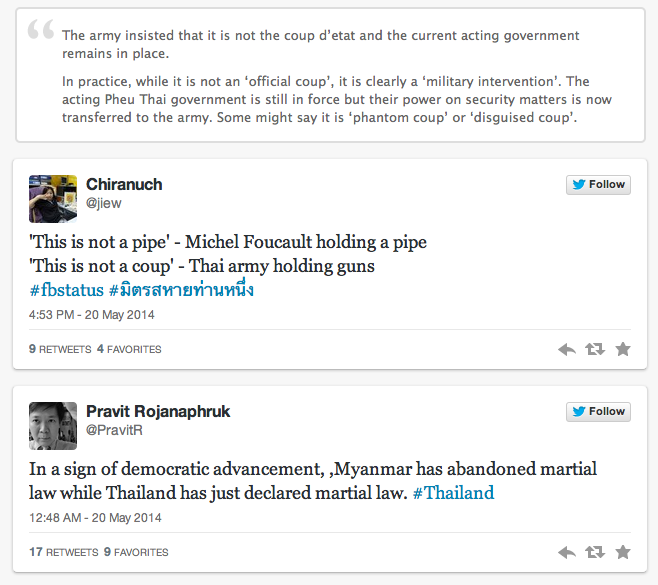
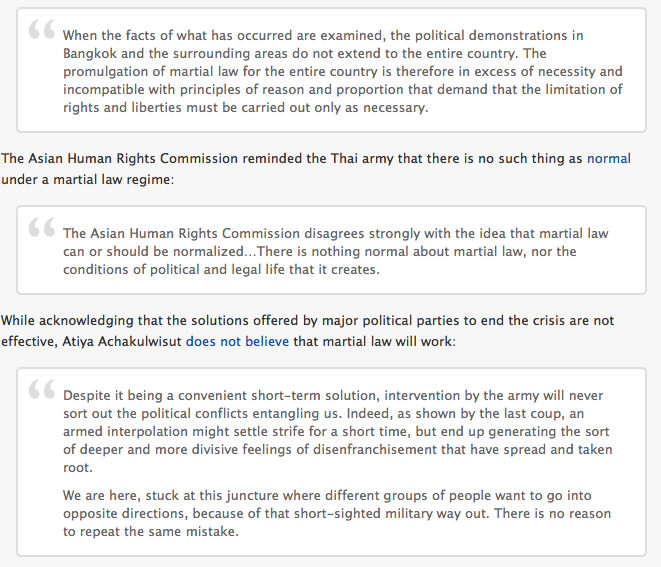
For a group of university scholars called Nitirat or Enlightened Jurists, the martial law declaration is unnecessary since the government can use emergency measures without the need of giving broad powers to the military:
Media Censorship
Thailand’s martial law, which dates back since 1914, gives the military the power to control the press. And this was what the army did today when it ordered 14 TV stations and local radio stations to either shut down or broadcast army statements. The army said it is asking for “cooperations” not to air political matters
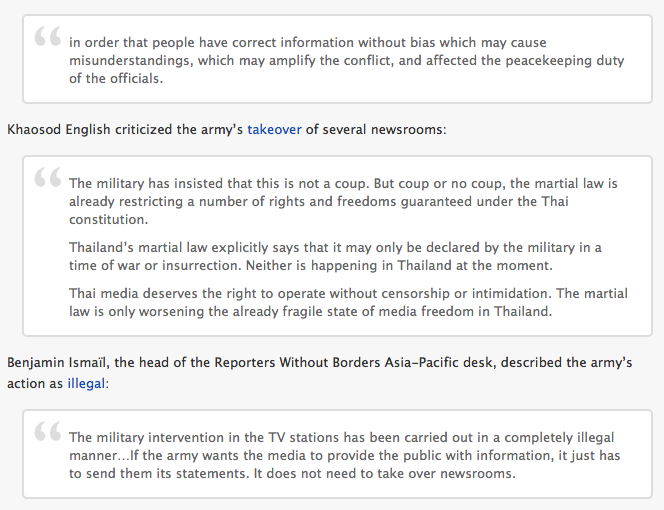
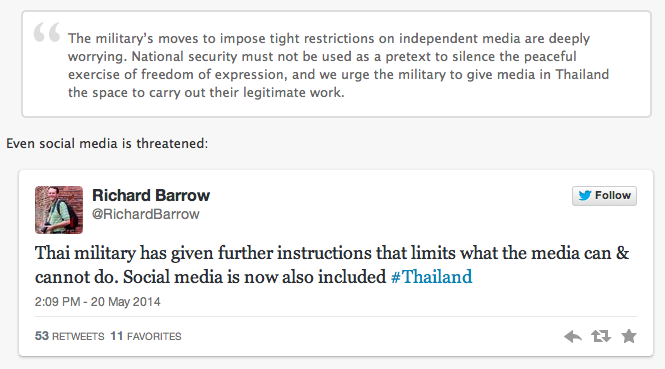
Richard Bennett, Amnesty International’s Asia Director, urged the army to respect the independence of media:
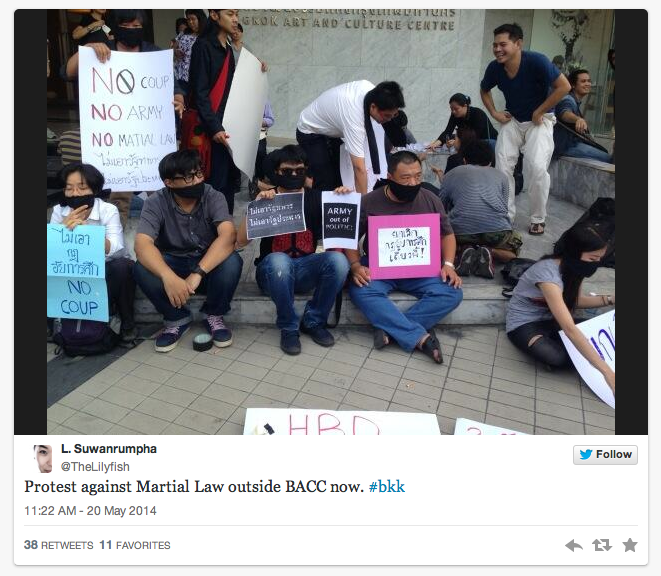
Anti-Martial law protest
Protests were organized urging the army to return to the barracks and to revoke the martial law declaration. Meanwhile, the opposition-backed protesters have vowed to hold bigger rallies in the next few days to force the removal of the civilian government.
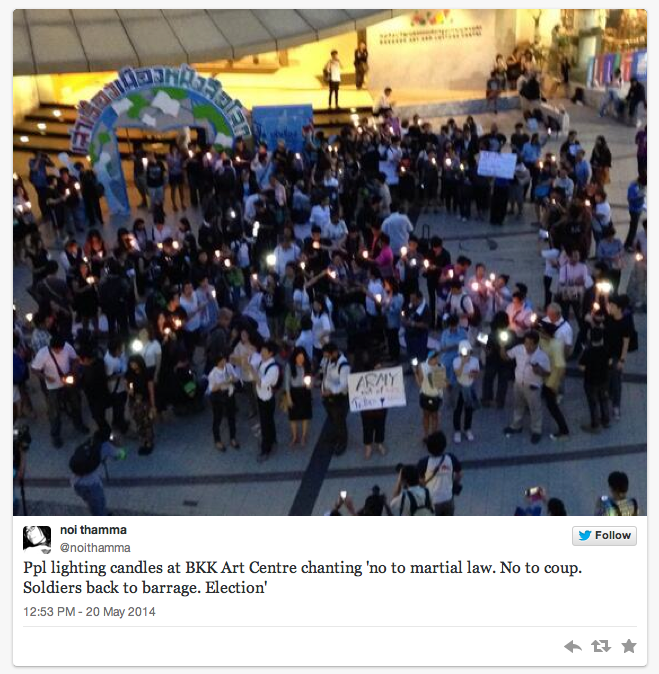
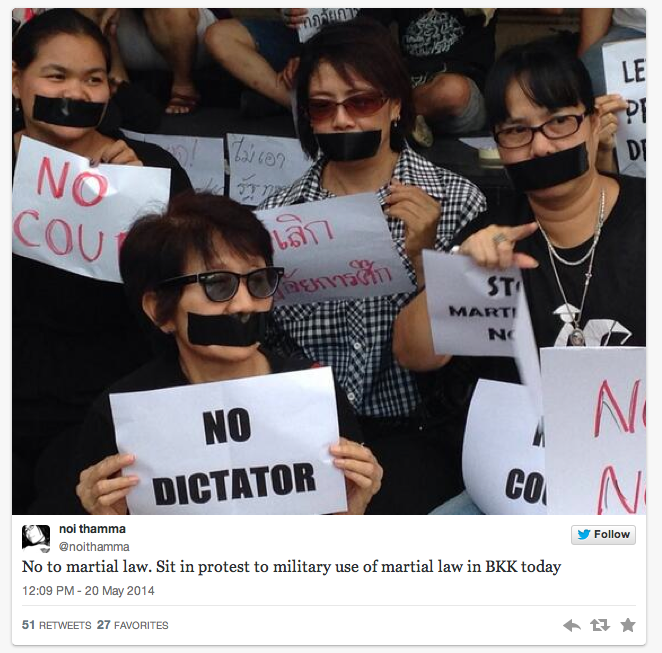
Coup in the time of social media
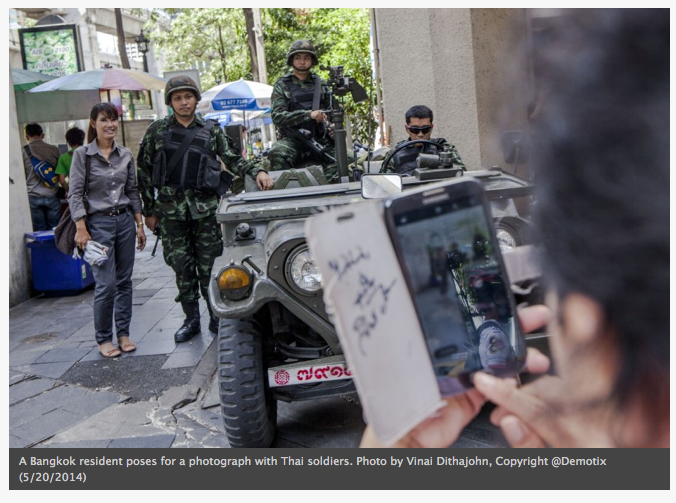
Curiously, many Thai citizens snapped selfie photos with soldiers deployed in Bangkok, the country’s capital. Coconuts Bangkok made this observation:
This article was originally published on Global Voices.
About the Author





