
A group of young Palestinian activists have sledgehammered a hole into a separation barrier between the West Bank and Israel to mark 25 years since the collapse of the Berlin Wall.
According to Palestine’s Ma’an news agency, the activists knocked out a hole in the barrier near north-west Jerusalem in an act of protest against Israeli occupation. In a statement on Saturday, the activists said:
“No matter how high walls are built, they will fall. Just as the Berlin Wall fell, the wall in Palestine will fall, along with the occupation.”
Their protests follow weeks of clashes around al-Aqsa mosque in East Jerusalem, Islam’s third holiest site and the former location of the Jewish holy Second Temple.
In footage filmed by Palestinian TV, the activists called upon people to take part in the ‘Intifada of Jerusalem’. They claim the destruction of the barrier, which is referred to by Palestinians as ‘the apartheid wall’, is a symbolic gesture for “the final, fateful intifada to liberate Palestine.”
“The separation barrier exemplifies apartheid in modern times. We will continue with our activities against the expansion of settlements and the construction of the barrier until it is removed,” a masked activist told Andalou agency.
The Israeli government began constructing the wall in 2002. When complete, 85% of the wall is projected to be within the West Bank. They claim that it serves a vital defence role, and has massively decreased incidences of violence.
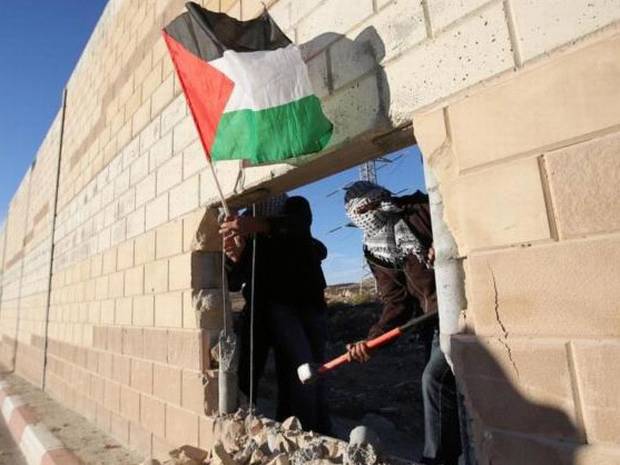
Image Credit: The Independent
The International Court of Justice, however, says that “the construction of the wall, and its associated regime, are contrary to international law”.
The separation wall is now five times longer than the Berlin Wall and twice as high. Many believe that, unlike the Berlin Wall, it is not likely to fall anytime soon.
About the Author





