
With the UK General Elections coming up soon, there’s a lot of talk about who to vote for. Will the Tories be given a second chance or will Labour steal the show? Or will the Lib Dems manage to win trust back off the public? Unfortunately, for most young Londoners, the topic of politics remains a foreign concept. While most don’t know which party to trust, others are simply unaware and unwilling to learn very much about these politicians who constantly seem to be letting us down.
One organisation is now attempting to change that. Bite the Ballot wants to repair the relationship between politics and young people in Britain, and is hoping to do so in time for the General Elections. In an attempt to find out more about this relationship, I spoke to Michael Sani, chairman of Bite the Ballot.
What is Bite the Ballot?
Bite the Ballot started in 2010 at a school in Dartford by two teachers, David Hughesman and Michael Sani, who were passionate about politics and realised that young people weren’t as politically involved as they should be. It seemed obvious to David and Michael that something had gone wrong.
Based on what they had seen, the pair put together a group of young people who started going out into Dartford with a camera and asking candidates what they were doing to engage young people. With the group actively pushing their peers to get more involved in politics, word spread about what the group were trying to do and they secured a spot on LBC radio to talk about their cause. After the LBC interview, they were offered various opportunities in lots of different areas to come and promote what they were campaigning for: to get as many young people as possible on the electoral register for the 2015 General Election.
‘I think it was after the General Election (2010) and after these guys had voted for the first time, we sat there one day and said, “We can stay comfortable and we can remain in Dartford, or we roll the dice and we go for it.” And we’ve gone for it.’
How did the campaign progress from there?
‘The first big action point was to go to the heart of the people who make the decisions,’ explains Michael.
Michael and his team began applying for the three main party conferences. Having missed the Labour deadline and being charged 250 pounds per head to attend the Conservative conference, they turned to the Liberal Democrats, who allowed them to attend the conference for free. This conference was the campaign’s first taste of networking with the MPs, the counsellors and the Lords.
‘It was just fantastic,’ says Michael. ‘We were there for 3 days and we met Nick Clegg in the foyer and talked to him and there was a real buzz. We met some fantastic people. We left the Liverpool conference with round about 25-26 business cards, emailed them that very same day when we got home, and the next day we had a phone call from Lord Roberts of London.’
It was that phone call from Lord Robers that got Bite the Ballot their first invite to Parliament and started off the campaign’s series of Parliament student debates. The first student debate saw 80 young people debating passionately about issues that affect them and questioning the decision makers, with a couple of Lords and MPs there to watch the debate. Having escalated from there, Bite the Ballot now has a great presence within Westminister. They have been in contact with some really influential MPs and Lords who have supported their cause in an amazing way.
Now, the campaign is focusing their efforts on the London election, hoping to get as many young voters registered as they possibly can. By using these London elections as a sort of trial run for the General Election, Bite the Ballot hopes to see many more young people on the electoral register in 2015, with the opportunity to go and vote or at least abstain so that they make their voices heard, rather than remaining as the “silent generation.”
Why should the youth become engaged?
Peter Lesniak, Director of Communications at Bite the Ballot, told me of a young MP who once said to them, ‘Young people have more important things to worry about than getting involved.’
‘What’s more important than participation in democracy?’ asks Peter. ‘Surely it’s healthier for democracy if everyone starts to play a role and if everyone understood right down to the consequences of some of our actions.’
At one of the Parliament student debates after the London riots, a young man very honestly said that the reason he smashed things up during the riots was because he knew it would cost the government money. At his comment, a young girl turned to him and remarked, ‘You mean it would cost us money because it’s our taxes that they’re going to use to rebuild things.’
‘He just glazed over’, says Michael. ‘But he doesn’t know because we don’t talk about it in school. I think it’s time to change. With the frustrations and with the coalition and with these hard economic times, it’s an opportunity for everyone to think, “There’s a lot of things that affect me. It’s time for me to start getting involved, it’s time for me to process the information I want to process and offer my opinions.”
Involvement with the everyday young person:
Bite the Ballot frequently visits schools and colleges and run events that aim to educate the students about voting procedures and the way politics works.
They have held Registration Rallies at 6th Form schools where they managed to get loads of young people on to the electoral register, with three quarters of the students not knowing what it was prior to the event.
They also held an event at a school that took the form of a referendum. On the day, Bite the Ballot taught 668 people how to vote by setting up a polling station and showing people how it works when you’re eligible to vote and the local or general election comes up.
When the tuition fees rose, the campaign held a student debate in Parliament, where Nick Clegg was present to listen to some of the concerns young people had regarding the issue. Simon Hughes was a guest speaker at that event and made it clear what happens if you go into Higher Education and how exactly these changes affect the youth. A lot of young people then left that debate feeling relieved and much more positive about going to university.
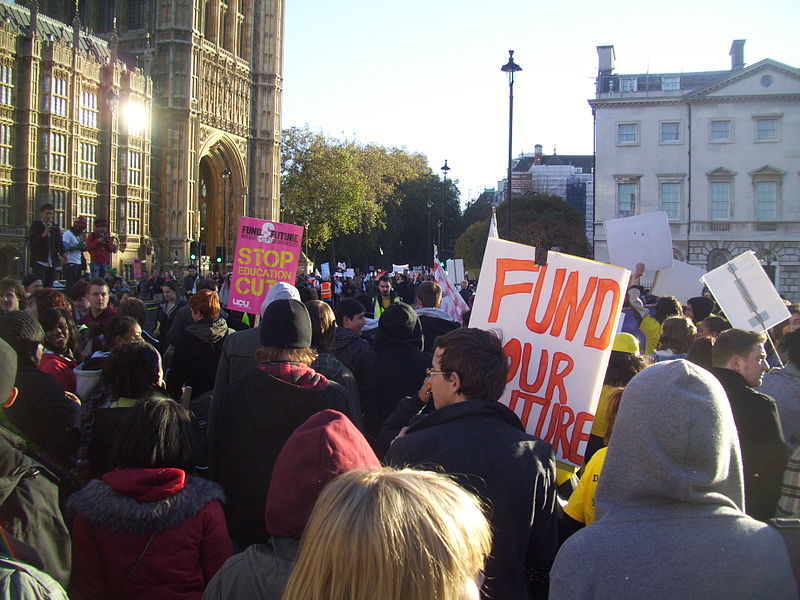
Student demonstrators march past the London Houses of Parliament in opposition to planned spending cuts to further education and an increase in tuition fees, November 2010. Image credit: BillyH
Bite the Ballot was also invited by the Cabinet Office to go in and talk about the change in going from the Annual Canvass to the Individual Electoral Registration. They were one of five organisations invited on the day to discuss how it would affect specific target groups, with Bite the Ballot there to represent young people. They have been back since then and have been speaking with the people who are calling the shots, showing young people that becoming involved with Bite the Ballot is not just about attending an event, but that the campaign is actually taking your suggestions and acting as the bridge between Parliament and the everyday young person.
Other projects: My Manifesto
Funded by the Joseph Rowntree Reform Trust, My Manifesto will see members of Bite the Ballot tour the UK and speak to young people in different areas about what issues they would want to see put on party manifestoes. The tour will see many of the younger members of Bite the Ballot visit rural, urban and city areas to make sure the youth in every corner of the country have a say.
‘It’s predominantly the youngsters that come with us,’ says Michael. ‘They’re the ones that can talk to each other, which is the real core of Bite the Ballot. The message comes from someone that you would normally talk to anyway, rather than someone that you can’t relate to.’
At the end of the tour, a report is going to be produced with some of the key issues that the youth of Britain would like to see brought to the manifestoes. By visiting all parts of the UK, Bite the Ballot hope to show MPs that they have young voters on the electoral register from every part of the country and hope to make them realise that these young people are now a vote worth winning. Once that has been achieved, MPs will ensure that they are taking into considering what the youth want and will turn to the Bite the Ballot’s report to make sure they have something on their party manifesto to make these young people want to vote for them.
Through Bite the Ballot’s network within Parliament, they were able to speak to the main manifesto writers who have agreed to look at the report produced at the end of the project and consider the issues that have been brought up by young people.
‘There’s every chance that Bite the Ballot is going to give young people something to vote for in 2015,’ says Michael.
![BTB Parliament Student Debate: Welfare State March 12 [Source: Bite the Ballot]](http://archive.the-ipf.com/wp-content/uploads/2013/10/btb-welfare-state-photo-march-12.jpg)
BTB Parliament Student Debate: Welfare State March 12
[Source: Bite the Ballot]
Do Bite the Ballot work with similar organisations like UK Youth Parliament?
‘We very much invite everyone to join together to do this because our biggest aim is to have the biggest turn out of young people voting in the 2015 General Election,’ says Michael.
He explains that when Bite the Ballot first started out, organisations like UK Youth Parliament were hesitant to get involved with the idea that another group like them didn’t need to exist when they were already doing the job.
‘No one organisation can turn around and say that they will be the reason young people vote,’ Michael explains. ‘There doesn’t need to be competition, it should just be one working together. If everyone interested in that happening comes together, you’ve got a chance. So we’re doing our bit, this is what we do, we want to work with the everyday young people, and when there’s chance for collaboration; let’s do it.
Are Bite the Ballot campaigning for a lowering of the voting age?
‘The majority of people that work in Bite the Ballot would never have a problem with the voting age coming down, but we’re just not campaigning for it at the moment,’ says Michael. ‘It needs to be rebranded before you just lower the voting age.’
While Bite the Ballot believe that there are many 16 year olds out there who are a lot more politically engaged than many 30 year olds, they want to ensure that more is done on an educational level before lowering the voting age. The campaign feels that it is important for people to leave school at 18 with an understanding of politics and what is going on.
Bite the Ballot also wants young people to realise that if they get their polling card and they don’t know who to vote for or they don’t know about the candidates’ policies, they can still go to the polling station and abstain their vote. Michael stresses that by abstaining their votes, young people are actually sending out a message that they don’t understand what is going on because no one talks to them about it.
‘That sends out a clearer message that you’re no longer the silent generation that don’t get involved, but actually 60% of young people send out this strong message that there’s no one to vote for. What a statement that would be!’
What are the difficulties Bite the Ballot faces?
While the campaign has had great coverage from the youth press, the national papers are reluctant to publish anything about it.
‘It is ridiculous really because it is something current, it is political, it is good news,’ exclaims Michael. ‘We’ve passed on the celebrity quote endorsement, but they won’t write an article about it unless that celebrity does an interview for them.’
Rather than approaching the story from the angle of a young person’s story, mainstream media has approached it from a celebrity angle, making it harder on Bite the Ballot to get much press coverage since they haven’t secured a lot of celebrity backing yet. However, they hope that between now and the event on Saturday, a couple of papers will pick up the story.
‘It’s just exciting. Everything that comes up is another challenge, but we like it,’ says Michael.
Bite the Ballot down the line:
‘I’d like to say in five years time we’ve been part of the collaborative organisations that have worked towards the biggest turn out of young voters ever in the General Election.’
Bite the Ballot then hopes to continue being the bridge between young people and politics; a place where the youth can turn to for information, to offer views and opinions, and to communicate directly with Parliament. They also hope to have more celebrity endorsements by then as a part of their aim to make politics something that is ‘cool to talk about.’
‘Sometimes you have to lure it out of some people,’ admits Michael. ‘But when they get going; wow! They want to tell you about everything that they’re bothered about and we need to create an environment where it’s easy and acceptable to do that.’
http://www.youtube.com/watch?v=mIRs3Yllvjw
How to get involved:
With Bite the Ballot on Twitter and Facebook, it isn’t difficult to speak with them and ask them questions about any doubts you may have. Use the social media as a platform to get in touch and ask them how you can find out more about a specific issue you have concerns on. Write on their Facebook wall and ask them to tell you more about the topic. Tweet at them and let them help you find out more by putting you through to the right people or finding you your answers themselves. You can also sign up to their newsletter to receive updates and links to their latest videos and interviews.
‘It just comes down to the fact that power comes in numbers. Just start talking about [politics] really. Whether you talk about it through Bite the Ballot or not, just start talking about it.’
About the Author





