
Oil & Gas Pipelines: Geopolitics in the Making
The announcement of the construction of the 1600 Km Iranian-Pakistani gas pipeline didn’t fail to create a true sensation in the world of politics, let alone in the corridors of the White House. In previous articles, I have talked endlessly about the shifting geopolitical dynamics in the Middle East and specifically in the Baluchistan Region that includes Pakistan, Iran and Afghanistan, yet the theoretical rant on the rise of the rest mainly driven by Chinese geopolitical ambitions is now crystallizing with every tube that is being laid down between Iran and Pakistan.
An unfaithful ally (Pakistan) collaborating with a declared enemy (Iran), all under the financing of the second world superpower (China) will not bring much thrust to the crippled foreign policy and strategic planning that the US is conducting overseas, and is sure to reverse the balance of power in the region. The Chinese backing of the pipeline is a clear act of defiance towards Washington, because it does not only redefines the rules of the game and establishes a new standard for approval of sensitive projects in the region, but also jeopardizes the effort of the US to tear down the Iranian economy, and bring to a halt the suspected military nuclear program the mullahs in Teheran are undertaking.
Oil and gas have long been decisive assets in determining the outcome of geopolitical games and conflicts, and their grand power in forging alliances and cementing collaboration is what threatens the very strategic scheme the US has been trying to implement in AF-PAK region. Iran has not only managed to distance Afghanistan from the US through its economic and political support of Kabul, but is now more than ever closer to breaking the US Pakistani alliance via its economic support of the Pakistani economy through the establishment of the pipeline that will provision Pakistan with an additional 4000 Megawatts of electricity. A reliant Pakistan on Iranian gas provisioning does not only ensure that Pakistan will orbit closer in the circle of Teheran, but will also kill any potential complicity of Pakistan in a future military action against Iran.
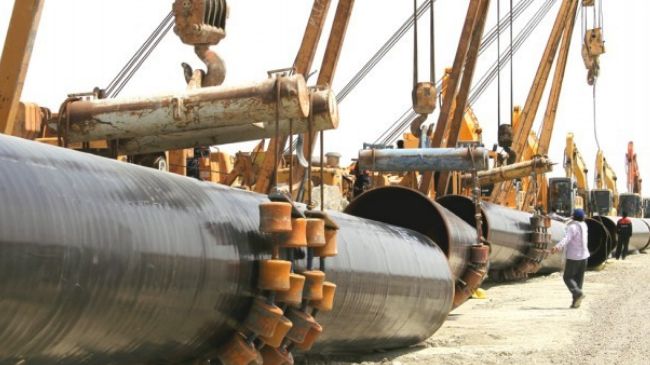
Construction workers at a site of the Iran-Pakistan (IP) gas pipeline.
The Islamic Republic of Iran, though under severe sanctions and economic embargo, is playing geopolitics way better than what analysts in the White House would have predicted, and this reinforces the fallacy of economic sanctions on Oil economies, a fallacy that proved inefficient in Iraq and is now blatantly failing with Iran. In a region where economic models are Byzantine and ailing, Iranian oil is a commodity that can ensure economic growth for its neighbors through the fueling of major projects, and the provisioning of electric coverage especially in times where social unrest is prone to benign disturbances and popular dissatisfactions with the lack of government-produced public goods. The US has challenged the sovereignty of Pakistan more than once, a challenge that couldn’t be silenced through small financial grants especially that Islamabads’ cooperation with Washington on counter terrorism has long been unrewarded. With such opportunity, Iranian policy makers couldn’t miss the chance to terminate US-Pakistani relations and boost Teheran influence over its neighbor in a never-ending game of dominos. After the US intervention in Iraq and Afghanistan, both countries ended up getting closer to the Islamic Republic, not by choice but by necessity given the lack of long-term vision on the part of US leadership. Now after the series of drone strikes on Pakistani soil, the storming of Bin Laden’s compound in Abottabad and the recurrent attacks of US media and US political sphere on the Pakistani intelligence (corruption and collaboration with hostile forces), Pakistan cannot refuse the extended hand of Iran, an extended hand that will at least prove to be an economic catalyst for growth and development in the mostly rural and tribal country.
If Iran is exploiting the US foreign policy breaches in Baluchistan, someone in the Far East is not missing on supporting the Iranian leadership in its anti imperialistic efforts to counter Uncle Sam. Beijing, keeping a low profile through the 90s and the first decade of the 21st century, is now moving on to upholding its imposed role of event shaper in Asia pacific, the Middle East and the Sub-Continent area, yet still without indulging in a direct confrontational policy with the US. China has been leading a new type of proxy warfare, a warfare not conducted with weapons and fighter jets, but with economic packages and financial loans. Well in line with Marxist “Economic Determinism”, Chinese officials are now realizing the true power of money in shaping global events and molding alliances, a lesson that has long been proven effective by the IMF and the World Bank loan programs. Financing the Gas pipeline between Pakistan and Iran with a $500 million package is not an economic signal Beijing is making, but a resonant geopolitical statement to the US that American blessing for major projects is now obsolete, and that Chinese interests in the region are as critical as those of the US.
What we are witnessing is the formation of a complex network of economic-based loyalties that China is establishing throughout South East Asia region, with Iran as a primary broker. The IP Pipeline, if ever achieved, will initiate a spree of pipeline branching that will ultimately connect China to Iranian Gas and Oil fields, making it impossible for the US to ever consider military action against Teheran given the fact that such action will directly jeopardize Chinese interests in the country. An economic oil-hungry giant satisfied, and US presence deterred is a dream becoming reality for both Iran and China who aspire to become key regional players. Iranian oil and gas capabilities have long been undermined, and the model developing now is strikingly similar to the case of Russian geopolitical development in the last decade. The Russian gas empire has only recovered from its Soviet collapse trauma after developing an extensive network of pipelines in Eastern and Western Europe with the help of business oligarchs, and what we are witnessing today in Iran is a similar scenario, with the only difference that the Russian oligarchs are now substituted with Chinese wealthy sovereign funds that are financing Iranian projects.
The years to come will witness an extensive pipeline networking throughout the South East Asia region, a networking that will seal forever the US leave from the region, and will anchor the establishment of a new balance of powers where China and Iran are the key decision makers, one signing events with Oil and Gas, the other with piles of dollars and financial loans. The rise of the rest is finally overcoming the initial period of economic growth and reaching out to the geopolitical aspirations for influence and control. A new world order is shaping up, and the US seems oblivious to these new geopolitical equivalents to tectonic shifts.
About the Author

More articles by Mohamed Belarbi »





Interesting US bashing with some/partial justification. However Iran & Pakistan are not in South East Asia region but South Central Asian Region (SCAR).
Had Dick Holbroke been allowed to work on US-Pakistan equation; things would have been much different. Eventually US will have to follow Holbroke-Nasr philosophy to get what she desires in Central Asia. But Obama will not get us there. Maybe Hillary….
Mohamed, a fantastic article , a Chineese boot with Iranian laces ready to kick the paranoid balls of america … What a wonderfull world we live in..
Nice article, Pakistan has great interests in the pipeline project and if they both can do they will have benefits but It’s not in favor of US as they have problems facing with Iran