
In an unfolding tragic tale of twists and turns, the Syrian conflict has transmuted from that of a show of solidarity for the Arab Spring in 2011 to that of a continuous conflagrative self-destruction perpetrated by several armed opposition factions majorly under the umbrella of the Free Syrian Army (FSA), several Jihadi groups notable among which are the Al Nusra Front and the Islamic State (IS); all of which though disunited on the battle front, are fighting a common cause of overthrowing the government of Bashar al-Assad.
Since the conflict started in 2011, it had been insinuated that the Syrian regime would fall within a couple of months, like that of Tunisia and Egypt. As protests against the government simmered down, it was met with a brutal response from security forces, giving birth to the armed opposition that is mostly made up of disaffected government soldiers under the umbrella of the Free Syrian Army (FSA). With a resolute government not ready to stand down, the scenario turned from that of protest scenes to a full scale conflict.
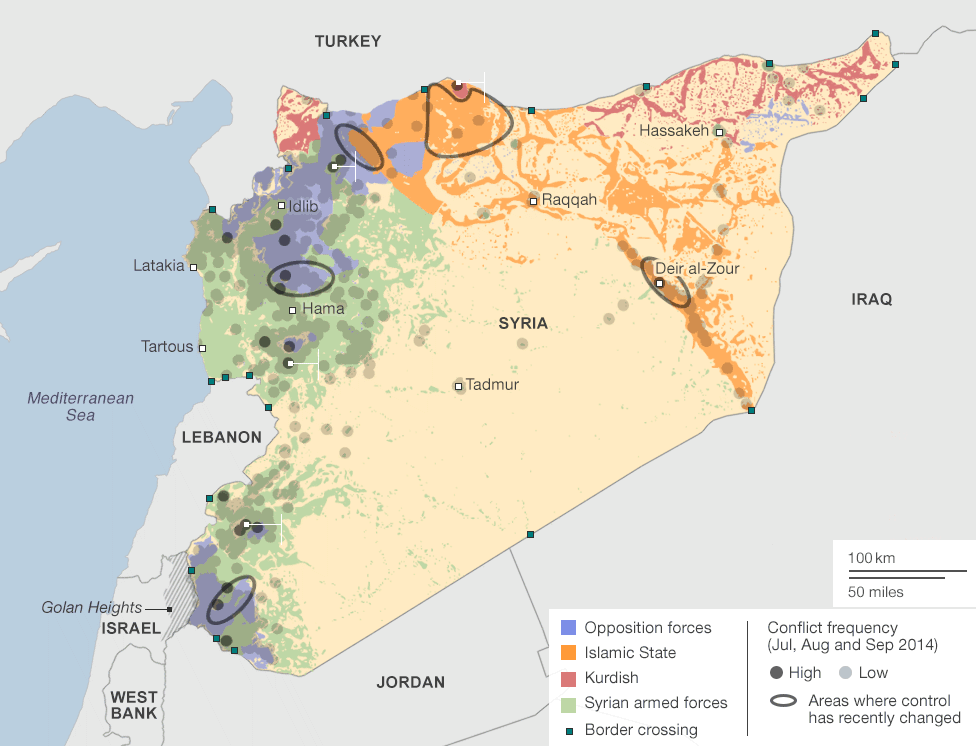
Mapping the Syrian Conflict. Image Source: http://bbc.in/1maaSrJ
As world powers (US, UK, France, China and Russia) bickered over resolutions and counter resolutions to resolve the conflict, their actions and inactions, buoyed by an unstable neighbouring Iraq facing a jihadi insurgency, turned the tide of the conflict to that of unfolding grotesque. Jihadi fighters from Islamic State (IS) and Al-Nusra with a vision of creating an Islamic Caliphate in the Middle East launched cross border incursions into Syria. The jihadists had two enemies: the Syrian government and the armed opposition forces. In the long run, IS managed to gain much more ground and declared a caliphate on conquered territories in Iraq and Syria.
Haunted by the ripples of past military campaigns in the Middle East (notably Iraq) the US and the Western powers, though yearning for the overthrow of Bashar al-Assad, dithered in active military support for the Syrian Opposition. With the Syrian regime finding support from Russia, there was no salve to the aggression of the opposition. As such, the Syrian conflict was left to run its brutal, self-destructive course in the hope that the struggle would be resolved on the battlefield.
The rise of IS, who are kitted with sophisticated weaponry captured from the Iraqi army and equipped largely by the United States, has changed the face of the conflict. With the capture of large swathes of territory across Iraq and Syria, they seem poised to present a knockout blow to what is left of the Iraqi and Syrian regimes, before then expanding their conquest beyond. Faced with this threat and following the brutal executions of hostages by the Islamic State, a coalition of Western and Arab Countries have begun taking military action by launching airstrikes against IS targets. However, airstrikes alone will not wipe out the capabilities of the Islamic State and while the US does have a working relationship with the Iraqi government, the same cannot be said for their relationship with the Syrian government.
Peace moves seem elusive and those arranged in Geneva between the Syrian Opposition and the country’s government ended inconclusively, rendering void the wisdom of top diplomats in Kofi Annan and Lakhdar Brahimi.
Lessons learnt from the Arab Spring, particularly in Libya, and the Iraqi story after the US invasion of 2003 proved that overthrowing strong regimes to the mercy of an uncoordinated opposition doesn’t favour the stability of the state in the short or the long run. Therefore, it is tragic to note that at this stage of the conflict the US is still trying to identify ‘the moderate armed opposition’ to equip with arms in the fight against the Islamic State.
At this stage it is my opinion that the Syrian conflict will be best resolved by the use of force against the Islamic State and other extremist groups, alongside political negotiation between the Government and the Opposition. Seeing that the Syrian Opposition does not have control over the activities of the Armed Opposition (Free Syrian army) and the Armed Opposition has a concrete command structure, the sustenance of the regime of Bashar al-Assad becomes necessary for the survival and continuity of the Syrian state.
The Syrian people have suffered untold casualties and destruction of their homeland, with this having had a spiral effect on neighbouring countries. As such, the conflict should be resolved by pragmatic means and by forgiving past misdeeds.
About the Author






So true. While the Americans are trying to identify the ‘opposition’ people are dying and no one seem to care about this. The conflict is still going on since 2011 and I think there is still no light at the end of the tunnel for the Middle-East nations. I am also not quite sure if a political negotiations would help the conflict to get to an end. If the Opposition agree to negotiate that doesn’t necessarily mean they will stop the conflict because they said so. They obviously will do whatever they want and the world powers (USA, UK, France, Russia and China) as you have described these countries, need to put more effort in solving the Syrian conflict. I also wrote a blog post for this ongoing problem, you can have a look: bit.ly/18uwfN2
O Yes Maria! you couldn’t have said it better. its sad to note the Syrians not having the power to end the conflict instead this lies within the realm of world and regional plans.
The best alternative is to talk/collaborate with Assad rather than the uncoordinated opposition.
Checked out your block and have seen similar ideologies steaming….. we sure could do some collaborations in the future