
The world’s theocratic states might soon gain a new member as evangelical (Christian) fundamentalism threatens to devolve Brazil back to the dark ages.
Its influence echoed clearly when Marina Silva yielded to a single but powerful tweet from one of the richest and most influential evangelical priests in the country. The presidential candidate changed her proposals, which initially promised to defend the rights of homosexual population after Silas Malafaia, priest of the Assembléia de Deus (Assembly of God) in Brazil, threatened that she would no longer have any support from the evangelical wing. In less than 24 hours, the “editorial mistakes” were corrected.
Fuelled by poverty and poor education
Extreme poverty, an educational system which is one of the worst on the planet and a gap left by the Catholic Church left room for a fanatical Pentecostalism and Neo-Pentecostalism that very much differs from what Martin Luther had in mind when he posted the Ninety-five Theses on the door of the Castle Church of Wittenberg. It’s likely that nearly none of the Brazilian Pentecostal evangelists has heard of the Protestant Reformation.
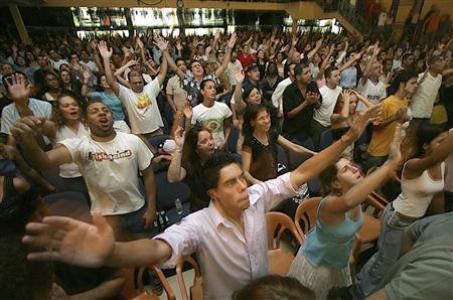
Brazil’s Evangelical revolution. Image Credit: churchandstate.org
The rise of Neo-Pentacostalism in Brazil started in late seventies. A model imported from America in which is traditional liturgies became theatrical spectacles was the cornerstone of what today is the 5th biggest institution in Brazil, the Igreja Universal do Reino de Deus (Universal Church of the Kingdom of God, or “IURD”). Their group is present in 200 countries. Universal also owns 76 radio stations and covers 75% of the national territory, produces books, newspapers and online newspapers. The founder of the Church, Edir Macedo bought Brazil’s second-most popular TV channel since 2007, “Record“, in the nineties.
“We declare that we will take possession of the means of communication, internet network and the political process, we will make the difference, we will influence Brazil with the gospel of Jesus.” – Silas Malafaia, Evangelical Priest (Assembly of God)
Incredibly, IURD is just the 4th biggest protestant church in the country, which remains largely Catholic. Only 22% of Brazilians identify themselves as Protestants. While Catholics have not been known to seek much political recognition in order to prevail their religious values, Neo-Pentecostal priests have been using politics to become more powerful and, as they say, fight for the protection of children against homosexuality, and family values.
In April 2013, Marco Feliciano, another Neo-Pentecostal priest was elected as president of the Minority and Human Rights Commission for the Brazilian Chamber of Deputies. The election caused a wave of protest, as Feliciano was infamous for his racial tweets (one of which he claimed that Africans descend from Noah’s cursed ancestor). Outraged, 150 evangelical priests, who felt misrepresented by Feliciano, wrote an open letter condemning his election. They went as far as creating a petition to remove him from the organ’s presidency.
During his mandate, Feliciano approved a bill to nullify excerpts from a 1999 resolution of the Federal Council of Psychology that prohibits professionals from offering treatment for homosexuality. He left the Human Rights Commission in December 2013. Incredibly, he is expected to be one of the most popular candidates for the Chamber of Deputies in next month’s elections.
Presidential candidates associate with movement
Marina is not the only candidate for presidency that had to get on her knees before the evangelical opulence: Dilma Rouseff attended the inauguration of the Temple of Solomon replica in Sao Paulo last July. The temple, built by the Universal Church of the Kingdom of God, can accommodate 10 thousand believers and is the biggest temple in Brazil. Despite investigation into the building by the Public Ministry (due to some irregularities in its constructions), the current President evidently couldn’t lose the chance to bond with such a demanding electorate.
Silva and Rousseff’s actions are scary, but understandable. According to the IBGE (the Brazilian Institute of Geography and Statistics) the number of evangelical believers has increased by 61% in ten years. The beneficiaries of Bolsa Familia, a cash transfer scheme created by Lula’s government, remain faithful to the PT (Workers’ Party). The only threat to their status quo would be if their electorate changed their mind on religious background. Evangelical Pentecostal religions are those that have the highest proportion of believers with per capita income below one minimum wage: 63.7% of the total.
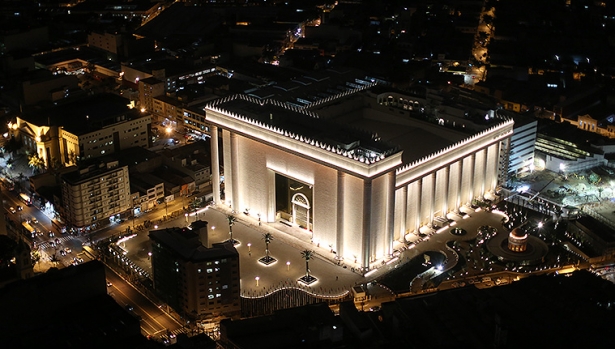
Temple of Solomon replica, Sao Paulo, Brazil. Image Credit: Christian Post
The words spoken by Silas Malafaia during an evangelical event in Campo Grande (Centre-West region of the country) don’t leave any space for misinterpretations: “We declare that we will take possession of the means of communication, internet network and the political process, we will make the difference, we will influence Brazil with the gospel of Jesus.”
If that is to happen, non-followers of Pentacostalism, homosexuals and women look to be even more in danger than they already are (44% of all homophobia killings on the planet in 2012 happened in Brazil). The evangelical movement will also be at risk. The priests and protestant congregations that don’t agree with the radicalism of the Pentecostal priests in power will also face harsh consequences. The erasing of concepts such as human rights, democracy and secularism from the Constitution could threaten Brazil’s future with the potential for a dictatorship.
About the Author





