
Dictatorships throughout the Arab world were quashed under the force of the revolutionaries that fought against them. The unrest gained momentum as more countries followed in Tunisia’s wake; people projected their voices from Egypt, Bahrain, Yemen, Libya and Syria, where fighting against the country’s leader Bashar al-Assad still continues, escalating into a civil war. Surprisingly Saudi Arabia is one country where we have seen few uprisings, they are happening but we have heard little about it from the worlds media. What has made this oil rich, politically connected country ‘seemingly’ immune to the activity around it?
A country of absolute monarchy ran largely by elders and traditional councils, Saudi Arabia remains traditional and is seen as a pinnacle for the Muslim faith. Governed by Islamic law, with no written constitution, Saudi in essence is governed by the ‘infallible’ law of God as opposed to the Western ideals of a democratic structure. The power of the monarchy when it comes to international relations, its historical relationships with countries such as America, and a sustained economic growth, on paper makes Saudi Arabia seem relatively stable.
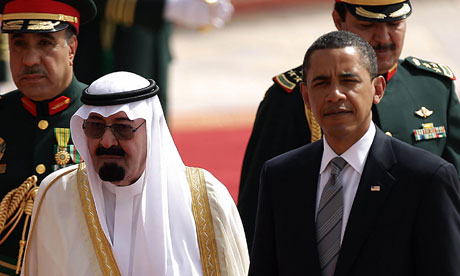
Saudi King Abdullah with US President Barack Obama. Image credit: Mido Ahmed/AFP/Getty Images
Pre-empting the call to go to the streets King Abdullah ploughed billions into the welfare system, and the monarchy’s ‘Open Door’ policy is seen to keep the king in touch with his people, under which citizens can meet with the king if they have a problem and get this redressed. This differs from other countries where there has been a short circuit between the nation’s leaders and its citizens, typical of a dictatorship. Despite there have been protests in the countries main cities such as Jeddah, Riyadh and Dammam. Saudi Arabia may be concealing the protests at home but this doesn’t mean the discontent has faded away.
http://www.youtube.com/watch?v=x-sqRD4bLwc
Shaimaa Khalil, travelled to Saudi Arabia where she discovered a growing young population increasingly active in finding their own way. Influenced by the swell of globalisation and an obsession with social media, the younger generation is more and more aware of what is going on in the world and other countries around them. Facebook, YouTube and Twitter are the latest platforms in allowing people to openly discuss social ills, corruption and government inefficiency. The activists Khalil met were far from complacent or happy with the way their country was being ran:
.
Jeddah, the port city of Saudi and traditionally more relaxed than Riyadh, has seen coffee shops spring up where local young men and women are gathering to read and engage in religious talks and discussions, looking for open interaction to what is going on around them in neighbouring countries.
Women are also fighting for social reform. Many are demanding the release of their husbands, held as political prisoners, the majority of which are Shia Muslims. Khalil met and spoke with some of the wives fighting for change; one women spoke of their growing impatience, “women have shown how capable they are and have demonstrated twice now in anger”. In a society infamous for repressing women, they will now be allowed to vote and be elected in the municipal elections, due to be held in 2015. But this is little rope in a country where women are not allowed to drive and can be arrested or lashed for doing so. Life for women is restrictive, and those that do speak out face an angry backlash from the more conservative female members of society who see this as a threat to their lifestyle. This has not stopped women from blogging and tweeting; female activists and journalists still speak out despite the limitations or unpleasant consequences.
Saudi has also seen political challenges. In February 2011 the Umma Islamic Party was formed in response to the protests. The party is pro-reform and fights for an end to absolute monarchy. Unsurprisingly its leaders were arrested by the authorities. A member of the party spoke with Khalil:
In 2011 protestors called for a day of rage in Rijhad. The streets were filled with more policemen and special forces than protesters, despite thousands of calls for protests on social media sites. One lone protester, Khaled Mohammed, a teacher with an autistic son spoke out in front of the security forces knowing that he would be arrested.
He drove away awaiting prison. The likelihood is that Khaled will have no trial and become lost as another political prisoner. On the 4th March 2011 a webpage appeared “Where is Khaled?”. For almost a year he stayed in prison without trial. He was then later charged, accused of “support of demonstrations, presence at the location of a demonstration, and communications with the foreign media in a manner that harmed the reputation of the Kingdom of Saudi Arabia.”
The activists views may not represent the majority of people, but more and more protestors are rallying in the streets fighting for change. It is doubtful that we will see change on the scale we have seen in other Arab countries, given the slow pace of political and social change we have seen so far. With all political parties quelled and people speaking out on the streets arrested, a mass of lost men imprisoned under the pretext of ‘political prisoner’ Saudi is for now masked by its wealth and controlled media, but how long can this last with activists voices going viral?
About the Author





