
The Great Barrier Reef: a monstrous hunk of calcium carbonate that supports an extensive network of sea animals by providing food and shelter. How often have we heard about the danger that the Reef is in? Too many times to count, and I’m not complaining. But what if there was an even more impressive shelter and ecosystem that was under threat from climate change and general bad practices in coastal regions?
It exists: the seagrass. From the get-go it doesn’t sound as appealing as ‘The Great Barrier Reef’ or even ‘coral reef’ for that matter; however, the importance and relevance of the seagrass should not be misjudged simply because of its name or lack of media attention. Only 60 known seagrass species exist in the world and 15 are on US coasts. Seagrasses are medium height, wavy, emerald green food sources for herbivores (Koch et al., 2012) and home to many small fish and crustaceans, just like those in Finding Nemo. Seagrasses provide important benefits to humans that those living inland may never know. Let’s familiarize ourselves with these benefits.
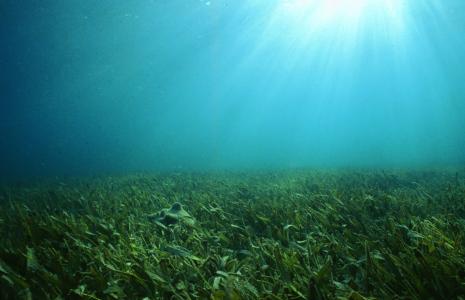
Image Source: Ocean Portal / Richard Ling http://bit.ly/1fjOR8r
Seagrasses are highly productive areas and support small scale fishing, also known as artisanal fishing. For example, in the Chwaka Bay in Zanzibar, the local fishermen gravitate to the seagrasses instead of the corals because they are closer to the shore which means they are less dangerous to access during storms, require less fuel, and the fishermen tend to get larger catches here which translates to more income (de la Torre-Castro et al., 2014). Even so, the majority of these fishermen live in extreme poverty. Ruining these seagrass ecosystems would destroy their livelihoods.
The benefits that seagrasses bring are not just for fishermen either; seagrasses help stabilize shallow water sediments and effectively enhance water quality and soil stability. Enhanced water quality is great for leisure on the coast: no one wants to vacation in murky water! But more importantly, by stabilizing coastal soils, we are better protected from erosion and loss of coastal land. Without the seagrasses the coastal-front properties would definitely begin to become a rarity.
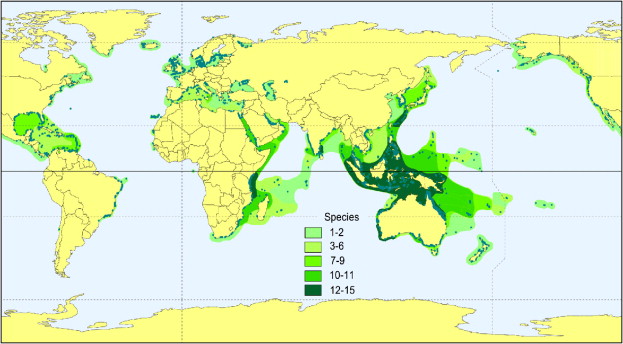
Image Source: Ocean Portal / 2005 UNEP-WCMC http://bit.ly/1fjOR8r
Quite a few initiatives exist that try and support recovery, conservation, and knowledge dispersal like the SeaWeb. This non-profit organization succinctly addresses the aspects underlying the issues with the decline of seagrasses. Because seagrasses are coastal ecosystems, coastal development, nutrient and chemical loading, as well as the misuse of fishing gear have negative impacts on seagrasses and sufficiently disturb the ecosystems and consequently, contribute to their decline.
Among these issues, one major force affecting seagrasses is ocean acidification. As a quick background, pH levels indicate how acidic or basic something is. On a scale of one to 14, seven is the middle ground and anything above is considered basic (like milk) and anything below, we consider to be acidic (like lemon juice). Which would be more preferable to live in? Something closer to the basicness of milk? Or the sourness of a lemon? The seas and oceans of the planet that are not considered extreme have reached a balance of around 8.2 which is slightly basic. This is what most marine plants and animals of the coastal region have adapted to.
Stay with me now. With the increase of carbon dioxide (CO2) into the atmosphere from factories, car exhaust, and the general burning of fossil fuels, water will interact with the CO2 and through some amazing (and tedious) chemistry, lowers the pH of the water. Amazing as this may seem, the more acidic the water, the less likely the seagrasses will be to survive. Some sea plants can thrive under these more acidic conditions, but they aren’t seagrasses and provide less economic benefits.
As seagrasses decline globally at a rate of 1-7% every year, awareness is a great start to fixing the problem of seagrass recession. Similar to many issues, it is difficult to take action and to truly care about something that is not necessarily affecting you daily. However, thousands of livelihoods around the world and neighboring the United States are being affected, and the minor changes that we make by being aware of what consequences our actions have is a step in the right direction.
About the Author





