
By his own admission, John Roberts didn’t grow up with great ambitions of saving the world. Coming from what he calls a “pretty privileged background” in southern California, through his school years he was more focused on spending time with his friends and playing sports.
But at the age of 21, John began to have increasing questions about the world around him. In particular, he says, he became “very confused by homelessness”. Having one day asked a homeless man to sit down with him and explain his story in exchange for some food, Roberts says he came away thinking “that felt good!”
Roberts was soon running a soup kitchen from the back of a minivan, delivering food to homeless people all over the area three to four times a week, funded out of his own pocket.
Still only a shade over 30 years old and propelled by the same kind of individual determination, Roberts has come a long way since then. After a fortuitous and eye-opening research trip to India, a quick sojourn in Mali and a fair amount of deliberation, Roberts got a small group of his travelling buddies on board to start the NGO, Heal the World. This small organization has successfully built and run schools in both Mali and Burkino Faso.
In 2012, Roberts, along with co-founder Patrick Steele, went on to launch the Open University of West Africa (OUWA), which looks to benefit thousands of young people throughout West Africa and even the continent at large, perhaps sparking a full scale African education revolution along the way. As Roberts says, you either “go big or you go home”.
http://vimeo.com/33575965
OUWA looks to bring the opportunity of further education to those who didn’t or couldn’t make it through the traditional channels. OUWA students can access all the necessary study materials and content online for free. Though OUWA has an online central ‘campus’ in Accra, Ghana, its reach is potentially, and ideally, universal.
Roberts uses the example of a pyramid, saying that many of the world’s universities are geared towards a small triangle at the top of the pyramid.
To that end, broader awareness and connectivity are key. Roberts has therefore productively used social media to reach potential students. Another of OUWA’s initiatives is that when students have studied for a year and shown their commitment to the programme, they will be given access to subsidized mobile phones with the technology to find everything needed for their studies from anywhere and at any time.
OUWA already has 40 undergraduates set to graduate with full degrees in 2015. When enrolment began in 2011, some prospective students travelled over four hours by bus just to sign up for the programme in person, which is one of the requirements. Roberts is hoping he can get up to 1000 new students in the near future and says his long-term vision is to have more than a million students enrolled in nearly free higher education.
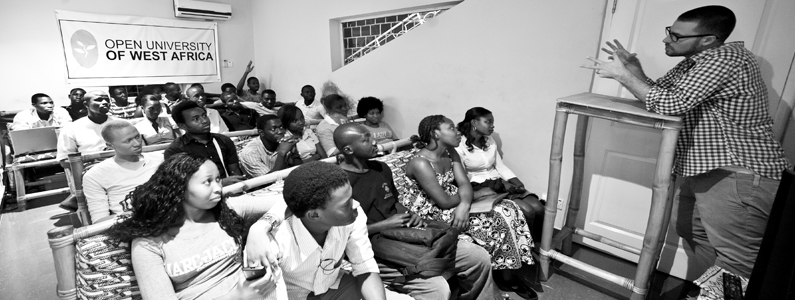
The incentives for prospective OUWA students go far beyond the almost non-existent fees and the availability and ease of access. At the end of their degrees, each OUWA faculty looks to gear students towards employment connected to the university.
For example, the Faculty of Business will have an incubator attached to it; the Faculty of Agriculture will be connected to working farms; the Faculty of Education will feed its own chain of low-cost private schools and so on. OUWA also runs an entrepreneurship programme (based on Stanford Prof. Chuck Eesley’s Technology Entrepreneurship open online course) to help young West Africans to launch their first start ups in conjunction with OUWA, with a particular focus on addressing urban poverty in their region.
Collaboration and teamwork, it is quickly apparent, are essential to both the success and the appeal of OUWA. Course material is coming from universities all over the United States, and Roberts’ has also used Facebook to approach any of his friends with doctorates or masters degrees and encourage them to contribute, with the incentive of owning a share in the business in return for their contribution. “Those shares are worth a penny a piece at the moment”, Roberts says, “but where we can take them is really super exciting.”
I first met John Roberts in Cape Town when he was in town for the Power of Youth summit, which brings together top young social entrepreneurs from around the world.
Since the Cape Town summit, Roberts has been looking to work with South African entrepreneurs in the education space.
Roberts is now based in Ghana “indefinitely”. Continuing to live by the motto of “go big or go home”, it certainly doesn’t look like Roberts is going home any time soon.
This post was originally published on Urban Voices.
About the Author





