
Throughout the reporting of international conflict, debate and discussions frequently revolve solely around issues of military actions, foreign spending, and often a clash of ideologies. As a result, an essential element to the story is either invisible or rendered a meager afterthought: the impact wartime has on the humans who must live it. Those who live in conflict zones—and indeed call such areas their homes—experience brutal scenes of destruction and death, right in their own neighborhood. While much of the rhetoric of war is given from a comfortable distance, those who live in the country of dispute will be there when whatever new threats or insurgents come their way. And—unfortunately yet unsurprisingly—those who must bear the brunt of such a traumatizing climate are women.
Consider the current case of ISIS in Iraq. It is here that women have been ordered to cover themselves up completely and remain in their house. Four women killed themselves after being raped. According to a UN report, women living under ISIS control have been kidnapped, raped, and forcibly married to militants of ISIS. Due to the increased crisis, the UN Population Fund said that an estimated 20,000 women and girls in Iraq are at a heightened risk of sexual violence. Women’s bodies represent the perfect way to impose an extremist agenda, showcasing patriarchal authority by policing and repressing women.
Gender-based discrimination is nothing new. Throughout nearly every conflict in history, rape has been used as a weapon to humiliate and terrorize both the individual woman and her community, while also serving as a way to demonstrate supposed authority and power. When a woman lives in a society where sexism and misogyny is rampant—and often ingrained in the religion and the law—such actions are even deemed permissible and increase during times of conflict. In the Democratic Republic of Congo, for example, approximately 1,100 rapes are reported each month, with an average of 36 women and girls raped every day. When in times of conflict, it is common for soldiers to believe it is their right to rape and abuse women, as they are able to assert force and dominance that is connected to their societal notion of masculinity.
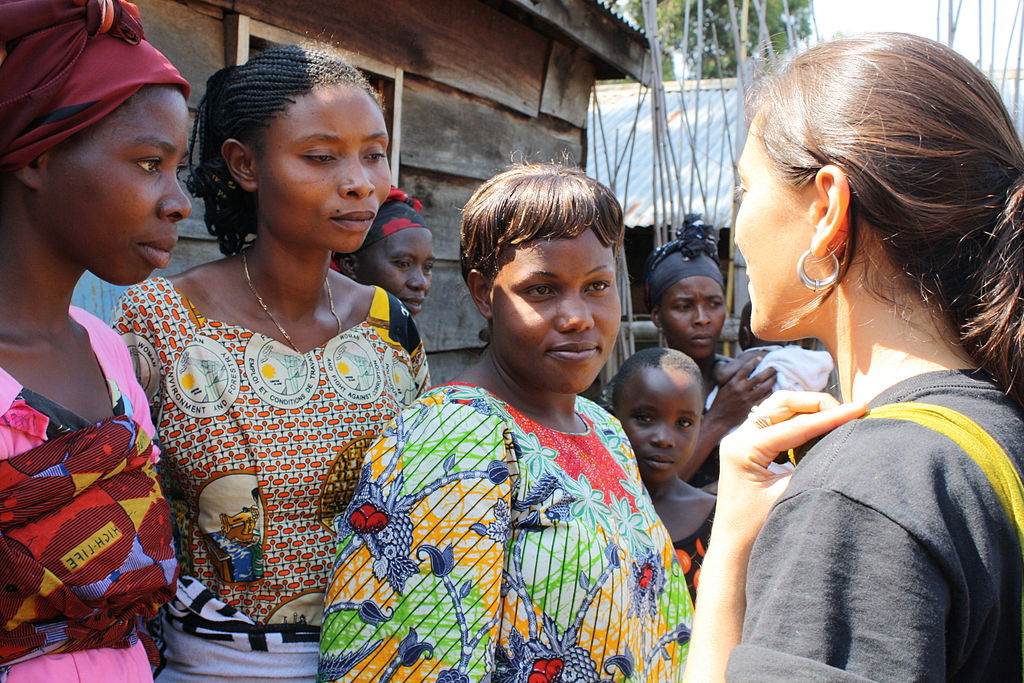
Psychosocial workers with International Rescue Committee (IRC) help rape survivors in South Kivu DRC
The sexual violence that women experience in conflict zones is a horrific incidence, resulting in physiological and physical trauma. There is little done to successfully assist the victim and obtain justice, usually because there are no sufficient laws enacted for such a crime. In an effort to create dramatic reform for sexual violence, the Global Summit to End Sexual Violence in Conflict was held in London from June 10th to 13th, hosted by the British foreign secretary William Hague and Angelina Jolie, Special Envoy for the UN High Commissioner for Refuges. The summit was the largest gathering on the subject, and focused on four specific areas: to improve investigations and documentation of sexual violence in conflict, to provide greater support for survivors, to ensure sexual and gender based violence responses and the promotion for gender equality fully integrated in all peace and security efforts, and finally to improve international strategic coordination. While continuing the discussion of how to respond to problems of sexual violence is indeed a worthy one, there comes a time when tangible policies and laws must be enacted to prevent further abuses. The fruitful conversations, meaningful presentations, and important investigations regarding sexual violence that occurred during the Global Summit last month should propel the next step in addressing the prevention of sexual violence in conflict zones. At the Global Summit, governments stated their commitment for protecting women in war zones from sexual violence. In Iraq, what women are experiencing under ISIS presents the perfect opportunity for governments to finally put that commitment to the test.
About the Author






You present a great overview of a very important issue. Thank you for this!