
The U.N. Security Council has unanimously agreed to extend the partial lifting of the arms embargo on Somalia for eight months. Despite the fact that a recent confidential UN report has revealed that arms destined for the fragile government in Somalia have been diverted to the terrorist organization Al-Shabaab. It has only been a year since the arms embargo was partially lifted by the UN to allow the new Somali government to arm itself. But with widespread corruption, ineffective security services and lack of government transparency, should the arms ban be reinstated?
It all began in 1992 when the UN Security Council imposed an arms embargo to Somalia in light of the civil war and the deteriorating humanitarian situation. Fast-forward more than a decade later; this embargo was partially lifted. Under the amended terms of the 2013 arms embargo on Somalia, the UN Security Council permitted the newly elected government to purchase arms to support their war against insurgency
Therefore, The UN experts monitoring the partial lifting of the arms embargo on Somalia have compiled a 14 page report accusing the newly formed Somali government of a ‘high level and systematic abuses’ which have allowed weapons to reach warlords and Al-Shabaab. The report also revealed that the government in Mogadishu failed to disclose arms shipments to secret locations around the capital.
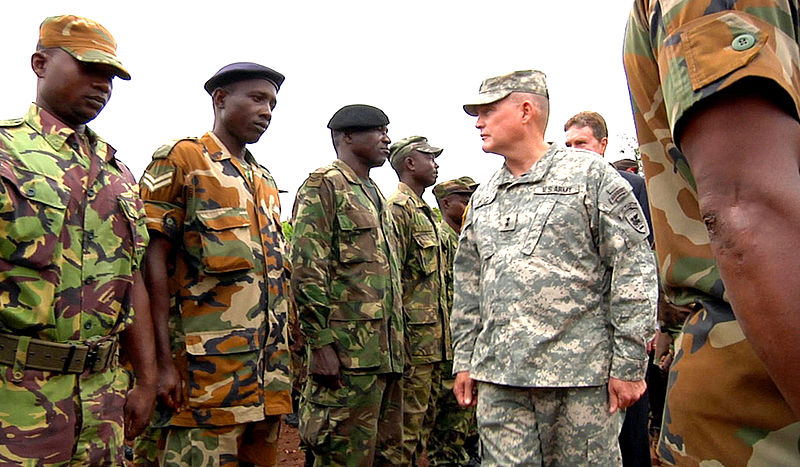
Maj. Gen. David R. Hogg (center), commander U.S. Army Africa inspects Sierra Leone troops during a deployment ceremony May 20. Nearly 1,000 Republic of Sierra Leone Armed Forces personnel completed training for an upcoming African Union Mission in Somalia (AMISOM) deployment. Image credit: US Army Africa
However the Minister of Foreign Affairs and International Co-operation Abdirahman Duale Beyle denied these allegations; “We are really surprised with these accusations, we have never sold our weapons nor misused them.” These latest accusation will certainly cause friction when the UN decides next month whether to ease Arms restrictions or extend it for another year. In addition, this isn’t the first time the government of Hassan Sheikh Mohamud has been accused of corruption. In November last year, Yussur Abrar the Central Bank Governor unexpectedly resigned after only 7 weeks in her post; citing deep rooted government corruption as the reason. Moreover, Mohamud’s cabinet ministers were branded, ‘corrupt, erratic, amateurish and dangerous by some government officials from London and Washington. Of course it also doesn’t help that every year Somalia is consistently voted the most corrupted country in the world.
Amongst corruption, security issues also plague the Somali government. On the 13th of February this year, Al-Shabaab detonated a car bomb that killed 7 civilians and injured 15 others in Mogadishu. Despite Al-Shabaab being ousted from the capital city in recent years, the militants have a stronghold in the countryside. Al-Shabaab fighters are currently numbered at around 8,000, which are considerably lower than when they peaked at 15,000 in 2011. Al-Shabaab maybe losing this war, however this latest terrorist attack is an alarming reminder of the constant threat they pose and the fragility of the Somali government.
The maritime security on the other hand has been a tremendous success for the horn of Africa due to the sharp decline in piracy of the coast of Somalia. This was largely due to a visible international naval presence and the use of private armed security teams on board the ships. The threat of piracy is still not over, the fact that a ship was hijacked just a few weeks ago in the Indian Ocean proves this. It was the very first successful highjacking this year. Remarkably, there were only 15 incidents that were reported off the coast of Somalia in 2013 compared to the 237 reported in 2011.
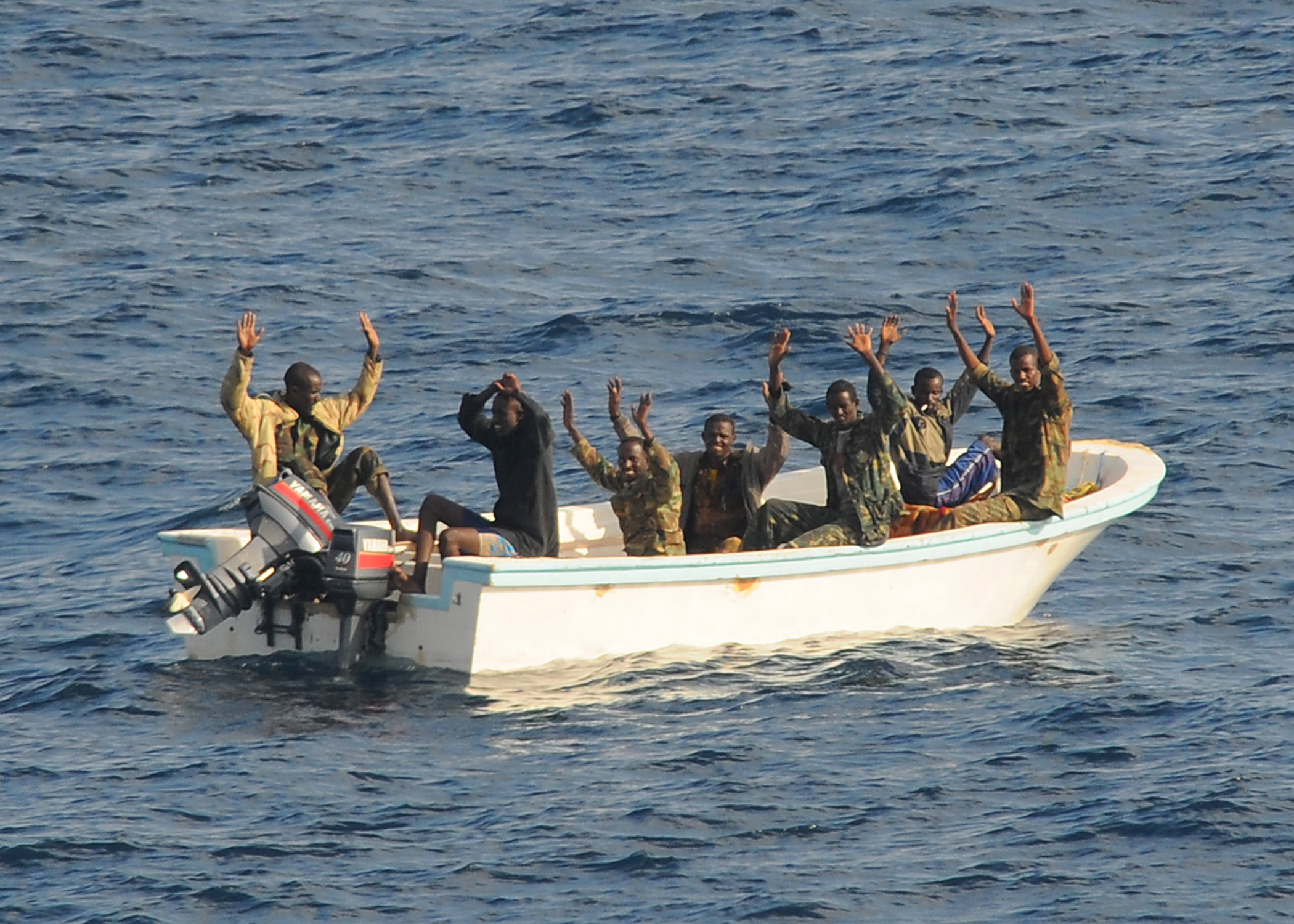
Suspected pirates keep their hands in the air as directed by the guided-missile cruiser USS Vella Gulf (CG-72) as the visit, board, search and seizure (VBSS) team prepares to apprehend them. Image credit: Mass Communications Specialist 2nd Class Jason R. Zalasky, USN
Tackling Piracy may no longer be a priority for the Somali government, which signed a £1.5 billion pound pledge from the EU last year. However, if Mohamud’s government wants a continuation of international aid, removal of arms embargo and EU donations then it must show the world that’s its exerting all its strength to be transparent, stamp out corruption and improve its security.
About the Author





