On the 14th of March 2012, a woman named Alem Dechasa committed suicide by hanging herself in her room at Der El-Salib mental hospital. Four days prior, as witnessed by an amateur video, she was kidnapped by her owner, her master, Ali Mahfouz. He grabbed her by her hair and dragged her to the car. She resisted, so he asked a friend to help him and they both forced her in, through the car window. No one intervened.
The scandal erupted from Dechasa’s abuse, and her subsequent death revealed a growing and more vocal rejection of Lebanon’s infamous Kafala (sponsorship) system. Under the Kafala system, any ‘unskilled laborer’ (domestic worker) has his or her legal status in the hands of an employer or ‘in-country sponsor’. In other words, Alem Dechasa’s legal status in Lebanon could have been revoked by Ali Mahfouz if he so desired, putting Dechasa in a very vulnerable position. “With the Kafala system,” International Labor Organization (ILO) senior Ms. Simel Esim was quoted as saying, “you are creating a total dependency of the worker on the employer for her food, sleeping, health, everything… total dependency creates total vulnerability and opens the door wide to exploitation.”
Lebanese and international activists have joined their voice to condemn this system of modern day slavery. A few months ago, I described the Kafala System as “responsible slavery”, referring to the perceived notion that all that is needed is for employers to treat their workers with kindness. That, in my view, would not solve the problem. After all, we still live in a country where it’s acceptable to advertise the nationality of the domestic worker, where an average of one domestic worker dies every week, where confiscating passports is commonplace and where a nationality, Sri Lankan, can be used to refer to the whole profession, with sentences like “what is your Sri Lankan? Ethiopian or Filipina?” a reality. Only recently has the realization that a more radical change is needed surfaced to the level of public discussion.
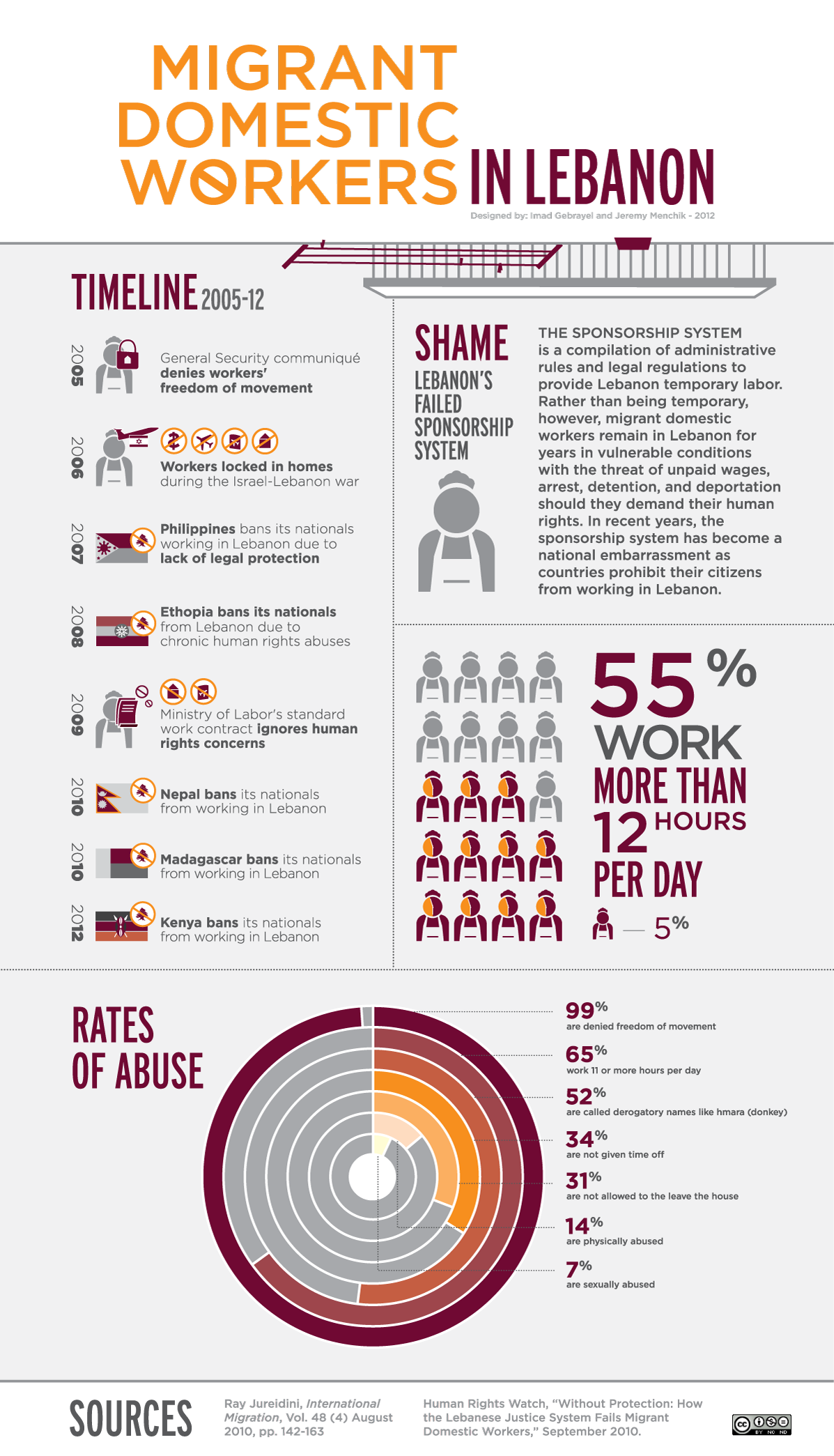
Back in 2010, Human Rights Watch released a report entitled “Without Protection: How the Lebanese Justice System Fails Migrant Domestic Workers”. Among the most shocking findings of this compilation of 114 judicial decisions affecting migrant workers, are that no employer was ever charged for locking workers inside their homes, denying them food, or confiscating their passports and that the average time needed for a court case to be resolved is 24 months, sometimes even going up to 54 months. This, the report continues, makes it hard for the worker to bring charges against her abuser. After all, under the Kafala system, the worker can have her right to live in Lebanon revoked for simply daring to defend herself.
And why wouldn’t she? Statistics compiled by the Migrant Workers Task Force (MWTF) and AltCity reveal that roughly 34% of migrant workers are not given time off, 31% are not allowed to leave the apartment, 99% are denied freedom of movement, 52% are called deragotary terms, and 14% and 7% are physically and sexually abused respectively. If you were thinking of working in Lebanon as a migrant worker, statistics suggest you should let go of some of your basic working rights.
Lebanon’s civil society has recently been focusing a good deal of its attention on this alarming issue. Five NGOs – Anti-Racism Movement (ARM), Amel International, Caritas Lebanon, Insan Association and KAFA – in collaboration with the Ministry of Social Affairs have launched the “Fi Chi Ghalat” (Something is wrong) campaign denouncing the Kafala system. It is demanding that all workers be included in Lebanon’s labor code, giving them the same rights such as minimal wage and maximum working hours as any worker in Lebanon should. The campaign features 9 different interviewees who point out what is wrong with the domestic worker situation in Lebanon.
Also part of the campaign was an event organized last Sunday the 28th of April in celebration of the annual Workers’ Day. The event consisted of a parade on Manara street from 11 am to 1 pm, followed by a festival in Sanayeh Garden from 1 pm to 4 pm, a short sketch by Ethiopian activist Rahel Zegeyeh and others pocking fun at sponsors, followed by the national anthems of the main migrant nations (Nepal, Sri Lanka, Ethiopia, Phillipines, Madagascar and so on) and a big buffet full of ethnic food.
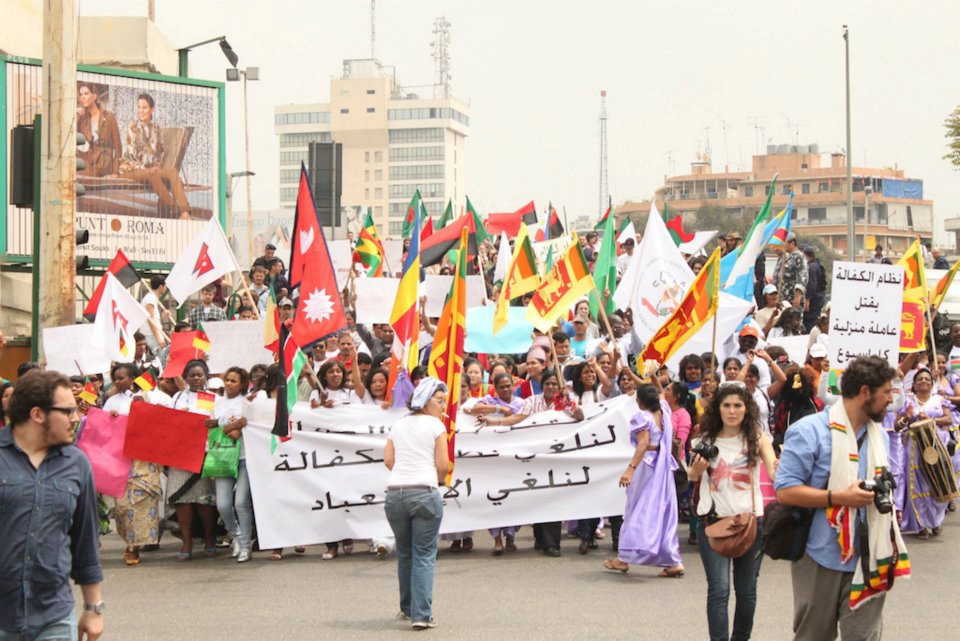
Workers’ Day Parade inside Lebanon
The mood was festive. Everyone was dancing, laughing and rejoycing a situation where race and nationality were not obstacles preventing anyone from enjoying Lebanon’s still-famed warmth and hospitality. Prevalent was the wish for that feeling to last longer, beyond the confines of Labor Day’s special status.
A few weeks ago, Rahel Zegeyeh wrote and acted in a play entitled “Shouting without a listener“. Lily, played by Zegeyeh, is trying to help her abused friend Mouna and discovers that doing so isn’t as obvious as it sounds. What Zegeyeh was trying to say is that she has been shouting for years without an ear willing to respond. For too many years, she has been attempting to help those less fortunate than herself with nothing but her strength and dedication on her shoulders. And finally, just finally, people have started listening. Over 120 people attended the play.
We still do not know how bright our future is. The situation with our neighboring countries leaves little room for hope, especially for such as small priority case. It is an unfortunate reality that countless men and women have suffered unspeakable pain, suffering and worse from the humiliating condition of being ipso facto someone’s property. Such a condition cannot go on. It just can not. It is time to put an end to the Kafala system.
About the Author