
The recent plight of Kenny Sansom raises again the issue of life after sport for former professionals. The ex-Arsenal captain and England full back has admitted this week to being ‘in a bad way’ as he fights alcoholism, gambling and the prospect of being homeless. Coming to terms with no longer plying their trade, many professionals have struggled to adapt to this concept. A combination of no routine and an abundance of money can lead to one going down the wrong path.
Sansom is not alone, very recently the latest in a prolonged series of mishaps for Paul Gascoigne witnessed him being charged with an assault (and subsequently fined). He has been one of the more fortunate ones having been treated in a rehab facility earlier this year after the media highlighted the fears over his health. He is a good example of a former professional struggling to adjust to life after sport. After retiring, he had various attempts to enter management starting with an 11 game stint at Boston United in 2004; this was followed by a 39 day reign at Kettering Town in 2005. His subsequent failure to make a successful management career further exacerbated his well documented personal problems of alcoholism, gambling and his marriage breakdown.
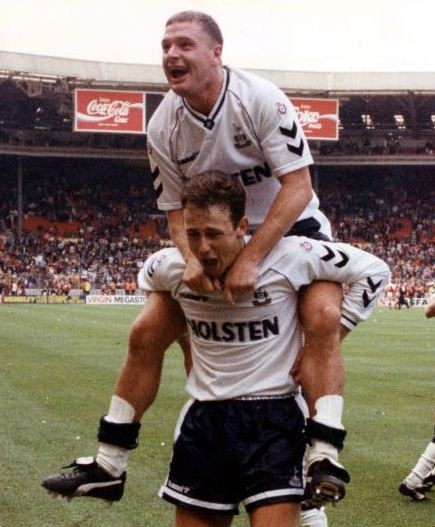
Paul Gascoigne. Image credit:TottenhamFan
A case that certainly pulls at my heartstrings is Alan Ball, 1966 world cup winner with England. Shortly before he died he was forced to sell his winning medals to improve his financial situation. He was joined by teammates Nobby Stiles, George Cohen, Gordon Banks, Ray Wilson, Bobby Moore, Geoff Hurst and Martin Peters who have all made the same sacrifice. They played football in an age when wages were no where near today’s astronomical levels. The gravity of the situation is highlighted when Peters was made redundant from the insurance company he was working for in 2001 forcing him to sell his medal.
1966 World Cup winner Alan Ball
Perhaps, to many people’s surprise the sport with one of the highest suicide rates is cricket. David Frith has covered this subject area extensively with his book, ‘Silence of the Heart: Cricket Suicides’ that covers over 150 cases. The history of the game has been littered with a consistent series of deaths with one of the most recent back in 2011 when former cricketer Peter Roebuck threw himself off a balcony in a hotel in South Africa. It does seem strange that cricket is associated with such an issue considering the media attention (or lack of) and the pressures that come with it when compared to the likes of football.
The following are just a selection of known cricketer suicides – Aubrey Faulkner, former South African cricketer, committed suicide in 1930 after suffering a long period of depression. Danny Kelleher played first class cricket for Kent during the late eighties to early nineties but was later released from the county. His career tailed off from that point on and he overdosed in 1995. Mark Saxelby led a solid career at the likes of Durham and Nottinghamshire, but similarly his career hit a patch of poor form and he fell into bouts of depression and died from consuming garden chemicals in 2000. Australian cricketer, Shame Clements had a limited career in state cricket with a total of 20 matches to his name. He shot himself at the age of 42 in 2001.
The above are just a handful of examples. I believe a contributing factor with suicides in cricket is down to the magnified pressure on individual contribution (I would happily hear alternative suggestions). If your team is doing well and you are scoring no runs at the top of the order then this will play on your mind. The individual contribution in cricket is more obvious than say in football. A back four defensive line in football may be leaking goals but it could be down to more of team based factor rather than one individual. The performance of a cricketer is broken-down in more finite detail; average runs per innings, strike rate, number of wickets taken etc. all statistics that can heavily scrutinise a player’s performance and ability.
Such pressure and weight on an individual’s mind over a number of years has the possibility to creep into other areas of vulnerability. The stress this would induce could lead to bouts of depression as shown with the above cases. I think it is fair to conclude that former sport professionals can be vulnerable after their playing days are over. The transition from a routine they have been used to into something less glamorous and demanding obviously can be hard step to take and recognise. We should note that Arsenal FC and the PFA has signalled their intention to help Kenny Samson with his latest troubles, but more needs to be done to raise this delicate issue to reduce future cases.
About the Author





