
What began in Syria with young schoolboys spraying anti-government graffiti on the walls of a school in March 2011 has erupted from peaceful protestation to civil war. In a country held sway by an authoritarian regime, President Bashar al-Assad has cracked down hard on the anti-government protestors eager for a change in rule. In June 2013, the UN reported that more than 90,000 people have been killed during the ensuing conflict, with 1.7 million fleeing to neighboring countries. The crisis in Syria has deeply affected the stability of the region, and as the violence continues, extremism is on the rise.
While the US has done much in trying to consolidate the opposition and provide humanitarian aid, the violence has continued, with sectarian divisions deepening. In order to maintain its credibility within the international arena, the U.S. stance on responding to its “red-line” on Assad’s usage of chemical weapons has resulted in a promise to deliver military assistance to moderate opposition groups. A promise that is looking like a reality after the almost undeniable chemical attack on civilians on the 21st of this month where it is estimated that 1429 people were killed . An act the regime continues to deny claiming the video footage and stories are “full of lies” blaming the rebel forces for the attack.
It looks as if America and France, now classed as America’s “oldest ally” after the UK’s shock vote not to intervene in Syria, are ready to fire missiles onto key military regime targets. Obama has decided to seek authorisation from congress regarding a military operation against Syria.
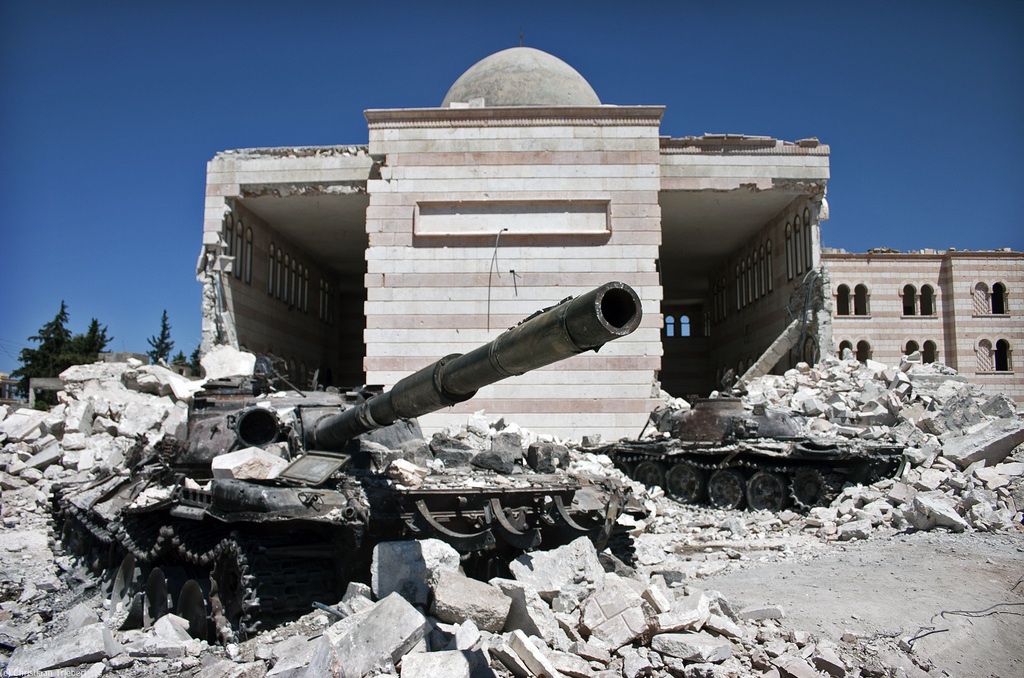
Azaz, Syria. Image Credit: Christiaan Triebert
However, this shortsighted answer to an increasingly more complex conflict fails to consider the reverberating effects of military escalation within a growing unstable region. As the conflict devolves further into sectarian and religious based violence, the intervention of outside states further complicates the burgeoning factional divisions and the role of al-Qaeda.
“If Britain had engaged in a rush to war on an ill-thought through basis, not working with the international community, not going through the UN, that would have been bad for our country and for the people of Syria as well”.
Ed Miliband speaking with the BBC after the parlimentary vote not to back US-led strikes on Syria.
It seem likely that the U.S. will take the route of providing military assistance to the rebels, when should it instead look to its two other alternatives, increasing its involvement with the Syrian National Council, and improving diplomacy with Russia in order to bring about a peaceful resolution.[1] However with the current political climate in Moscow with its own unrest in the south, and concern over its “sphere of influence,” President Putin appears dedicated to supporting the Assad regime. Not only would they run the risk of battling in a proxy war, but also share a common thread in the risk of prolonging an insurgency and arming future jihadists.
The U.S. has promised to militarily back the moderate opposition groups, backing up the “red-line” that Assad’s regime crossed with the use of internationally prohibited chemical weapons. However, the burgeoning al-Qaeda element within some rebel factions coupled with the U.S. war with al-Qaeda make the decision contentious.
Arming the resistance would place the United States in a compromising position, not just from the fear of weapons falling into the hands of al-Qaeda, but also the risk of tensions with other foreign actors. With Iran warning the West earlier this year that, “Syria is the ‘resistance front’ and that any attack on Iran’s strongest ally in the region would be considered an attack on Iran,” the presence of the United States in the conflict could be considered an immediate threat to Iran’s efforts.[2]
http://www.youtube.com/watch?v=hDnthh6BWBo
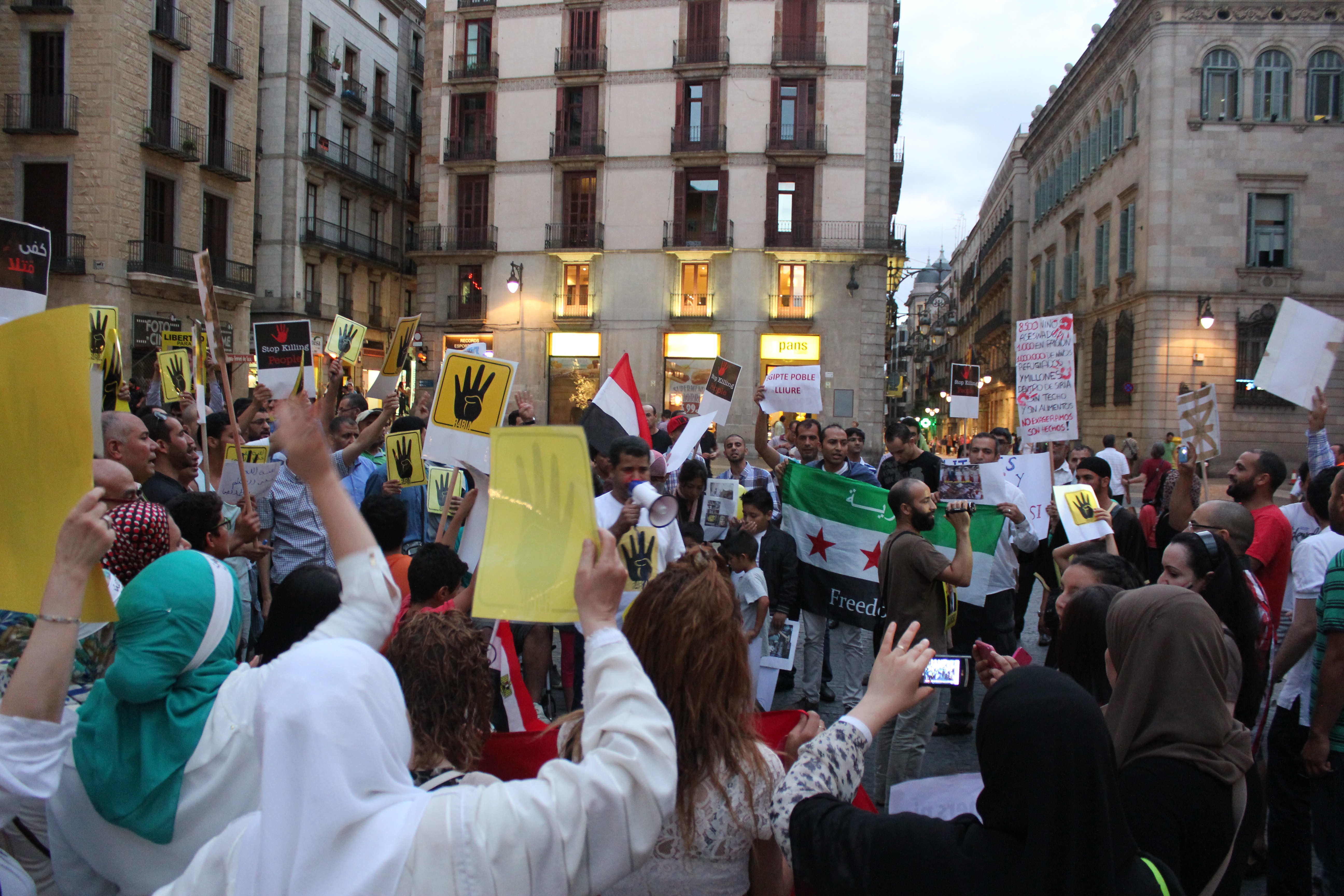
Protesters meet outside the Catalan Government building to protest against the bloodshed in Syria. Image credit: Martin Kelly
As the United States holds the role of the world’s superpower, it still has a stake in the stability of Syria. Should America employ cooperation with Syria’s moderate opposition, the Syrian National Coalition for Opposition and Revolutionary Forces, to facilitate a peaceful dialogue with the current regime and international actors?
Chemical attacks on civilians have changed how the world is reacting to Syria, once cautious of starting another war in the Middle East Obama is now urging America not to turn a blind eye to what is happening. Obama does not need the backing of congress to carry out attacks on Syria but has insisted that it is important to have the debate which is due to be carried out on the 9th September. Despite this we could see an attack on Syria any day now, we watch with bated breath to see how events will unfold.
[1] Chatham House “Syria: International Response to a Growing Crisis” April 2013 www.chathamhouse.org pp 5.
[2] Adelkah, Nina. “If Syria is Attacked, Will Iran Retaliate?” Terrorism Monitor. Vol. XI. Issue 4. February 22, 2013. Pp4.
[3] Ibid.
About the Author






A very good analysis , I encourage you to continue writing .
A US intervention without UN approval will be a war crime. And I think few are those in the Middle East who still believe that the US ‘intervenes’ for humanitarian reasons.
[…] debate on military intervention in Syria. In fact, you would have heard nothing but. Should the U.S. intervene in Syria? Will Obama get the approval he seeks from Congress? Should David Cameron retire after losing the […]