
Educational reform is a topic of much debate in American society. Whether you are watching a political debate, surfing the headlines of CNN, or at a dinner party with friends, everyone has an opinion on what is wrong with education in America and how it can be fixed.
There are some that argue longer school days will help, although countries with higher performing students actually spend less time in the classroom than American students. There is also a growing belief, especially in many urban inner cities, that charter schools are a better alternative. While some charter schools perform, misappropriated funds, inadequately prepared teachers, and underdeveloped curriculum plague many others (edweek.org). There is also a great body of research that argues a parent’s income and education level is the biggest predictor of a child’s success in school. In turn, this may spawn the notion that for some children, their own success is tied to forces beyond their control. For these students with a lower SES, it is a constant uphill battle with little to no resources that can help them along the way. However, that must change.
One issue that is quietly (and perhaps not by accident) overlooked is teacher quality and preparedness. Teacher preparedness helps not only helps the students, but it also deals with the issue of quality teachers leaving the field due to burn out.
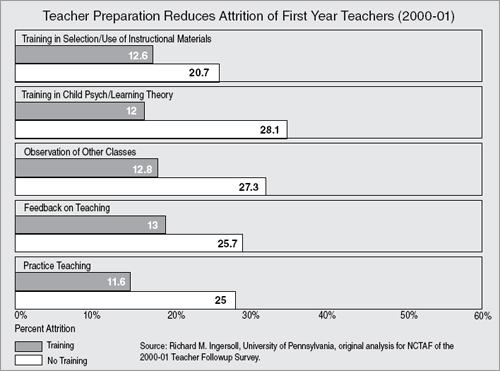
A study conducted by the Consortium for Policy Research in Education did a comparative study on Teacher Quality and Preparedness of six nations – USA, Thailand, Singapore, Japan, Korea, and Hong Kong. Test data was used from 2003 to compare math and science scores between the many different nations, which all five of the Asian nations scored higher than the US in Math and Science. However, it is important to note the US scored higher than Hong Kong and Japan in Reading literacy.
It also important to note that there is no significant difference in instructional hours required between the US and the Asian countries compared. The US already requires more instructional hours than Japan and almost half of the states in the US require more instructional hours than Korea.
While shifting through the data, there are many things that stand out. For one, teaching in Asian countries on average is viewed with more esteem than teaching in the US. For example, in Hong Kong, being a teacher is more esteemed than being an accountant, doctor, or scientist. In the US, becoming a teacher can be viewed as a no man’s land for recent grads that haven’t figured out what they want to do yet. It’s well below becoming a doctor or lawyer, but it’s better than being a cop or a fireman.
Our children’s education. Via marketplayground.com
Ironically enough, policemen and firemen go through a more strenuous background check and requirements for their fields in comparison to teachers. There is also the notion that joining programs like Teach for America is the domestic version of the Peace Corp: man the trenches in an inner-city school to beef up the resume for when one applies to the real field of choice. Or better yet, it’s for people who just like to have their summers off. Also compared to the other countries, teaching in the US has a low level bar set, as well as with other professions within the US. In Hong Kong, the top third of college grads are selected for the teaching profession, while in the US teachers are average or below average compared with other college graduates.
The latter portion of the report focused on each nation in isolation. In the US, there was data that compared teacher preparedness and quality alongside factors such as school setting (i.e. rural, suburban, urban) and poverty level of the school (high and low).
In every category there was a significant difference between low and high poverty level schools. When it comes to teachers being mis-assigned (teaching in a field they don’t have a degree in), whether or not teachers are certified, or whether or not they have a degree at all, 10% of teachers in high poverty schools are not fully certified. Half of the math teachers in high poverty schools don’t have a major or minor that even pertains to math. There is also a significantly large gap between middle school grades and high school grades when looking at teacher quality and preparedness. This means that students are not receiving the proper foundation as they move on to higher grades. By then, some students have become jaded to the idea of school and have all but given up.
The discrepancy between teacher quality and preparedness is significant amongst high and low poverty schools. While we cannot change the SES level or income of a student’s family, we can change they quality of teacher those students get. If anything, those with a high poverty level should be getting the best of what we have to offer, not the worst.
This article was written by Alisha Brown and originally appeared on the Urban Times.
About the Author






I think this article goes right in line with the somewhat recent movement to lessen the power of teacher unions. Unions have a long history of protecting all teachers, whether they have demonstrated competence or not. The longer we continue to protect weak and unprepared teachers, the more difficult the job becomes for the higher-quality teachers and the harder it is for more prepared individuals to enter the profession in the first place. Unions should be taking a hard-look at your data here and considering what they might be doing to damage our education system.
YES!!! I agree that in the beginning unions had a plan in mind but now they need to adapt and change that plan. Teachers could do so more if we were adequately prepared. I admit that my “crash course to teaching” wasn’t very good, and in the end I was a detriment to my students in those first years. Years they cannot get back. I will never forget or forgive myself for that. Things that I picked up on later I could’ve learned before I stepped foot in a classroom had I been properly prepared. I also think at 21 I was too young to be in charge of a classroom, it should’ve been MANDATORY to me student teach for at least an entire school year. Maybe even two.
I think your information is great and helps to enlighten us as Parents more to the value or devalue of the teachers here in America. I believe that a teachers role has greater significance in the lives of our children than a Doctor or a Lawyer. One reason is because this is who are children spend at least on 60% of their time with on a daily basis. The influence to our children is a lot greater, I believe than Parents realize. However, what I would like to know is what we can do an a nation or even an individual parent to begin to see some change in the way our school system is embraced and how this embracing will impact our children whether they have the financial backing for a great education or not. If education is to be valued it needs to be available to every person(s) regardless of there financial status. Last but definitely not least the value of a teacher is talked about in the word of God as a great responsibility but no where is the value of a Doctor or Lawyer mentioned so we need to have more value for the one who teaches (being held to a higher standard) then other professions.