
In May 2014, a natural disaster the size of which officials claim hasn’t been seen in over 120 years hit Serbia and Bosnia, when a huge low-pressure cloud system hovered over the region shedding three-months worth or rainfall in only three days.
Many Serbian and Bosnian cities are several meters underwater and have been evacuated, leaving at least hundreds dead and tens of thousands homeless and displaced. In Serbia, the government has been accused of botching relief efforts, while civilian-led movements have stepped up in an impressive way.
Flood warnings for Serbia and Bosnia-Herzegovina were first announced in mid-April 2014 and some minor flooding, not unusual for the region for this time of year, was seen later in the month.
During the week of May 12, a veil of clouds covered the region and rain constantly poured down for several days. By May 15, the first deaths were reported and over 500 people were evacuated from their homes. The rain kept coming in a constant stream in the following days and the many rivers that run through the two countries kept rising.
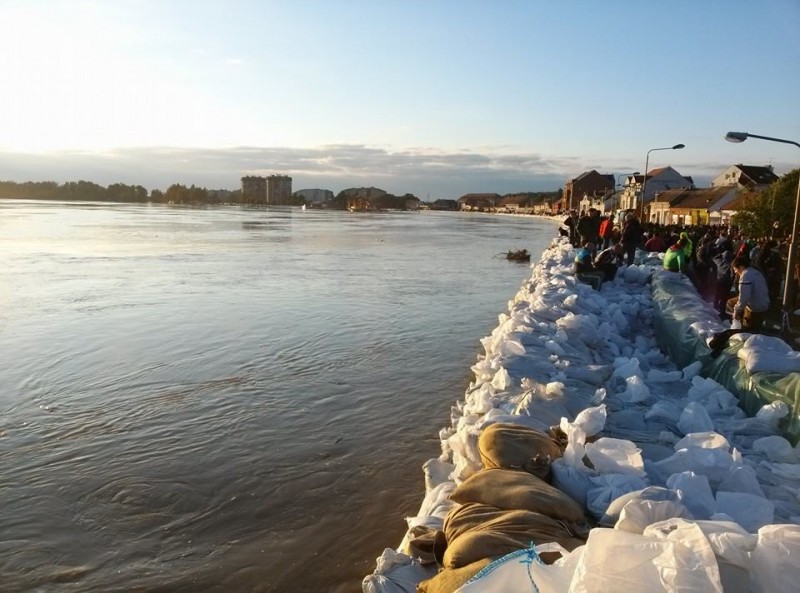
The river rising in Sremska Mitrovica, Serbia, on May 17, 2014. Photo by Stanko Pužić. Used with permission.
Five cities, including the capital Belgrade, and 16 municipalities declared a state of emergency on May 15, while the western and central parts of Serbia were hit hardest by the flooding. Rescue operations by military forces were almost immediately implemented, and major evacuations of several cities were quick and mostly successful. Obrenovac, a city just outside Belgrade and a major national power plant, lost several hundreds of lives in the process.
Official relief efforts and placement of evacuees, however, were not as well coordinated as the military and police rescue efforts.
On Sunday, May 18, an op-ed from Druga Strana (Other Side) portal titled “State, We Don’t Want to Keep You Any Longer” criticized the poor organization and lack of information provided by the government of the Republic of Serbia during this disaster. It soon began widely circulating on social networks and was reposted in many other locations. The site is occasionally unavailable, allegedly due to the number of visits to this particular article on the site.
The op-ed summarizes the disappointment of many in Serbia regarding what seems to be lack of organization among top government officials during the tragic floods. It begins by praising the highly effective coordination of citizens and several new civic movements during the natural disaster:
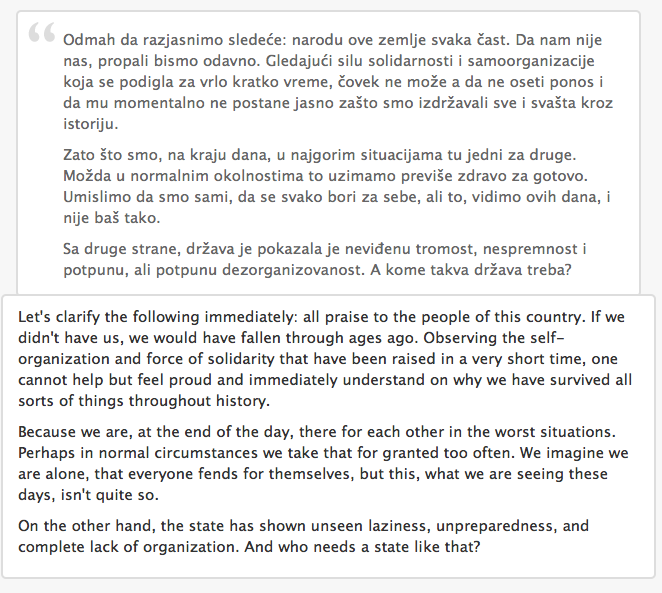
The post goes on to list a number of faults committed by the government during the floods that can often be heard on the streets in Serbia and seen on social networks these days. Among other things, President Tomislav Nikolić has been criticized for only having addressed the nation through media once during the entire ordeal, while Prime Minister Aleksandar Vučić, previously accused of repressing media in the country, has been criticized for claiming too much air time and, along with other ministers, taking advantage of the tragedy for photo ops and political points.
In the meantime, people have banded together to create several civic movements to aid in the disaster relief, from reinforcing dams in cities such as Kostolac, where 20 percent of Serbia’s power supply comes from, to creating information verification and distribution systems on social networks and sites such as Poplave.rs (Floods) and Nestali.rs (Missing). In the first 24 hours of setting up the site for missing people in the floods, the site had 270 reports of missing people and 11 people found.
A team of journalists, bloggers, IT and PR professionals are behind those two sites as well as others, in a highly coordinated effort to transmit and disperse only verified and up-to-date information to the masses as well as map the flood damage.
Among many tweets criticizing the government and praising civilian efforts during the floods, one by blogger and photographer Dušan Ninković expressed what many have been feeling for days:

This article was originally published on Global Voices.





