
How differently the Old Continent looked a century ago!
The British Empire on which “the sun never sets”; the imperialistic Germany which, as Kaiser Wilhelm II proudly claimed, was looking for “their place under the sun”; the Industrial Revolution in full swing; the inner conviction about the superiority over other nations; shortly speaking, the imperialistic spirit was visible from Berlin to Bruges, from London to Lisbon from Moscow to Madrid. Despite the fact that the Concert of Europe (established in 1815, in Vienna) had begun to weaken at the end of the nineteenth century, it was still very difficult to predict the upcoming disaster. The best example was the reaction of the Belgians on the eve of the outbreak of war, who were described by the Daily Telegraph’s correspondent to Brussels in such words: “[they are] literally fighting to enlist and get rifles. There is wild patriotic enthusiasm and no sign of fear”.
The ‘cup of tea’ called imperialism, was full of pride, unhealthy patriotism and a lack of prudence; it simply must have overflowed, which it did in the summer of 1914. As the famous German Chancellor, Otto von Bismarck accurately predicted in 1888: “One day the great European War will come out of some damned foolish thing in the Balkans”.
In the words of German Admiral von Tirpitz: ”the greatest insanity in which races have ever been engaged” started in Sarajevo (the capital of Bosnia) on the 28th of June 1914, where nephew and heir to the Emperor Franz Josef – Archduke Franz Ferdinand and his wife were shot dead by a Serbian terrorist, member of the Black Hand society – Gavrilo Princip. On the same day, Austria-Hungary after receiving a carte blanche (read: an unconditional support) from Germany, declared war on Serbia, whose ally – Russia, ordered a general mobilisation on the 29th of July. It triggered a domino effect and as a result of the complicated system of alliances: one country after another started joining the war (inter alia, Britain had to join the war only by virtue of the Treaty of London, signed in 1839, in which the neutrality of Belgium was guaranteed). Moreover, the European heads of states did not expect that the war would last that long and would involve that many resources. Initially, in accordance with The Schlieffen Plan for example, France was supposed to be knocked out in 6 weeks. It was, as Australian historian L.C.F. Turner described it, a “tragedy of miscalculation”.
Frankly, there are no words to describe the calamity of the war; the numbers speak for themselves and frighten enough to leave them without any comment:
- The war lasted 1 565 days.
- It is estimated that around 8.5 million soldiers died during this period.
- 1/3 of the personnel died because of the Spanish flu.
- 11 British and Commonwealth soldiers died for every metre of ground gained during the Somme.
- 21.1 million soldiers were wounded during the course of the Great War,
- 119 tonnes – quantity of nerve gas used by French, British and German forces.
- 8 million horses were killed during the First World War.
This year, in the centenary of the Great War outbreak, various acts of commemoration have been held across the Old Continent. On the eve of Britain’s entry to the First World War (the 4th of August 1914), the Foreign Secretary – Sir Edward Grey notably told one of his friends that “the lamps are going out all over Europe, we shall not see them lit again in our life-time” – this year the lamps went out again in order to remark that event. The Tower of London moat has been turned red by 888,246 ceramic poppies, one for every British and Commonwealth soldier killed during the conflict.
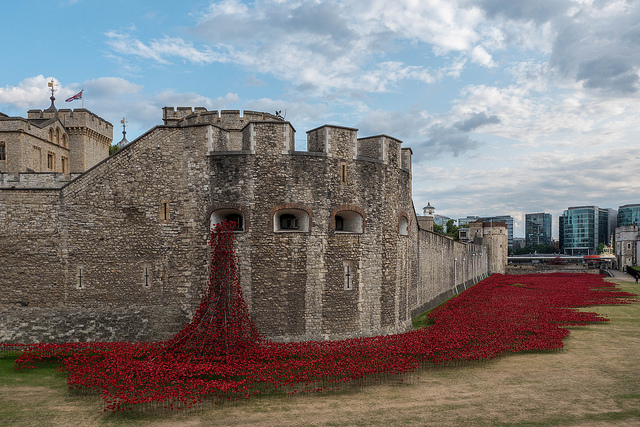
Image courtesy of David Pearson © 2014, some rights reserved.
On the 3rd of August 2014, on Hartmannswillerkopf mountainside (which is also known under the name ‘The Man-eater’, as more than 30 000 soldiers lost their lives during the fights there), the presidents of France and Germany, Francois Hollande and Joachim Gauck respectively, stood for a minute in silence to commemorate the 30, 000 luckless souls that sacrificed their lives. However, “the twentieth century, so bloody, should not be a warning in vain,” said Mr Gauck and also added: “It’s true, Europe is a difficult project, but the generations that preceded us, our ancestors who fought here on Hartmannswillerkopf, on the Marne or in Verdun, would gladly have faced only our difficulties.“
Bearing in mind the current situation in the Middle East, it is very difficult (if not impossible) to imagine such close cooperation between the Palestinian Authority and Israel, and although noone is driven by jejune optimism these days, the world is waiting for a handshake between Benjamin Netanyahu and Mahmoud Abbas; a very similar to Yasser Arafat and Yitzhak Rabin’s from Camp David (which took place on the 13th of September 1993), but this time not a meaningless but a meaningful one – which would mark the twilight of the conflict and the triumph of peace. One might say that the Oslo Accords were illusory but after all, so was the Locarno honeymoon and look where Germany and France are now.
If the old saying is true and the history does like to repeat itself, then who knows what the future may bring.
About the Author





