
When the last polling stations closed in Italy on Sunday night, it had already been clear that the elections turned out to be just what had been expected. Despite the first time front-runners had been declared for the main parties, turnout was very low at 43.1% – at least not worse than in 2009, thus ending a decade-long decline. However, the rest played out the way many forecasts predicted: extremist parties – especially far right ones – gained many seats in the parliament at the expense of the mainstream parties, the European People’s Party (EPP) and the Socialists and Democrats (S&D).
The most worrying results for the European Union come from France, the United Kingdom and Greece. In France, the two mainstream parties have lost considerable shares of the vote to the far-right National Front around Marie Le Pen. She has already promised to “destroy” the EU from within. Meanwhile in the UK, Nigel Farage, leading the Eurosceptics with his party, UKIP, received 27.5% of the vote, fuelling fears that the UK is on its way to quitting the EU. In Greece, the far-left coalition Syriza came first in the election, delivering further proof for the deep resentment many Greeks feel as a result of year-long austerity measures and unprecedented unemployment rates.
So, even when European leaders emphasise the stabilisation of turnout and are eagerly discussing the filling of the top European posts, there is one clear message that emerges from these elections: a large proportion of European citizens are fed up with the Union. Disillusioned indifference over past decades has turned into anger and active opposition to the EU.
Several points need immediate attention. First, introducing front-runners in order to address the democratic deficit has not brought the desired effect of (re)engaging young, often unemployed, and older, disillusioned citizens. Indeed, the fact that, once the results were public some leaders reneged on their promise to appoint the winning party’s front-runner as President of the European Commission, is another step in the wrong direction. The EU needs unity and has to fill the most important posts as soon as possible, for horse-trading will be seen as deceit and play into Eurosceptics’ hands. Concurrently, an agreement has to be found to render the European fundamentals much more accountable and democratic, especially the European Commission, which is in need of reform. The time has come for direct elections, of at least the president, if not all Commissioners, and there is no longer an argument for an assured Commission for each member country, which gives the Commission a bloated and unwieldy image.
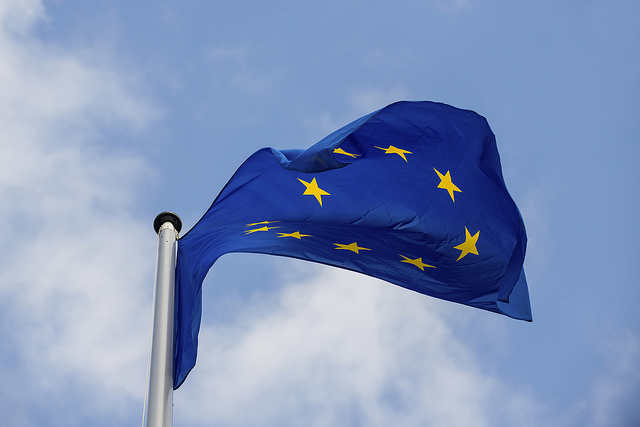
European Flag in the wind. Image courtesy of European Parliament/Flickr © 2014, some rights reserved.
Second, while more arguments are made that the banking union is essential for the survival of the Euro and in support of a return to economic growth, the matter becomes too abstract for many voters. Deeper integration is the right way, yet it is also important that there are tangible, easily identifiable results for the average citizen. An energy union, as proposed by Polish Prime Minister Donald Tusk, would see prices drop not only for businesses, but also for households. Thus, one could simultaneously reduce fuel poverty (which is unacceptably high in developed countries such as the UK) and lower costs for businesses, which would be inclined to employ people with this money.
Third, transnational problems, chiefly immigration, need a concerted policy from all member states. Only through common measures can the individual countries achieve a satisfactory outcome for everyone. However, the EU has been slow on immigration issues, which keep putting more and more pressure on Italy and Spain.
It has long been argued that immigration and other transnational policy problems, such as environmental degradation, are most aptly addressed through the European Union, yet these efforts have not been enough, as is evident by recent immigration or environment statistics.
The election has given a warning shot to European leaders. It is now their responsibility to reform the way that the EU is run, as well as the policies it adheres to. If they have more substantial proof of their work and can give tangible examples to voters, they will essentially have a much better chance to withstand the surge of far-right parties and convince a large majority of citizens to rally behind the European dream. One thing the election has shown is that it is time to change. Not in the way Farage or Le Pen want the Union to change (i.e. to dissolve it), but with deeper integration and profound reforms of the democratic process. Mainstream parties have another five years to demonstrate the European Union’s utility and importance, before the citizens take to the polls again.
About the Author






Michel- Is the problem not deeper than that though? Even if people could be made to trust or respect the EU, there isn’t enough trust between different countries to make a single polity workable at the moment? You can reform political processes at EU level, but you cannot change the fact that the EU will never be an effective supranational body while it is intergovernmental in its design?
Thanks for the comment! You are right when you say that it cannot be as effective as it could be as long as it is intergovernmental in its design and it is difficult to see national leaders relinquish their powers completely in favor of a unified Europe. But, nonetheless, no national leader will feel obliged to work as hard as he can on a European agreement if there is no pressure from his constituency. After all, politicians want to be re-elected, so they care most about the immediate impact of a European directive on their own constituencies rather than the benefits that it could bring to the majority of European citizens. However, as argued in the article, some problems are bigger than nation-states and the EU is the most progressed supranational body ever, which makes it (in my opinion) our best hope to overcome such big problems as immigration or environmental degradation. Therefore, I think that European leaders should realize that exploding the EU (as Marine Le Pen likes to call it) is not an option and moving forward with integration is the best bet to re-engage disillusioned voters. But moving forward in a different way, giving citizens tangible results like lower electricity prices as a complement to the abstract banking union, which is hugely important for the overall economy.
Hope that answers your questions 🙂 thanks again for commenting
Some good points, but I disagree with your comments on the commission and immigration.
If commissioners were not sourced from each member state, what would be the alternative? While a meritocracy may be preferable in principle, the reality would surely be a Western (read, German) dominated commission, as they would most likely field many of the best qualified candidates. The current system is rightly based on equality of national representation in the executive that makes decisions for all members, even if they aren’t there to represent their own countries.
Secondly on immigration, I presume you are referring to a common policy for immigration into the EU rather than within it (as the latter already exists). A common policy at this level would be neither wise nor possible as each country faces drastically different issues with non-EU immigration. In some EU countries, it is a total non-issue, in others it is the absolute political priority. Add this to different demographics, labour markets and welfare policies, and it is clear that a single policy for external migration would be unworkable.
Integration, yes… but only where and when it is viable.
Thanks for commenting 🙂
As regards your point about the commission, I do see the limits of a meritocracy as it would disadvantage smaller countries from the periphery (especially those outside the euro-zone), but I believe that at least the president of the commission should be elected directly.
With regards to your comments on immigration, I perfectly agree with you that different countries face different issues and scales of problems. But that is exactly the advantage of working within the EU rather than as single nation-states between one another. Within the EU, it easier to strike deals, where one country that might have no benefits of a common immigration policy will still agree to one because of benefits it will receive in another area. I have not given any points about the content of such a policy. What I wanted to point to is exactly what you are saying, i.e. that some countries are overburdened by this issue and need help from other member states, especially because it is exactly those countries that struggle with the sovereign debt crisis.