
For the past 3 years, Syria has been immersed in a bloody and complex civil war that has claimed the lives of over 150,000 people. Millions more have been displaced, and it is unlikely that they will be returning home anytime soon. For those still in Syria, death and destruction have become commonplace, and daily life is a constant struggle:
According to the U.N., more than 9.3 million people are affected by the crisis and 3.5 million Syrians are living in areas under siege. Men, women and children have fallen victim to bombardments, rockets, mortars and other attacks. Cities that are surrounded by government troops or militias lack food and medical supplies. One-third of the country’s water treatment plants no longer function, and more than half of the health centers are destroyed.
In February, the UN Security Council unanimously passed a resolution to boost access to humanitarian aid to Syria. While this was a progressive move for the characteristically obstinate institution, it has done little to change the dire circumstances within the country. Moreover, there appears to be no end in sight, as peace talks between the government and the opposition have failed continuously.
The current government in Syria has been accused of war crimes, but President Bashar al-Assad has repeatedly refused to step down. In September, the UN found clear evidence that the government had utilized chemical weapons. Subsequently, under heavy pressure from the international community and the threat of a US intervention, the Syrian government agreed to a UN Security Council resolution requiring it to eliminate its chemical weapons arsenal.
On April 27th, the Syrian government missed the second deadline to complete this task, but is apparently only days away from finishing the job. According to the New York Times, Syria has now shipped out or destroyed 92.5% of the arsenal. That accomplishment, however, “… is now overshadowed by reports that Syrian forces have attacked targets with bombs filled with chlorine gas. The government denied those reports.”
Moreover, there have also been reports of army helicopters dropping barrel bombs in heavily populated areas. Barrel bombs are drums filled with shrapnel and explosives, and are capable of leveling entire buildings.
https://www.youtube.com/watch?v=CqX7N9t2Uxk
Despite the continued violence and disarray, the Syrian government recently announced that it would hold presidential elections in June. Many have viewed this as a cruel joke on the Syrian people. After all, the Assad family, which is much like a mafia, has viciously ruled over Syria for decades, and it is unlikely that they will allow this to change. Moreover, Assad just announced that he will run for re-election, and it is widely considered that he will win. Additionally, as Ben Hubbard notes for the New York Times:
Hence, many have viewed the elections as a sham and a pathetic attempt for the Syrian government to appear legitimate. Not to mention, millions of Syrian refugees will not be able to vote in the elections. Furthermore, for those still in Syria, heading to the polls could mean the difference between life and death. Why would anyone risk his or her life to vote in a predetermined and undemocratic election?
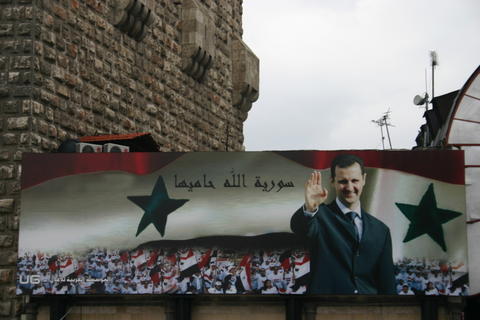
Billboard with portrait of Assad and the text ‘God protects Syria’ on the old city wall of Damascus in 2006. Image credit: Bertil Videt
To make matters worse, the UN has claimed the elections could derail the Syrian peace process. Lakhdar Brahimi, a peace mediator, recently told the members of the U.N. Security Council, “If there is an election, then my suspicion is that the opposition, all the oppositions, will probably not be interested in talking to the government.”
Despite all the criticism, the Syrian government has maintained that the elections will be fair and democratic. On April 23rd, lawmaker Maher Abdul-Hafiz Hajjar became the first officially registered candidate.
Unfortunately, these elections inspire little hope for change in Syria, and it is very difficult to be optimistic about this country’s immediate future. Moreover, the current crisis in Ukraine has regrettably drawn a great deal of focus away from Syria. Syria’s fate is largely tied to relations between the veto-wielding states in the UN Security Council, primarily the US and Russia. Presently, that relationship is very strained, as thousands of Russian troops have amassed along the Ukrainian border, and, in response, the US has sent troops to Poland for exercises.
Correspondingly, Fawaz Gerges, who holds the Emirates Chair in Contemporary Middle Eastern Studies at the London School of Economics and Political Science, contends:
Assad would not have sought a third presidential term if Iran and Russia, his two powerful patrons, had advised against it. Both have tipped the scales in his favour and obviously view him as indispensable. This explains Assad’s ability to resist the powerful regional and international coalition battling his regime and to go on the offensive. Indeed, the new proxy battle playing out in Ukraine between Russia and the US would stiffen President Vladimir Putin’s resolve to resist Western efforts to unseat Assad. The Ukraine crisis will most likely intensify the great power struggle over Syria and the Greater Middle East.
Ergo, the US and Russia must learn to overcome their differences and cooperate, or countries like Ukraine and Syria will continue to pay the price. Powerful states have often allowed weaker states to suffer in the pursuit of their own selfish interests, but what is occurring in Syria is absolutely despicable. Accordingly, a UN-appointed human rights commission recently argued that the UN Security Council bears responsibility for the war crimes in Syria. As Al Jazeera notes,
Therefore, the international community needs to make a more concerted effort to end this conflict for the sake of the Syrian people. We cannot stand idly by as this country rips itself apart. The Syrian government must be held accountable for its crimes. This will never occur if the major powers continue to allow their differences to prevent decisive action. In this complex and globalized world, cooperation is the key to survival.
About the Author





