
The war on drugs in the Americas conjures up a broad array of images: assassinations, gangs, executions, cartels and battles with the police and armed forces. The war on drugs also brings home the images of those who are affected by the drugs themselves; addiction, or those innocents caught in the crossfire. It is a conflict that is drenched in blood. Then there is the cost to the governments participating in this war; In 2010, the US Federal Government spent $15 billion on this alone. With a feud that reaches back to the Nixon administration, the total cost from to 1971 to 2012 is estimated to be over $1 trillion. To give some perspective of just how much money this amounts to, this exorbitant sum, devoted purely to preventing the sale and transport of drugs would cover New Zealand’s GDP for nearly five and a half years. A sobering statistic by any measure.
Recently, however, a number of governments in both North and South America, in which this decade’s long face-off plays out, have begun to perhaps recognise this expensive impasse, and ease back the restrictions on certain narcotics, notably cannabis. Perhaps the most widely known examples are in the U.S. states of Washington and Colorado. In the 2012 elections, the option to legalize purchase of small amounts of the drug for personal use was on the ballot, and it won. As a result of this victory for anti-prohibitionists, those over 21 can legally buy it from licensed stores. Two years on and an almost identical measure was voted for in Alaska. Several thousand kilometres south of the U.S., and Uruguay has recently passed a nationwide bill that legalizes the sale, growing, and consumption of the substance.

Image Source: L’OBS http://tempsreel.nouvelobs.com/monde/20131210.OBS8989/cannabis-l-uruguay-ose-la-legalisation.html
Could this be the start of new era? The nascent emergence of a continent-wide approach to tackling a problem that has so far vexed many successive governments, taken so many lives, and sapped hundreds of billions of dollars on government spending? Perhaps so. Regarding attitudes towards users, the legalisation of cannabis appears to be part of a growing trend in changing attitudes towards the drug itself. The aforementioned referendums in the U.S. and legislative measures in Uruguay do seem to indicate a marked adjustment in how this issue is approached. The governments of these states and the country may realise that adults should be allowed freedom of choice in their lives. The legalisation of cannabis is an extension of this.
On the scale of the drug war, the approach may well have beneficial effects, such as undercutting the smugglers, which was in fact the intention of Uruguay’s government. Remove the ability to make profit by legalizing something that is illegal, and the business no longer becomes worthwhile, as the cartel’s raison d’être is, for all intents and purposes, brushed aside. Indeed, a study that was published shortly before the measures passed in Colorado and Washington estimated that the cartels could lose out around 30% of their earnings. (Oregon was also factored into this, but the measure did not pass.) Another study, from RAND corporation in 2010, hypothesised that legalisation of cannabis in California would effectively obliterate the cartels’ profits from its sales. Moreover, the legal sale of the drug would be subject to much more stringent quality controls, thereby safeguarding from potential adverse effects of its consumption.
On the surface, it may seem like a new era is approaching when it comes to drugs, and in some respects this is true. Increasingly, addiction is being seen as more of an illness rather than a crime, and the addicts as patients rather than felons. But for all the talk of liberalisation and changing attitudes, little actually seems to be changing or indeed will change. The hard drugs like cocaine, LSD, heroin and meth-amphetamine remain criminalised, and this is a situation unlikely to change any time in the near future. Governments may be tentatively approving measures to ease the penalties and restrictions on a drug like cannabis, but little to nothing has been said about the aforementioned hard drugs. Moreover, the current tough measures do not look like they will be halted. In late winter 2012, Janet Napolitano, former US Secretary of Homeland security stated that war on drugs was not being lost.
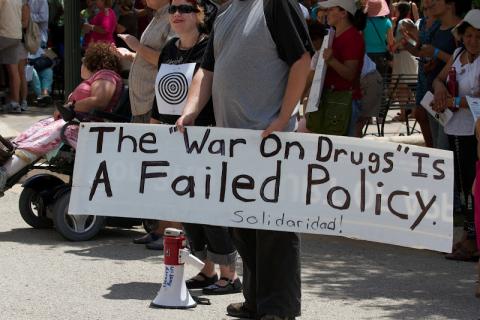
Image Source: The Petroglyph http://thepetroglyph.com/americas-drug-war-a-failure/
Moreover, others have argued that the drug liberalisation in recent years, especially in the U.S, will in fact do little to curb the cartels profits. Keegan Hamilton writing in The Atlantic argues this very point will hold true unless more of the border states liberalise their drug laws. However, this seems unlikely as many of these are controlled by the Republicans, who aren’t exactly the vanguards of drug liberalisation. Nonetheless, Keegan’s assessment seems to have been short sighted. US legalisation in Colorado and Washington appears to be having the effects projected, in that cartel profits are being adversely curtailed some instances.
In any case, this does not change the stark reality that the attitude to the war itself largely remains the same, and probably will do so for many years to come. For all the softening of restrictions on cannabis, the US continues to pump multi-billion dollar budgets into halting the supply of drugs, most US states continue to prohibit the drug, most Latin American countries have not taken the liberal steps of Uruguay, and the other, harder narcotics are unlikely to pass legislative efforts at decriminalization in any regional or national chamber.
Whilst there are minuscule signs of change, the status-quo looks likely to remain just as it is for quite a while. For any real progress to be made, the change in attitudes to drugs will have to be much more radical. Cartel profits might suffer from legalizing one of their products, but drugs like cocaine and heroin will still net them millions of dollars in revenue. Moreover, it cannot be a loose assembly of American states and South American countries. All nations who are affected by this war would arguably have to pass similar liberalisation laws. Naturally, this does present the risk of addicts having easier access to their fix. However, if this undercuts the cartels, the dollars saved from not policing the border could be better spent on treatment, and the drugs themselves like the RAND report stated would be subject to more stringent safety controls.
In closing though, this sort of attitude seems unlikely. Government attitude to drugs remains stubbornly puritanical, with the attitudes and money pointing in much the same direction as they have done for the past forty years.
About the Author





