
As the political crisis in Egypt deepens and anger spreads from Cairo to the different Egyptian governorates, the attention of citizens has turned towards the Egyptian Armed Forces. Some are now hoping that a coup will end not only the crisis, but also the rule of the first elected civilian President Mohamed Morsi.
During his first few months in office, Morsi appeared to gain control of the politically and economically powerful military by retiring a number of senior officers. The most important being Mohammed Hussein Tantawi, the head of the Supreme Council of Armed Forces (SCAF), which ruled the country in the period between Mubarak and Morsi. Experts hailed this move as the long-needed end to the political role of the Military, which had played a prominent part in Egyptian politics since the 1952 coup.
However, the Egyptian Military has been sending signals to the populace during the ongoing turmoil. The most prominent of which was a statement made by the new Defence Minister Abdel Fatah El Sissi where he warned of state collapse, if the current turmoil drags on. He stated that the Army is “the solid mass and the backbone upon which rest the Egyptian state’s pillars,” hinting at intervention. The new Chief of Staff, Sedki Sobhi stated that the Egyptian Army “keeps an eye on what goes on in the nation and if the Egyptian people ever needed the armed forces, they will be on the streets in less than a second”.
Lately there have been widespread rumors that El Sissi was about to be removed by the President due to disagreement on the destruction of the tunnels between Sinai and Gaza by the Military. The Presidency immediately denied such allegation stating that there is a high level of cooperation between the Presidency and the Military. The question that now imposes itself is: “has Morsi finally de-politicized the Egyptian Military?”
The answer to this question is a clear “NO”.
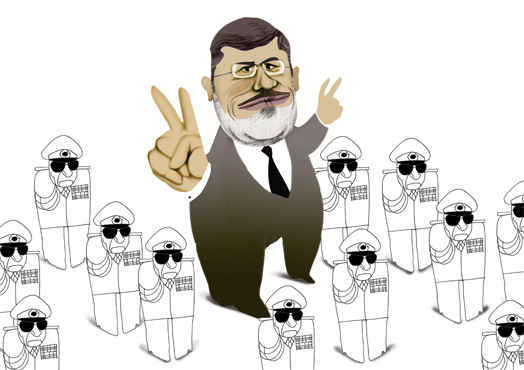
Cartoon by Mohammad Ali Ziaei
The Egyptian Military remains an independent political and economic power, heavily penetrating the state. Some experts estimate that the Military controls up to 40% of the Egyptian economy. The Military business empire extends from mega infrastructure-projects to consumer goods. These enterprises are exempt from taxes as stipulated by Law no.32 of 1979. The new constitution adopted in a controversial referendum gives the Military broad powers, and keeps the Military outside the realm of civilian control. This enshrined the economic and political power of the Military over the state and the elected President. In short, Egypt can be classified as a “Deep State”. Thus, the notion that Morsi depoliticized the Military is feeble at best. On the contrary, he seems to have reached an arrangement of co-habitation with the Military. However, the poor performance of the President combined with strong resistance to his policies seems to have excited the appetite of the Military for a return to direct or quasi-direct rule – Morsi gave them an opening.
The Military has recently been trying to whitewash its image and resurrect its popular appeal. This explains the lack of resistance to the forced retirement of senior officers that were associated with the suppression, abuse, and murder of protestors in a number of now infamous incidents. Thus the removal of Tantawi and his replacement by a younger more approachable El-Sissi was necessary. It is important to point out that Tantawi was decorated with the highest medal in the country and calls to bring him to trial went unheeded. The Military has been trying to reconstruct its image as a neutral institution that has no political affiliation, only interfering on behalf of the “people”. This theme is repeated in most of their statements, before emphasizing their readiness to intervene to protect the “interests of the nation”. There are also attempts to show that Morsi and El Sissi are at odds with each other, particularly in relation to Hamas, which is being increasingly portrayed as a danger to Egyptian national security, and a source of terrorism. Morsi is portrayed as a man willing to sacrifice Egyptian interests for the sake of ideological commitments to Hamas. On the other hand, El-Sissi is portrayed as a man whose primary concern is Egyptian security and national interests.
The hand of the Military is strengthened by the shortsighted, exclusionary policy followed by the Muslim Brotherhood and President Morsi. Fear of an economic collapse combined with the neo-liberal economic remedies used by the President are increasing discontent and making the Army more attractive. This is especially true amongst women and religious minorities that are fearful of losing their civil liberties. Equally, the middle classes feel increasingly economically and politically disenfranchised. It is worth mentioning that this discontent has spread from the capital to the periphery of the country, showing an increase in the level of discontent and a widening of the zone of confrontation. The clearest example is the coastal city of Port Said that declared civil disobedience and a general strike.
The Military remains an exceedingly powerful actor in Egypt and the possibility of direct intervention is increasing as the political turmoil in the country continues. The major restraint against Military intervention is the United States. American aid and weaponry are of the utmost importance to the Egyptian Military. Conversely, stability in Egypt is of the utmost importance to the United States. As long as the Brotherhood convinces the Obama Administration that they can maintain stability in the country then the room for the Military to maneuver will be severely limited. However, if Morsi loses the backing of the Americans and political turmoil and violence continue then a coup becomes more and more plausible.
About the Author






[…] it needs to leave first. The Egyptian Military never truly left the Egyptian political scene. In a previous article I argued that President Morsi has failed to end the role of the Military and that the re-shuffle of […]