
The Turkish Prime Minister, Recep Tayyip Erdoğan, has the status of a national hero in the Middle East. This status was first created during his now famous walk-out during a debate with Shimon Peres during the World Economic Forum in 2009, where Peres attempted to justify Operation Cast Lead in the Gaza Strip. What made this walk-out even more popular among the Arabs was that Amr Moussa, the General Secretary of the Arab League at the time, was present and he did not follow the Turkish Prime Minister. This walk-out symbolized Turkish strength and Arab weakness. It was the beginning of the awakening of the Turkish role in the Arab World. The Ottoman had returned. This policy of extending Turkish soft power reached new heights with the advent of the Arab Spring; the Turkish position in support of the Arab revolutions, in particular the Syrian revolution, its brand of economically successful Islamism, and the historical ties between the Arab World and Turkey have been the basis of this growing Turkish soft power.
Turkey is considered by many in the region to be an economic and political success story. Under the leadership of the Islamist Justice and Development Party, Turkey has achieved impressive growth rates and has pioneered the model of a successful, pious, economically powerful Muslim bourgeoisie. Most Arabs, Islamist and secular alike, look at this brand of Turkish Islamism as the model to follow.
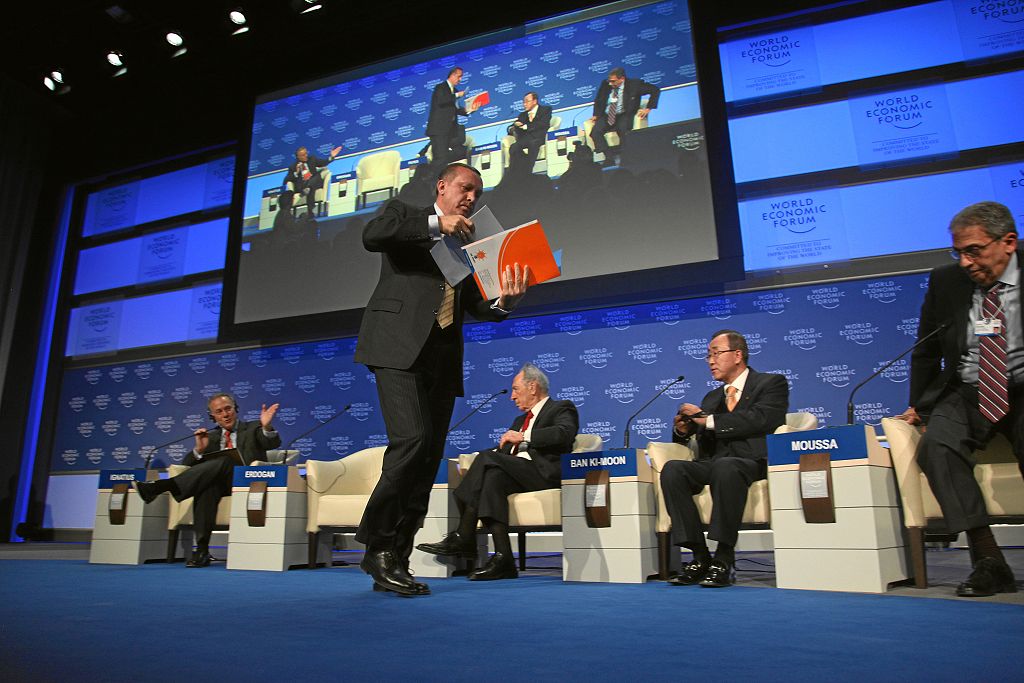
Recep Tayyip Erdogan, Prime Minister of Turkey, leaves a session at the World Economic Forum in Davos. Image Credit: WEF/Flickr
This model is very attractive to secular forces in the Arab World because it respected the secular nature of the Turkish State and the democratic process that brought them to power. There were no attempts to roll back civil liberties. The Islamists on the other hand, look with admiration at the ability of the Turkish Islamist forces to successfully manage the country and turn it into an economic power house. On the political side, the Islamist government was finally able to end the notorious role of the Turkish military as an independent power center heavily penetrating the state, what has been also called the “the deep state”. By doing so the Islamist government increased the entrenchment of the democratic process and ended the rule of the generals. This also made the Turkish model very attractive for the Arabs, particularly in a country like Egypt, where the military still remains an independent power center outside the control of the civilian government. It is worth mentioning that there were hopes that President Morsi would follow the same path and end the role of the politically powerful military, hopes that were quickly shattered by the accommodative approach followed by Morsi towards the Egyptian generals.
In terms of foreign policy, Turkey followed a policy line that focussed on enhancing its regional prestige among the Arab masses. This policy was in place before the advent of the Arab Spring. Turkish policy and rhetoric were clearly anti-Israeli and pro-Palestinian, especially after the flotilla incident, where a number of Turkish nationals were killed off the coast of Gaza. Turkey took a harsh stance against Israel at a time when Egypt, the biggest Arab state, was participating in the blockade of the Gaza strip; once again, exposing Arab governments as either weak or collaborators with Israel. This anti-Israeli rhetoric reached a climax when Turkey declared that it would use force to protect any flotilla that aimed to break the siege of Gaza, threatening to spark a military confrontation between the two countries.
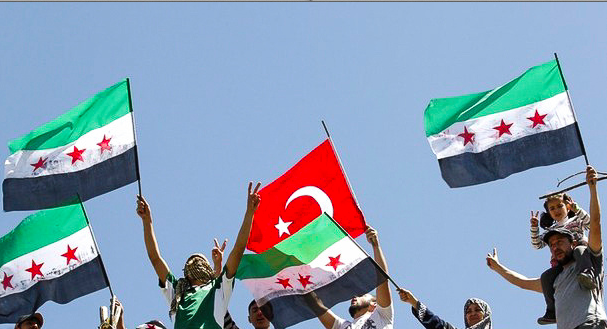
Syrian refugees wave Turkish and Syrian Independence flags during a protest against Assad at Yayladagi refugee camp in Hatay province on the Turkish-Syrian border April 10, 2012. Image Credit: Freedom House/Flickr
This policy reached new heights with the advent of the Arab Revolutions, especially the Syrian uprising. Although, at one point considered to be one of the closest allies of the Assad regime, Turkey was able to distance itself from Assad and strongly support the uprising. Turkey provided refuge to the leadership of the free Syrian Army, and has been openly critical of the Assad regime’s suppression of the uprising, calling on him in a number of occasions to step down and end the slaughter.
This policy is part of Turkish ambitions to play a major role in the affairs of the Arab World. Turkey, which tried to cast itself as more European, exemplified in its attempts to join the EU, ignoring factors of history, culture and religion seems to have rediscovered itself. Turkish policy has aimed at regaining its traditional role as a regional power house, and it has realized that one of the main components of this is soft power, which it has steadily accumulated over the past few years. This combined with economic and military power, set the stage for the return of the Ottoman to the Arab World.
About the Author






Not a single line spared to mention the countless breaches of freedom of information such as the arrests and imprisonment of hundreds of Turkish journalists. Or other “success stories” like the denial of religious liberties to minorities or civil liberties clamp-downs by the states security forces, accusing anyone opposing the AKP’s political line a terrorist.
Thank you very much for your comment. Please consider that this article refers to the perception of Turkey under the AKP in the Arab World, it is not meant as a justification or defense of the AKP. The argument refers to the increase of Turkish soft power in the Arab World and is not intended to defend or critique the civil liberties records of the Turkish government. It is written from an Arab rather than a Turkish perspective.