
Earlier this month, Jon Stewart announced that he was leaving Comedy Central’s The Daily Show after 16 years as host. For much of that time, The Daily Show set (and continues to) the gold standard for television satire in the United States and beyond. Jon Stewart has had a material impact on the way that news is done in the world’s most powerful country. It’s worth taking a moment to consider the many different ways in which his impact has been felt, but first, a word about satire itself.
The Important Art of Satire
“I have never made but one prayer to God, a very short one: Oh Lord, make my enemies ridiculous.”
(Voltaire)
Satire matters. Of all the reactions one can legitimately have to the overreach of power – anger, despair, righteous indignation – few are so harmful as ridicule. Given that all power – even and perhaps especially tyranny – depends to some extent on the participation of the masses to enable, perpetuate and enforce it, must appear worthy of obedience, whether through respect or fear. Ridicule chips away at both. A society that permits the satire of its institutions is one provides for a destructive and valuable form of dissent.
It’s no exaggeration to suggest that strong, biting satire is both a symptom of, and a contributor to, a healthy democracy. Indeed, recent attacks on satirical institutions such as Charlie Hebdo by Islamic fundamentalists – humanity’s latest fascists – are a poignant reminder of why we should distrust and revile those who cannot stand to be joked about.
Less grandiosely but no less importantly, satire can serve as catharsis. With public approval of the US Congress dipping to record lows, traditional party allegiances in the UK breaking down over exasperation with mainstream politicians, and political dissatisfaction rife in Europe over the Eurozone crisis, the West is living through some of the most politically cynical times in recent memory. To indulge in the mockery of our incompetent governors is a blessed relief; a much-needed release valve for our collective frustration. In many ways, Jon Stewart’s retirement comes at the worst possible time, yet he leaves the art of satire in excellent health.
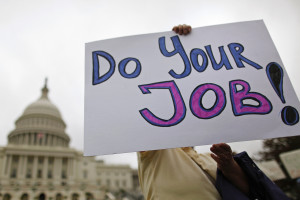
Image Source: http://bit.ly/182kEXY
His protegés and the healthy condition in which he leaves satire today
Under Jon Stewart, The Daily Show became a finishing school for up-and-coming comedic talent. Many of his “correspondents” went on to become stars in other fields – such as the increasingly diverse actor Steve Carrell – however some of those who chose to continue in comedy have been as impactful as Mr Stewart himself.
The standout example is Stephen Colbert, who left The Daily Show in 2005 to host The Colbert Report. Mr Colbert refined his own brand of satire, pretending to hold the same views as his targets but extending them to ludicrous – if usually logical – extremes. Such was his success that he was picked to replace the venerable David Letterman as host of The Late Show, the longest-running and perhaps most-esteemed of the many American late night talk shows. These shows, far more than their British equivalents, have a tradition of comic commentary on current events beyond the celebrity chats which are their main focus. Consequently, their hosts are nearly always comedians, and indeed Jon Stewart himself hosted one for two years before he took over The Daily Show and made it what it is today. There is broad overlap in this world, and many of today’s talk show hosts acknowledge Jon Stewart’s influence, the extent of which became clear in his appearance last year on Late Night with Jimmy Fallon.
British-born comedian John Oliver is the latest Daily Show alumnus to follow in this path, leaving in 2013 to host Last Week Tonight, a weekly media/political satire show for HBO. Last Week Tonight has just started its second series and has already achieved widespread acclaim, particularly for Mr Oliver’s typical practice of investigating a subject in extreme detail in the show’s second segment, and then linking that investigation to attention-grabbing tactics that often leverage social media. It’s clear to see the influence of Mr Oliver’s Daily Show experience in moments like this; his fantastic comparison between the USA and Australia on gun control contains clear traces of his nascent comedy-activism.

British Political Satirist Jon Oliver. Image Source: http://bit.ly/1zLg1Jn
The impact he’s had directly on the US news media
Indeed, though Mr. Stewart appears less interested than his protégé in directly calling his audience to action, his show dominates the news agenda to a tremendous extent nonetheless. This is due to his exceptional talent for identifying and skewering hypocrisy, corruption and bias. His renown is no accident; he and his writers really are some of the best in the business.
The impact he has had on his targets is undeniable. One notable example was his blistering appearance on the CNN debate show Crossfire in 2004. Ostensibly, he was there to promote a book, but throughout the show he returned the conversation to his many criticisms of its format: a Democrat and a Republican pundit would take turns questioning their guests, forcibly superimposing a belligerent left-wing/right-wing filter over every issue. Mr Stewart’s dissection of this approach makes delicious viewing for any satire fan: he dismisses the hosts as “partisan hacks” who fail to fulfill their journalistic responsibilities and the programme itself as dishonest, polarising “theatre”. When Jonathan Klein took over as president of CNN less than a year later, he cancelled Crossfire, and even stated that Mr. Stewart’s criticism was a factor in his decision, saying he agreed “wholeheartedly with Jon Stewart’s overall premise”.
For almost all of his 16 years on The Daily Show, Jon Stewart has been a thorn in the side of bias, laziness and gimmickry in US media and politics. Unlike so many similar liberal commentators, however, his targets know they can’t ignore him – or perhaps they just can’t resist rising to his bait. All of Fox News’s biggest names have felt the need to react to Mr. Stewart’s prodding: Bill O’Reilly, Sean Hannity, Greta Van Susteren, Howard Kurtz. His scathing, week-long attack on CNBC’s miscalculations regarding the 2008 financial crisis prompted a confrontational interview with Jim Cramer, host of the channel’s Mad Money programme. The much-hyped meeting drew 2.3 million viewers and made a huge dent in Mr. Cramer’s credibility, with the next day’s media widely reporting that he had been crushed (it was even mentioned in a White House press conference). Days after the show aired, a group of economists issued an open letter to CNBC demanding higher journalistic standards.
His contribution to informing and impassioning the public
For all the wounded accusations of bias that he draws from his targets – and to which he freely admits – it’s usually difficult to say that Jon Stewart is wrong. This is partially due to the fact that his show is very thoroughly researched, but also because many of his bits seek to expose and lampoon corruption or hypocrisy in establishment figures, which is easily done with just a couple of video or audio clips. His constant attacks on Chris Christie, the governor of New Jersey, are paradigmatic examples: each is a devastating blow to the man’s credibility, accomplished with almost contemptuous ease and élan.
This is Jon Stewart’s bread and butter, and makes for rewarding satire. But if his success has a dark side, I would suggest it emerges on those occasions where Jon Stewart does get it wrong. His favourite targets in the news media like to protest – or perhaps ‘whine’ would be a better word – that his accusations of bias are hypocritical when he is himself so openly liberal in his political leanings. His response is that, as a comedy show, he shouldn’t be held to the same standards as serious news programmes, which have a duty to inform the public in an accurate, impartial manner. This has usually seemed reasonable to me, but as his satire so often depends upon exposing misrepresentations of fact – whether wilful or not – Jon Stewart has had to hold himself to high standards when dealing with questions of truth, and there have been occasions where he has fallen short.
For example, in 2014 he apologised for suggesting that the death of a black man in California resulted from one of several cases of police violence, when in fact the cause of death was listed as a drugs overdose. Fox News, rather distastefully, leapt on this mistake with relish, prompting Mr. Stewart to respond with a four-letter word and the spiteful retort that “The Daily Show has to be right one hundred percent of the time. Fox only has to be right once.”

Fox News’ Bill O’Reilly and Jon Stewart in a Head to Head Debate. Image Source: http://bit.ly/1JRcxPy
He was perhaps right to feel frustrated, but the spat reveals something important about the brand of satire that he minted and which his heirs are refining: its purveyors must be impeccable in their integrity and their factual accuracy. The news media are right to fear their influence: in skewering their targets, satirists set themselves above them, and as such appear to be more credible to the public. Mr. Stewart can resist comparisons with news media all he likes, but so successful has he been in exposing their failures that he has, in the eyes of many of his viewers, come to be more trusted with the truth. (This was the subject of his interview with Fox News’s Chris Wallace in 2011.)
This is a dangerous case of affairs in some ways, but perhaps it’s the ultimate proof of Jon Stewart’s success and his extraordinary influence. To anyone who understands the importance of satire, whether for keeping the establishment honest, for informing the public when it’s not, or simply as catharsis, his impact has been peerless.
About the Author





