
Earlier this week a UN Special Rapporteur Rashida Manjoo, told the press she believes that the UK has a ‘sexist culture’; particularly when it comes to the portrayal of women in the media. A professor in public law at the University of Cape Town, Ms Manjoo told journalists that her concerns about the portrayal of women in the UK media were shared by government ministers that she had spoken with, and that in her opinion it was evident that:
Brief excerpts of her interview quickly began to trend across the social media and it wasn’t long before the papers hit back.
The Sun newspaper running a two page spread by Louise Mensch titled ‘Shut it, Sister’ suggested that because the Queen is our head of state, we couldn’t possibly have a problem with sexism.
The Daily Mail’s Daniel Hannan wrote:
Surprisingly perhaps, the worst offender when it came to publishing an insular, reactionary work of mock indignance was the Daily Telegraph. In a tragically ill-informed article titled ‘Rashida Manjoo, it’s nonsense to claim that Britain is sexist’ the Daily Telegraph’s James Delingpole; dismissed the UN rapporteurs comment’s as ‘politically correct mischief-making’, going as far as to claim that “…in Britain, at least, we live in a world much more favourably arranged towards women than it is for men.”.
Delingpole makes his claim without citing a single verifiable figure that provides evidence to support it. That should be expected really, because there are none. There is, however, an abundance of figures which don’t sit too comfortably with the self-deluding beliefs of closet chauvinists like James Delingpole.
Inequalities in Politics
Women only represent 23% of MPs in the House of Commons and 23% of Lords in the upper house [1)
Only 3 of the 22 Ministers in the current UK Cabinet are women.
Inequalities in Buisness
Women hold board positions in only 19% of FTSE 100 companies.
The proportion of women holding executive positions at FTSE 100 companies is only 6.1%.
Inequalities in Academia
Women Make up less than 20% of professors at UK Universities.
Inequalities in social matters
Women account for 73.1% of victims in incidents of domestic violence.
One could go on like this all day; but the very fact that such appalling statistics are so readily available is shameful. It is a simple truth that where there is no parity, there is inequality and where inequality exists; justice does not.
But is that problem cultural?
Well, it seems the fault does not lie with legislature of the UK. Since 1918 and the Qualification of Women Act, the legislative history of the UK, with regards to progress in dealing with incidences of discrimination, should surely be regarded as exemplary.
The fact that the UK has enacted the Equality Act 2010 – which covers everything from workers pay to access to employment – is evidence enough that our political leaders are leading by example.
An argument can be made that the courts are also taking leading by example. For instance, the UK has one of the highest divorce rates in the EU. Thus, perhaps we should celebrate that our legal system supports the rights of women to end unhappy and potentially abusive relationships.
Furthermore, the recent introduction in England and Wales of ‘Clare’s Law’ (also known as the Domestic Violence Disclosure Scheme) is demonstrative of a proactive culture within our criminal justice system when it comes to dealing with cases of abuse. The scheme allows individuals to have access to police data if they suspect that their partner has a history of domestic violence.
But while critics may argue that it has taken the criminal justice system eleven years to bring charges against a doctor in a case of female genital mutilation; it is also true that visible evidence of police action is not necessary a prerequisite for the presence of justice.
Our laws are not to blame, our courts are not to blame yet inequality prevails. How then can the problem be anything but cultural?
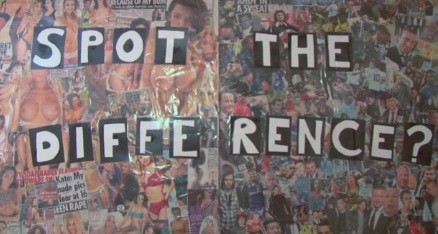
Women and men are portrayed differently in the media. Image credit: Getty Images © 2012.
If we are to look at recent articles in British newspapers, we will perhaps notice an important pattern around the portrayal of women in the media:
Sometimes the tabloid’s will mark International Women’s Day with articles like:
‘Brit babes are biggest love rats! Girls the world No 1 at playing away’ – as the Daily Star did this year.
Other days there are papers, such as the Daily Mirror, that place a topless paparazzi photo of Heidi Klum alongside a story of a young woman who was murdered by her partner. This is most interesting as research suggests that sexualisation of others makes violence towards them seem more acceptable.
It seems that these contradictions in the portrayal of women in the media is becoming ever more common, as editor of The Spectator, Frazer Nelson, noticed this week.
One such example is that of Lucy Holmes, founder of campaign group, ‘No More Page 3‘. Like so many others Lucy noticed something was wrong in our media culture, particularly when it came to the portrayal of women. On the day that Jessica Ennis won her Olympic gold medal, Lucy noted that the largest female image in The Sun was that of a young woman showing her breasts for men, on the paper’s infamous ‘page 3’. She decided she wanted to change that, which lead to the beginning of her campaign group.
‘No More Page 3’ is a campaign group with one reasonable purpose: to take the bare boobs out of the Sun.
It’s importance in the next phase of the women’s rights movement in this country should not be under-estimated. So long as the biggest selling newspaper in the UK devotes more space to the accomplishments of women’s mammary glands then it does to their achievements in politics, science, the arts, sports, engineering, business, charity work, medicine, law; everything that makes our society great – we will not free ourselves of a sexist culture.
[1] ‘Women in Parliament and Government’ November 2013 House of Commons Library.
About the Author





