
Amid very little fanfare on the part of international media, the United Nations Security Council (UNSC) unanimously approved of an unprecedented addition to one of its missions. On March 28, delegates drafted Resolution 2098 (2013) which mandates that the United Nations Organization Stabilization Mission in the Democratic Republic of Congo (MONUSCO) be granted an additional intervention brigade in order to “neutralize and disarm” militants in the eastern regions of the Democratic Republic of the Congo. This marks the first occasion where the UN, an organization created specifically for the maintenance of peace, is exercising its Charter in a way that allows it to become the aggressor.
The intervention brigade will be headquartered in Goma, a large city in the heart of the conflict zone, and consist of three infantry battalions along with one company of artillery and one company of special forces and reconnaissance. Its primary mission is to ensure the security of the civilian population against the activities of the March 23 Movement (M23), the Lord’s Resistance Army (LRA), the Democratic Forces for the Liberation of Rwanda (FDLR), and “all other armed groups.” Seeing as how this resolution is a direct response to the Congolese military’s (FARDC) participation in previous acts of sexual violence, the protection of women will also be of particular concern.
It is widely recognized that war rape, the impressment of child soldiers, indiscriminate killings, and several other crimes against humanity being committed in the region are atrocious and need to end. However, is it appropriate to entrust the aggressive execution of this mandate to an organization whose primary purpose it to promote peace? The resolution clearly states that the creation of this brigade is an extraordinary circumstance and is not a precedent setting decision. But how can that possibly be true when the act of assembling the brigade will create an example for the future, good or ill? The UN can’t simply make something and then pretend that it never made it. This force has a very high potential of being a game changer for future UN peace operations.
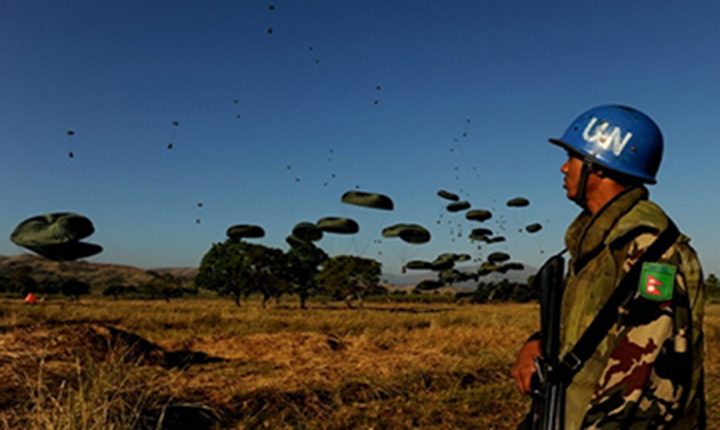
Are we looking at a new precedent for UN Peacekeeping missions? Image: BlatentWorld/Flickr
Maria Cristina Perceval, Argentinean delegate to the Security Council, expressed concern over the hasty adaptation of the resolution. “In any case, the idea of ‘enforcing peace rather than keeping it’ required deep reflection, certainly more than a week of negotiations.” It is important to keep in mind that the primary difference between peacekeeping and peace enforcement is the application of violent force. In peacekeeping, violence can only be used for protection against direct physical threats. Peace enforcement uses violence without direct provocation, often targeting suspected combatants in a manner much closer to that of war. Delegate Perceval’s concern clearly addresses how this new execution of the peace process will affect future missions and hints at the dangers of unanimously supporting hastily sanctioned international force.
The UNSC’s Guatemalan delegate Gert Rosenthal was also cautious before signing the resolution, but for different reasons. In order for MONUSCO to be viewed as an honest broker for peace, it needs to retain neutrality towards all parties involved. This will be impossible if a portion of it is actively hunting and killing members of groups it is trying to negotiate with. He reasonably proposed that the intervention brigade be formed separate from the main body of MONUSCO in order to create clear differentiation between its primary mandate (protection of civilians) and new mission (killing of combatants). It is unclear why the other delegates obviously did not agree.
The creation of this brigade is a true innovation because the activities of the UN are meant to be fundamentally different than the actions of the North Atlantic Treaty Organization and countries that have trouble differentiating between peacekeeping and peacemaking. The United Nations is supposed to represent a universal meeting ground where groups can discuss their differences without the threat of violence. Could this brigade be the beginning of a slippery slope where the organization entrusting itself with world peace might become one that more closely resembles a belligerent force willing to conduct war? MONUSCO’s mandate is currently set to expire March 31, 2014, so perhaps a year will tell.
About the Author





