
There are no shortages of academics who refer to America as an imperial power. Noam Chomsky, for instant, has issued trenchant criticism of the US, overtly proclaiming that it is indeed an empire. Other authors such as Niall Ferguson, and Michael Mann have similarly expressed its imperial nature. Although Ferguson sees this as far more positive idea, reasoning that its valuing and promotion of the rule of law, democracy, and free market capitalism are immensely positive, and that its decline from its prominent role in world affairs would be immensely harmful to international order. However, the morality of and wether it is a good thing are not of concern to me. What matters is if the US truly is an imperial power. Is it like the Empires of old, or is it something different, is ‘empire’ really an adequate term to attribute to it.
To understand if the US really does fit into the category of an empire, we must first look back into the past. When one is presented with the term Empire, one arguably thinks of the imperial dynasties of Rome or Britain. Both expanded out in to the wider world, bringing with them their own customs and ideals, and colonised their respective acquisitions, setting up their own governments in them. These powers would also station their troops in the colonies and assimilate the indigenous populations into their own ranks. The use of Indian troops in World War II is a prime example. It was also not unknown for both empires to put down insurrections with notable ferocity.
With the traditional interpretation of empire set out, we can now see if the US fits into this framework. The first question is wether it has expanded out into the wider world. On the face of it, this would be a resounding yes. Beginning originally from thirteen colonies it has expanded into the North American continent, becoming a fifty-state federal republic, with a few unincorporated territories that have not yet been granted statehood. However, the latest admission of state to the union was in 1959 when Hawaii and Alaska gained statehood, and prior to this, they were still territories that belonged to the US. And whilst it has in the past, undeniably seized territory and claimed it as its own, this does not appear to be the case anymore, and neither has it happened very recently.
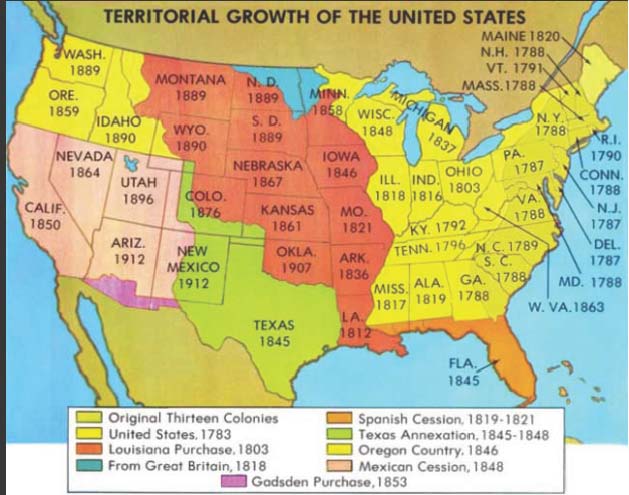
Growth of the continental U.S. [Quia]
Before people cite Iraq and Afghanistan as cases of the US seizing territory, they have not claimed it as part of their empire like the British did with their colonial possessions, and they have or are planning in the near future, to withdraw all their forces from the aforementioned countries. Moreover, Iraq and Afghanistan are both governed by their own governments. The same cannot be said for British colonies, India was controlled by a British Governor-General, not by the Indians themselves.
So the United States is clearly not an empire in the traditional sense, at least, arguably not anymore. However, I would contend that it is an empire of sorts, and I will explain why.
Firstly, the US has an enormously powerful military, indeed it is so far currently unrivaled at the present time; Its military budget is bigger than the top ten other spenders combined. It would therefore not be a stretch to say that this bestows it hegemonic power. An idea that is further reinforced by its extensive deployment of troops across the globe. In 2002, it was estimated that there were around 800 US military bases worldwide, contained in 63 countries, and with troops located in 156 countries. These staggering numbers are testament to the extent of its power, and bears a striking resemblance to the military dominance of the British Empire, who were the world’s leading power until the late 19th century. Of course, as addressed, the colonial aspect is distinctly absent here, but this does not discount American power at all. Furthermore, its key role in NATO today further signifies this dominance.
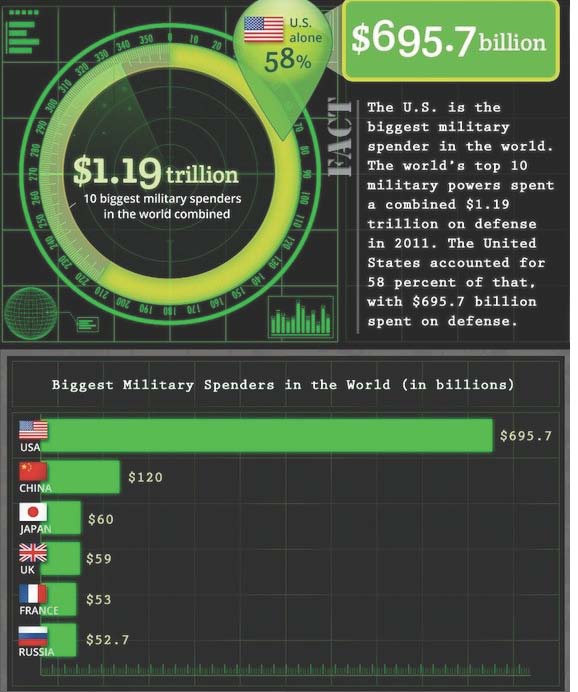
The US military budget is unrivaled by any other nation [Huffington Post]
In conjunction with this, the exportation of the free market economic system by America to other countries and its dominance thereof is seen as a form of imperialism, or rather, capitalism itself is inherently imperialistic. Vladimir Lenin, for instance, authored a pamphlet on this precise matter titled Imperialism, the highest stage of Capitalism . In it, he argued that the First World War was fueled by imperialistic sentiments as one aspect was to acquire capital. In fact, he went so far as to claim war was an unavoidable aspect of capitalism. I would disagree with that latter statement, and argue that the free market, whilst not being entirely ‘free’ as I argued in another article, has actually helped preserve peace to some extent. States are arguably more likely to trade than wage war.
Nonetheless, I am inclined to agree that the exportation of such a system is an example of the US being a kind of empire, albeit a liberal one. And what is certain is that the US is a dominating force in regards to such a system. Its economy is the largest on Earth, although that does not make it an empire in and of itself, its hand in world economic affairs perhaps does. The IMF has its origins in the US, as does the World Bank, and the dollar is the ‘International Reserve Currency’ . It is not a stretch to say that therefore the US benefits because of this status quo. The imperialistic part is perhaps how in the cases of the IMF and World bank, the US was key in funding reconstruction efforts following the Second World War and continues to play notable roles in both of these organisations.
But is this a sign of empire? It is very easy to accuse the US of imperialism in this instance at the time. The end of the war had witnessed the near destruction of Europe, nations were broken, and needed to be rebuilt from the ashes. In addition, the USSR, who itself funded reconstruction efforts in territories under its sway, represented an ideological and economic threat to the US. In essence, the latter’s hand was perhaps forced by the risk that the whole of Europe might fall under the sway of communism, which in turn would only present a greater threat to the US in the future. It was therefore, arguably in its own interest not only because of the lure of the free market and the aim to spread its influence but also out of security concerns at the time. Concurrently, the Western states readily accepted the US aid, effectively consenting to the US having a greater roll in economic matters.
That said, it is different now. The threat of Eastern Bloc influence has, for all intents and purposes, subsided. The dangers today are less visible and more ambiguous. In spite of this, the US still remains as a dominant force in the world. As I outlined earlier, it continues to dominate in military and economic means, and its influence is ubiquitous in world affairs. Furthermore, the effects of what happens in the country can affect the rest of the world. Take the recent near default of debt by the US government. The effects of of such a scenario were said to be dire, with stocks at risk of plunging and global interest rates rising
Thankfully this didn’t happen, but it does rather bring to attention just how powerful the the US is and moreover its extent thereof. Other states are invariably economically tied to it, much like empires of the past where colonies were intertwined with that of their respective controlling country.
![The Marshall Plan distributed billions of dollars to Europe [Marshall Plan.com]](http://archive.the-ipf.com/wp-content/uploads/2013/12/PastedGraphic-3.jpg)
The Marshall Plan distributed billions of dollars to Europe [Marshall Plan.com]
I would therefore contend that the US is an Empire, however, it could perhaps be deemed a confederate empire. A confederacy is defined as; “a union or combination of peoples, states, etc.; alliance; league for some purpose”. This certainly seems to be the case here. After all, we have the various nation states of the world united by an economic system that US has, and continues to promote. As was just mentioned, the US economy effects those of everyone else, numerous countries trade with it, and the dollar is the international reserve currency. Secondly, we have military dominance, and of course NATO. Thirdly and what makes it a confederate empire is that despite these unions, and like what the Confederacy in the American Civil War was in favour of, the states that are aligned with it are very much independent nation states. They may be economically tied to the US, but they most certainly govern themselves and pass their own relevant laws. This was not the case with the imperial dynasties of Rome or Britain as I discussed earlier on. It is in essence indeed an empire, but certainly not one of yore. It may be powerful, but its promotion of free market economics and that countries under its influence are independent states make it a very different empire to what has been seen before.
About the Author





