
Drones: America’s Favorite Weapon
Unmanned Aerial Vehicles (UAVs), commonly known as drones, have become the primary tool in the fight against terrorism since President Barack Obama took office. Originally used for purposes of surveillance, drones have evolved into elite killing machines.
Drones are often used to target and kill individuals suspected of involvement in the planning and execution of terrorist attacks, but many of these strikes have occurred in countries the US is not currently at war with – Somalia, Pakistan, and Yemen. Thus, the use of drones by the US in these countries is arguably a violation of their sovereignty and illegal by international law. Furthermore, there are conflicting reports on the number of civilian deaths drone strikes have caused, and there is a general lack of transparency from the US government on this issue. As the Scottish Global Forum think-tank highlights,
Accordingly, some argue that the US drone program does more harm than good, and say this policy has the potential to perpetuate, rather than help end, the War on Terror. As Audrey Cronin notes, the picture is mixed: “…Drones are killing operatives who aspire to attack the United States today or tomorrow. But they are also increasing the likelihood of attacks over the long term, by embittering locals and cultivating a desire for vengeance.” Likewise, a recent report from Human Rights Watch has argued that current use of drones by the US violates the laws of war.
According to Dr Mary Ellen O’Connell, professor of international dispute resolution at Notre Dame University, “We are killing people with drones and other means outside our conflict zones, in Yemen, in Pakistan and in Somalia… In these three countries, everyone we kill is a civilian and the only number that matters is total numbers.”
Needless to say, drones are quite a controversial topic. The use of drones for targeted killings began under President Bush, but this policy has increased exponentially under President Obama. In fact, the first drone strike under President Obama occurred just 3 days after he took office, on January 23, 2009. According to Jack Serle:
Initial reports said up to ten militants were killed, including foreign fighters and possibly a ‘high-value target’ – a successful first hit for the fledgling administration… But reports of civilian casualties began to emerge… At least nine civilians died, most of them from one family. There was one survivor, 14-year-old Fahim Qureshi, but with horrific injuries including shrapnel wounds in his stomach, a fractured skull and a lost eye, he was as much a victim as his dead relatives… Later that day, the CIA attacked again – and leveled another house. It proved another mistake, this time one that killed between five and ten people, all civilians.
Since Obama’s inauguration in 2009, the CIA has launched 330 strikes on Pakistan – his predecessor, President George Bush, conducted 51 strikes in four years. Moreover, Obama’s drone program recently reached its fifth anniversary, and it is estimated that it has resulted in the deaths of at least 2,400 people.
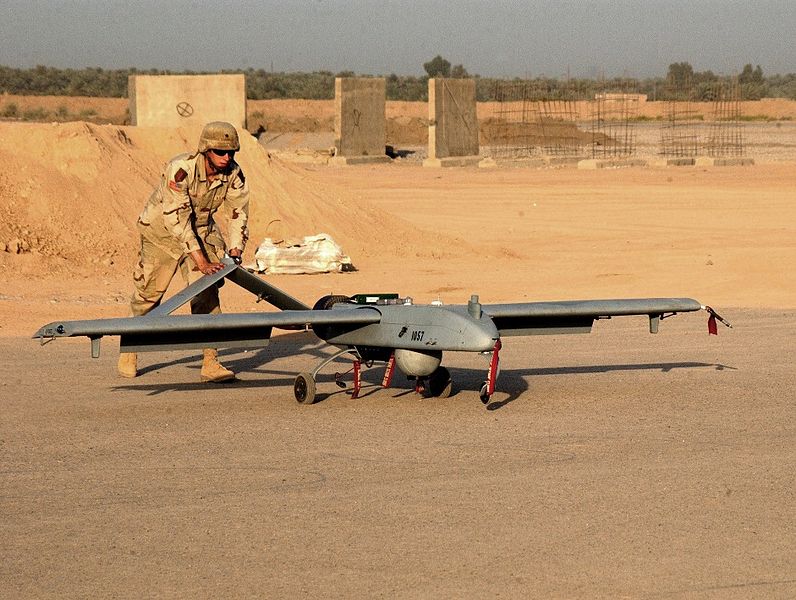
Spc. Jeremy Squirres of Company A, 101st Military Intelligence Battalion, 3rd Brigade Combat Team, 1st Infantry Division, prepares a Shadow 200 Unmanned Aerial Vehicle for launch at Forward Operating Base Warhorse, Iraq. Image credit: MarsRover
There is also heavy criticism of the criteria the US employs to select targets for drone strikes. Much of this criticism has been directed at a practice often referred to as “signature strikes.” Signature strikes involve targeting groups with drones who appear to be behaving like militants in insurgent controlled areas. Cronin argues the indiscriminate killing of some civilians will be inevitable as a result of this loosely defined practice. One might also question how the US defines a target as an imminent threat or a high-value target, as “Only 58 known militant leaders have been killed in drone strikes in Pakistan, representing just 2% of the total deaths.“
Despite these facts, the US government has relied heavily on the use of drones and drone strikes in its counterterrorism efforts. Drones have been presented as a more discriminate and proportional means of conducting war, and in the current context of the War on Terror they have become extremely politically palatable. As Daniel Byman argues:
Although a drone strike may violate the local state’s sovereignty, it does so at a lesser degree than would putting U.S. boots on the ground or conducting a large-scale air campaign… And compared with a 500-pound bomb dropped from an F-16, the grenade-like warheads carried by most drones create smaller, more precise blast zones that decrease the risk of unexpected structural damage and casualties.
Moreover, the government has the public’s backing, as a majority of Americans support the use of drones and drone strikes. According to a Gallup Poll, 65% of Americans support drone attacks on terrorists abroad. It is also notable that there is bipartisan support for this policy, at a time when Republicans and Democrats can barely agree on anything, let alone stand to be in the same room with one another. As Gallup notes, “A majority in each party says the U.S. government should use drones to launch airstrikes in other countries against suspected terrorists, Republicans (79%) are significantly more likely to say so than are Democrats (55%) and independents (61%).”
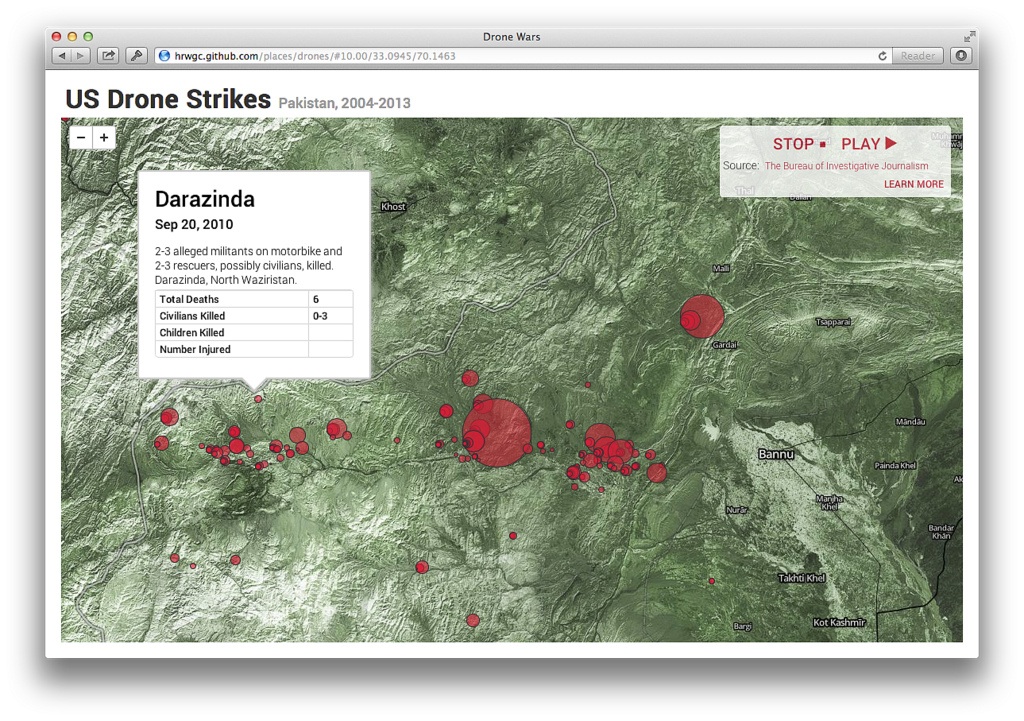
Drone Strikes in Pakistan. Image credit: Mapbox
The US Public and Drones
Although Americans have often signified a concern and disdain for the loss of foreign civilian life in war, they are even less fond of risking their own troops lives. Having experienced the disastrous results of the wars in Iraq and Afghanistan, Americans are quite war weary and not fond of putting American soldiers in danger, or “boots on the ground.”
In many ways, despite many questions about the morality of drone strikes, it is easy to understand their appeal. Drones offer a push-button approach to warfare, in which enemies can be eliminated without risking the lives of American soldiers.
Additionally, given both domestic and international scrutiny towards the detention camp at Guantanamo Bay, Obama is reluctant to expand there. Yet, it is evident that Americans still view terrorism as a threat to their safety, and would react negatively to inaction. Thus, it seems President Obama prefers to kill suspected terrorists rather than imprisoning them.
Consequently, Obama has leaned toward drone-strikes in order to simultaneously pursue a forceful foreign policy and allay anti-war opposition. Basically, due to the fact that drones are an ostensibly quicker and cleaner means of combatting terrorism, they are less likely to experience opposition. The US government’s lack of transparency on this issue also helps reduce opposition, as the public doesn’t have a clear picture of when and why drone strikes are executed. Moreover, it is also very difficult to report on drone strikes, given they often occur in remote and hostile areas. As a result, the American public is not very informed on the use of drones and drone strikes by their country. Moreover, many Americans have admitted that they are not following news about the government’s use of drones. Thus, it is disconcerting that a majority of Americans are supporting a controversial policy they are not very informed about.
In May 2013, President Obama promised to scale back drone strikes in order to reduce civilian casualties. He also promised greater transparency on this issue. The US has reduced drone strikes in Pakistan, but in spite of this the program has still received criticism. As Stephanie Nebehay notes:
A U.N. human rights watchdog called on the Obama administration on Thursday to limit its use of drones targeting suspected al-Qaeda and Taliban militants… U.S. drone strikes have led to excessive civilian casualties and unrestricted data collection has eroded the right to privacy, the U.N. Human Rights Committee said in its first report on Washington’s rights record since 2006… The United States should give more information on how it decided someone was enough of an “imminent threat” to be targeted in covert operations, the panel’s report said… It should also “revisit its position regarding legal justifications for the use of deadly force through drone attacks,” investigate any abuses and compensate victims’ families, the committee said.
It should also be noted that while a majority of Americans do support the use of drones, there are still those that oppose this practice. That being said, both proponents and opponents of the drone program have advocated for more transparency. However, what opponents and proponents of the drone program disagree on inherently is the overall effectiveness of drones as a counterterrorism strategy. Consequently, there are still many open questions surrounding drones, and until there is more public discussion on this topic the answers will continue to remain unclear.
The US and Drones: What Next?
The precedent set with the use of drones now determines the way in which they will be utilized in the future – not only by the United States, but also by other states and non-state actors that are also developing this technology. Drone strikes have also placed a great strain on the relations between the United States and the countries in which it carries them out, Yemen and Pakistan. Correspondingly, given that drones have become the primary tool in America’s fight against terrorism, and the War on Terror has no clear ending, this is an issue that will continue to evolve and have far-reaching consequences.
Drones arguably make war more likely in the future as well, as they insulate the public from the costs of war given they require no human sacrifice, at least not for those conducting the strikes. A major part of the reason war is so abhorrent to people is because they don’t want their people to suffer its destructive consequences. They don’t want their sons and daughters to have to die fighting in a bloody conflict. Drones eliminate the probability of this, and arguably make war attractive as drone warfare essentially involves the simple push of a button. When war appears costless, it becomes more attractive.
Drone pilots sit in trailers thousands of miles away from their targets, and they are not in any physical danger. This also presents questions about the morality of firing at an enemy that cannot feasibly fire back, particularly when the logic used to define the “enemy” is often quite dubious.
Hence, as the Scottish Global Forum notes:
As we can see, the arguments against drones are many and convincing. However, their extensive use is a clear indicator of their perceived value and effectiveness by political and military policymakers… However, the satisfaction of those residing in the White House and Pentagon does little to assuage the strong moral concerns which continue to saturate the debate on drones (and on US foreign policy more generally). Critics continue to question whether drones are as effective as their advocates claim.
At this point, only time will tell what the long-term consequences of drones might be. What is clear, however, is that the American public might reconsider supporting a policy that has limited transparency and thus no substantial accountability in place. Particularly as this policy is the centerpiece of Obama’s counterterrorism strategy, and Americans deemed the prevention of terrorist attacks around the world as the issue that should hold precedence in U.S. foreign policy. Americans should also consider the precedent being set, as noted above, and the fact that other actors may consider using drones to target Americans at home, traveling, or in the military abroad.
Drones appeal to the American public because they perceive the world as a dangerous place, and they value their safety. The greatest perceived threat to Americans is terrorism, and drones appear to be the most practical response to this at present. Americans are not fond of “boots on the ground,” because they realize that it not only puts their soldiers in danger, but it doesn’t necessarily work either, as learned through Vietnam, and now Iraq and Afghanistan. They also do not like civilian casualties, because they value human life, and they realize, through both logic and experience, that it is simply bad publicity to kill civilians. Given that drones have been framed as a solution to these problems, it is plain to see why they are appealing to Americans.
An open issue is the extent to which the support from the U.S. public is a product of well-informed citizens who have carefully considered the nature and consequences of drone strikes. The War on Terror has been a primary objective of the U.S. since 9/11, and the U.S. government has advocated drones as a critical and largely successful component of this effort. Reports of the limitations and downside of drones have arguably received less attention in the U.S. compared to the rest of the world. Civilian causalities are downplayed in the U.S. relative to reports from neutral sources. Moreover, there has not been much discussion or debate about how drone strikes are perceived globally. One obvious concern is that drone strikes catalyze the radicalization of the population where they are being actively used and deployed.
Thus, a case can be made that the American people are not as worried about the drone program as perhaps they should be. Perhaps privately, the American public has carefully considered the various concerns over drones. In doing so, it is conceivable that they have come to the independent conclusion that drones are effective, moral, and legal, which has led them to offer their support for the program. Yet, there is no concrete evidence to support this notion, given the lack of public debate over the topic, and polling data shows that many Americans admit to knowing very little about the issue.
Hence, it would be encouraging to see the American public, as well as members of Congress and the Obama administration, engage in a more active and transparent debate over the matter. As part of this debate, the public should make a more concerted effort to follow coverage of drones in the media, and from more than just American sources. In the process, those on both sides of the debate might be given cause for relief, and the questions surrounding the effectiveness, morality, and legality of drones would finally begin to have clear answers. Moreover, a more engaged public will ensure the longevity of the democratic process, as well as prudence in future wars, should they arise.
The unique position the United States holds in the world and its unparalleled global military presence often places it in difficult situations. The U.S. was once reluctant to involve itself in world affairs, but WWII and subsequent events over the course of the 20th century changed that. Consequently, the image and perspective of America transformed for both its people and the global community. There is an expectation that the United States will exert its influence when crises arise around the world. Whether it chooses to act in these situations or not, criticism is inevitable. The point is, the United States is not alone in this world, but its culture and the pressures exerted on it often expose its independent and solitary self-image. The drone debate allows for a reevaluation of this image, which in turn could foster improved relations between the United States and the rest of the world.
Accordingly, I will conclude with several queries that the discussion in this article, and the conversation surrounding drones in general, relates to: Is there something unique about the relationship between society and the military in America that differs extraordinarily from the rest of the world? What future implications does the increased dependence and use of drones and other robotic weaponry in combat have for American military personnel? To what extent are the problems America faces a product of the people and culture, or the government? Moreover, what do Americans identify as the root causes of the challenges they encounter? Finally, is it America’s role to intervene around the world, acting as a “world police”? These are very complicated questions, but they can perhaps be answered in part through a more concerted public debate over drones.
This work draws heavily from my Master of Science thesis entitled: “The Use of Drones and Drone Strikes by the United States: The New American Way of War?” This can be found online at: https://independent.academia.edu/JohnHaltiwanger
About the Author





